
By C. D. Rose.
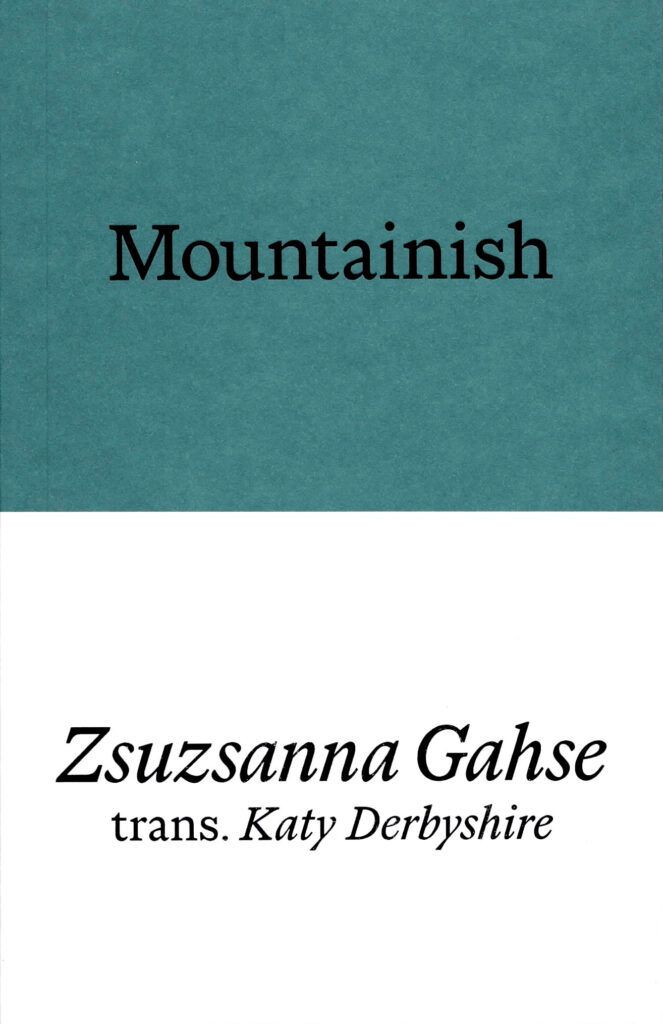
Zsuzanna Gahse, Mountainish, tr. Katy Derbyshire (Prototype, 2024)
Zsuzsanna Gahse’s Mountainish is a slim book with short, numbered sections rather than chapters, and whose blurb promises the reader ‘a multi-layered typology of all things mountainish.’ These days, on receiving such a book, a reader might easily anticipate what they’re in for: reflections on all manner of interesting ephemera; odd encounters with random strangers who’ll tell oblique stories; a few chunks of auto-ish fiction. Mountainish doesn’t disappoint on this front, and yet, as soon as we get to section 5, which ends with the narrator ruminating on how bacteria are like ‘harmless clowns that take pleasure from plopping,’ we realise that our expectations are about to be confounded.
Mountainish, you will be pleased to know (or disappointed, perhaps, depending on your persuasion), is not a book in which sheer cliff faces are scaled, blizzards are fought or flags are erected on lofty peaks. No voids are touched and nothing is done because it was there. This is a book with no tales of derring-do (though there are several accounts of people, or other things, falling off mountains). Rather than for the base-layered, fleeced and cramponed person in your life, Mountainish is more for those who would arrive to have a look at some huge mountains and then, weirded out, instantly turn round and go home, to somewhere reassuringly flat and low.
The book, however, certainly does not render mountains mundane. The sublime here is found elsewhere. If Mountainish is ‘about’ anything (other than mountains, which are its starting point rather than its destination) it’s about lists, notebooks and classifications; it’s about the strangeness of human behaviour when faced with ultra-massive, ancient chucks of stone; it’s about how we make life comprehensible. Caves features heavily, and this book has a cave-like quality, not vast caverns of wonder but curious small spaces which underlie the ground we stand on. This isn’t a book about the sublime but about how we deal with it.
It is also a book about language, not only the language of mountain-ness itself (there is lots of focus on adjectives – of colour, shape and size – though all of these are examined carefully and mostly discarded as if in rejection of the great canon of MountainLit) but also of how nuances of pronunciation and micro-dialects dwell and thrive in mountains, not unlike those clownish bacteria. A huge mention here must go to Katy Derbyshire, who has done an amazing job of taking Gahse’s detailed study of and games with the minutiae of languages and cast them into engaging and highly-readable English.
Mountainish is, as far as I can tell, only the second of Gahse’s works to be published in English (Dalkey Archive seem to have put out Volatile Texts: Us Two, translated by Chenxin Jiang in 2017), though she has an extensive bibliography. It is to be hoped that Derbyshire (and the good people at Prototype) will once again don some stout walking shoes to guide us through more of them.

ABOUT THE REVIEWER
C. D. Rose‘s three books The Biographical Dictionary of Literary Failure, Who’s Who When Everyone Is Someone Else and The Blind Accordionist form a loose parafictional trilogy about lost books and forgotten writers, about who is forgotten and who remembered, and how, and why. Walter Benjamin Stares at the Sea, a collection of short stories, was published in January 2024. You can read an interview with him here.
Twitter: @cdrose_write

