
By Patrick Autréaux (tr. Tobias Ryan).
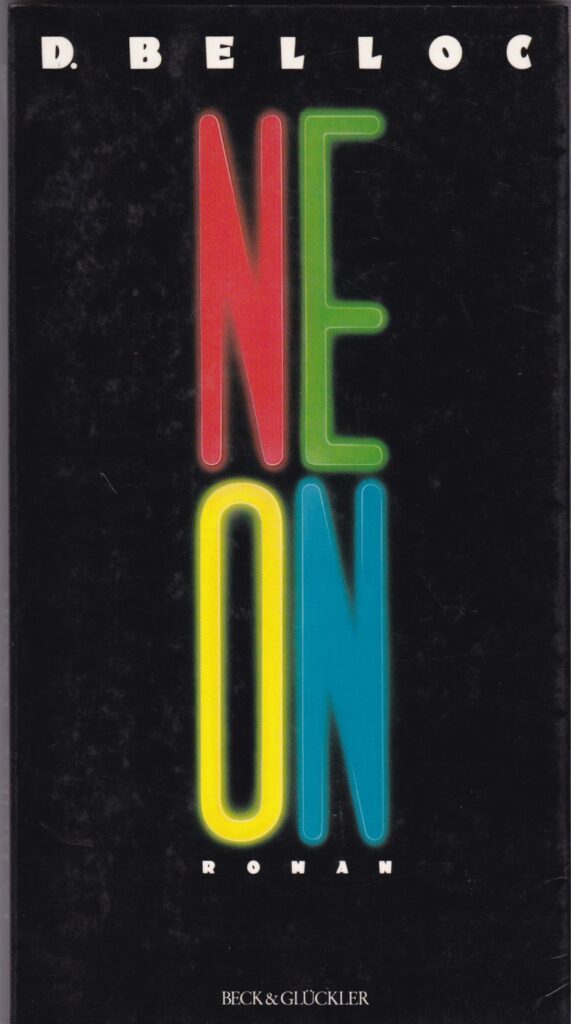
I had caught a glimpse of him among the noisy characters of a bygone age, retrospectively, as their names were nothing more than echoes. On the shelf, his books rubbed shoulders with Hocquenghem, Dustan, Guibert, Collard, and several others. I had found them second-hand, and by a luck worthy of notice, learned that his first novel, Néons, was to be republished, seeming to loom from the inexhaustible reserves of the forgotten.
This inaugural blow had initially, however, been recognised by a strange fairy godmother. Marguerite Duras herself singled him out with the hand of Justice. A gesture (and a long interview in Libération) with which she had embraced the text, stripping it to the bone, and knighting its author. But fairies are as powerless as the Lord above when it comes to guaranteeing one’s destiny.
Denis Belloc was certainly not the author of just one book. Others followed, up until 2000: Suzanne on his mother’s youth and his father who died from a heavy blow taken in a boxing match; Kepas about dope; and several novels torn from what Duras called “the social night”. And then nothing. We went from the AIDS years to those of the PACS. The rest died, and he, the only prole, was silent, exhausted by alcohol and smack, so one of his American fans reported. And perhaps that’s how he would have summed it up: it pisses me off. The cry of a man who could no longer avoid the obvious: in the literary milieu he was never on anything but borrowed time.
It’s beautiful but it’s seedy, says the tranny Triche in Les Ailes de Julien. She is lecturing a young runaway who is discovering nighttime Paris. “On the days when it’s dark, I forbid you from loving the night!” she says. Aren’t the places that go beyond seedy those to which we must descend in order to write? It is with a wary eye one must approach Belloc’s books. He wrote too little and too much. Two ley lines are traced across frequently autobiographical terrain: that of the family, a violent father, drunken mother, and fugitive son, and, within this triangle, a swamp: the threat of incest or insult, welts and shiners, brazen language as tight as a net from which it seems you will never escape; and secondly, the world of queens, fixes, and prostitutes, soft cries which break through the night heading back up Boulevard de Clichy, not whore folklore but a solitude so defiled that you no longer exist. A kind of coma, Belloc sighs, where nonetheless a desire for purity exists. But one which leads to suicide. You have shown us the night in your head, Duras said.
In a televised interview following the publication of Néons, the blabbermouth doing the interrogation suspected him of having exaggerated. As though warning a naïve john, very sweetly, he responded that in reality things were rougher still. His harsh, raw, violent language was remarked upon. It’s everyday speak, he retorted. Two realities confronted one another in the arena where the dark, horned body of the world lurks, terrifying even those trapped within it. We run up against it, brutally deflower it, fuck standing in pissoirs, come drips, if at all, live alongside towelheads, kikes and fags, whom we despise but are all smiles with in the stairwell. We listen through the walls, which separate us only to box us into our isolation. There are the sounds of sick bodies and the strikes of madmen from above. Sounds like that get everywhere, never once letting you so much as dream. We read nothing except brand names and supermarket flyers, sometimes L’Humanité or a Stephen King to give us a fright. There’s an abusive father, a mother who’s a nag and a souse. That is until his last novel, Un Samedi soir chez Bob. It gets to you, you want to flee, you easily understand the kids who run away, but we keep our noses attuned to the stench of a reality from which nothing can tear us, from where we will be expelled to nowhere but the garbage heap. And to avoid that, we stay with our cheek pressed to the filthy tarmac or the hood of a car. All things pass. Or else we nail ourselves to the night with the blows of pills or dope.
It is a murky, almost Beckettian world through which we trudge. We act, but we’re treading water. We become “made-up absences”. And when ejaculations are bitter, we are nothing more than the relics of an imagined innocence: “I am my schoolbag set down in the pissoir.” We swallow all life’s plastic, all of everyone else’s detritus, our own, everything that floats and pollutes us. We lumber our children with the waste we bear, and the infections we got from lovers we despised. There is the occasional guardian angel. Not saviours, but those who, all the same, want to protect us, who want better things. And above them, the never complacent author, not hiding behind the adornments of identity, nor covering up anything despicable, but writing without judging those whose lives he unfurls before us.
This was D. Belloc, who held onto his initial without explaining why. We ask too many questions, and rarely the right ones. Let’s say his first name is only a particle, almost a crutch, a writer being the kind who limps through life. Because there was also Denis Belloc, at least in as much as he can be seen in his rare televised interviews. For the talk show host Pivot, who, according to Raymond Cousse, was “a fence offering literary critique”, he has the aura of a first-rate novelist, under high protection, Duras leaning over his cradle. Three books later, with Méphisto Ardisson, he appeared at Le Palace looking like the perfect junkie author.
The two journalists try to play on the hoodlum’s unwholesome ways, as though the only things of which he was comprised were the pissoir rent boy, one that like to be fucked, and the small-time recidivist crook, in and out of borstal and the nick; and who, in his Chinese Portrait, calls himself a cocksucker, meaning it as an insult, bearing all vices but faggotry especially, a sleazy cancerous disease, a violent death in an airplane crash, torture, one, obviously, of impalement, arsenic. But from one programme to the next, we see a reserved man who smiles little, perhaps from fear, perhaps not giving a damn — it’s the same thing. And in contrast, it’s the vulgarity of the questioners that embarrasses. The lack of delicacy and disdain from one; the voyeuristic interest of the other. Confronted by them, we might say he conceded, more so than not responding, with the elegance of a man who has had to come through solitude and debasements so devastating that only effacement without fuss or posturing remains.
In front of Pivot, who seems to be putting up with him, he confirms he is a painter and that he has had numerous exhibitions. He has to explain that colour and graffiti saved him from a spiral that could have led to his end. A painter-writer, one that also knows that writing leads to the troubling sill of a window. He said that to Pivot, for whom it appeared “literary”, and on whom, as he listens, we can make out a distant pout: don’t overdo it, mate. Don’t overdo it, no, and not only for those who fondle books more so than they read them, but for us, who don’t always want to know what a writer really is. We can sense that Belloc would like to talk about painting, just to show how dangerous writing is, if treacherously normalized by the fence opposite him, who deigns to offer his petty judgements, who observes and condescends. But he keeps his head. Belloc has a rageless, taciturn wisdom, which makes us wonder if he won’t suddenly get up and say: “Sir, I see your disdain and your arrogance. The vulgarity of your questions revolts me: you’re pissing me off. Not only you, Sir, but everything you represent. All of it does my head in.” But he keeps his counsel, and a handsome smile cracks across his young, serious, almost sad face.
At Méphisto’s the vulgarity is more cynical, it’s more a grimace than a smile at the corners of his lips. After all, Ardisson is something of a TV Laclos: he does moralizing scandals. Denis Belloc no longer talks about painting, but of smack devouring everything (sex, friendship, the body, writing too, and no doubt painting), of slang, for which he was criticised, and of realism. He could have talked about the fundamental illegibility of those who speak clearly, but prefers to imply that writing goes too far; that writing makes you relapse; that writing is still possible, even when the critics throw their acid. It is true that the writer annoys the acid-throwers. Pissing off the world is a defence for those without the power to do harm. That’s what I see on his face: an incredible innocence accusing itself of every vice, and no doubt possessing them; an innocence which knows filth so intimately he has no need for malice.
Belloc, like any uncertain thief-saint, can see the evil in people’s eyes. From this humble strength, he derives no glory. In front of Pivot, Collard had the charm of someone who was going to die, and Hocquenghem looked down at the fence, who stayed on his guard with him; with Ardisson, bewigged Dustan seduced by counter-seducing. Belloc sweats, ashen, with something almost serious to him. His pale, dull flesh remains moulded by the milieu from which he emerged. A petty delinquent and a victim, he got out but seems to be stuck in his camp. Not that he wants to be. He stands in-between. It’s always bored me, life, he says. Perhaps he knew he was trapped anyway. There is no chance to defect, no social salvation, only toleration and compromise. He knows he is trapped but he doesn’t wrangle or campaign. Class struggle puffs him up, he wrote somewhere. But calling himself a faggot brings out a playful smile. Does it embarrass you? He would end up among the last of the fairies, but of the kind not to make a fuss, “I never liked talking,” preferring to doss about on the fringes of days: “I watch, and I wait for the night.” One who lives in “immense solitude”; Hocquenghem would write that he suffered less from oppression than from separation.
Unknown saint, living in limbo, there is little to no doubt that Belloc was always going to drown there. That was all the more evident once he stopped writing. Fifteen years later and his death has passed unnoticed. And we could already see that when he sat opposite those TV guys: young, still, but having seen it all, he confuses them because his murky clarity is immiscible in the world of letters.
All the better. It’s that which constrains him, honest man and writer, to gathering a kind of manna at a border from which almost nothing can be seen: that which flocculates when we write “tightening the nuts and bolts”, as he said, or, to quote Duras, “at the words’ crest”; there, where the black, horned body of what one has to write, that which no one can ever truly read, lurks. But whose business is that, after all? What counts is that you have danced with the moths, and are finally able to fall silent.
In Néons, we are asked: have you reconciled with life? And his response: somewhat. We are never reconciled to life.
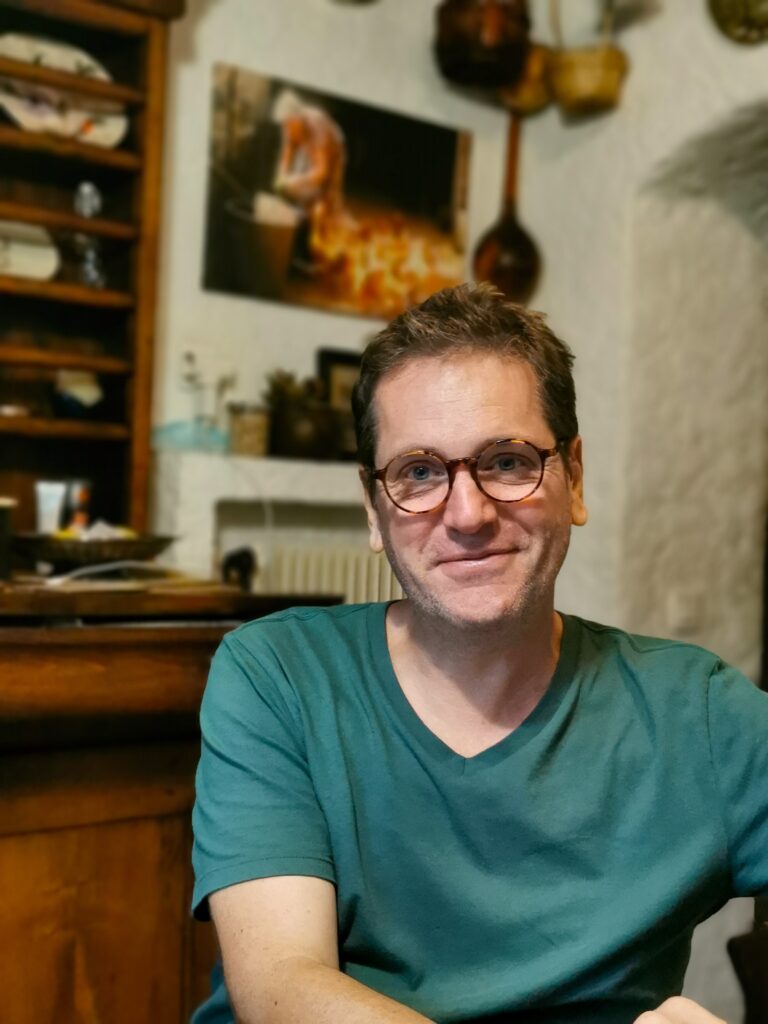
ABOUT THE AUTHOR
Patrick Autréaux (above) is the author of dozens of books and articles in French (mainly published by Gallimard and Verdier). His essay ‘A School of Life’ appeared in Socrates on the Beach (issue 9) and ‘New Prose’, taken from his book Se suvivre (Verdier), was published by Asymptote. Recently, Pussyboy (Verdier), a novel about an erotic passion, was translated in Spanish at Canta Mares (Mexico). He lives between Paris and Cambridge, MA.
ABOUT THE TRANSLATOR
Tobias Ryan lives in Paris, France, where he works as an English teacher and translator. He is also Co-Editor-in-Chief of minor literature[s]. Twitter: @TobiasvRyan

