
By Steve Finbow.
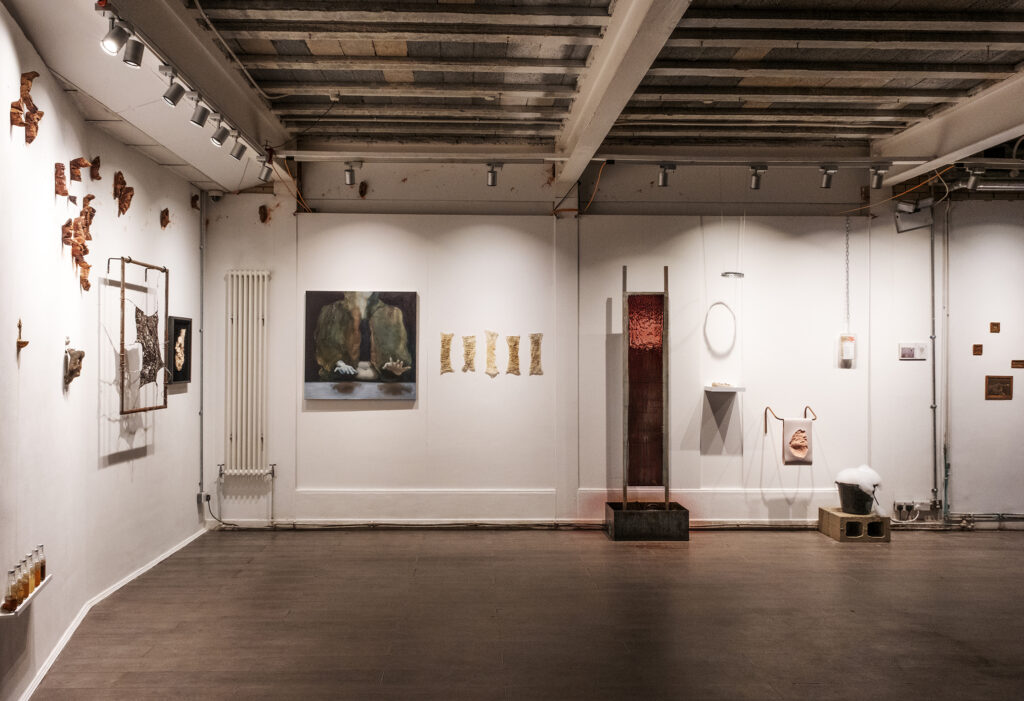
Second Daughter III (A Girl is a Haunted House), The Bath House, Hackney Wick, London
As the day ends, the sun in the east of London flushes out pale lavendars and pinks, then turns blood red as it turns on itself, becoming a more definitive shape, the more definitive, the bloodier. Until it sits, totally unaware of the rest of the universe, waiting at the edge of a sky that doesn’t yet know what colours it wants to be, a crow waiting for the inevitable onset of human slaughter. The light is fleeing. The Bath House awaits. Thank you, Kathy Acker.
To enter the exhibition Second Daughter III (a girl is a haunted house) is to step immediately into a crisis of visibility. This is not a collection of artworks to be merely viewed, but a calculated, unsettling disruption of the visual field itself – a catalogue of corporeal and symbolic manifestations. The show, which gathers 26 works across installation, sculpture, and painting, is less concerned with the aesthetics of the gaze and more with the structural problem of the body as a site of representation, sacrifice, and, ultimately, art.
Curated by Dani Cohn and Holly Lou Jones, with the film programme curated by Lucy Chappell, the anxiety that pervades these rooms is the dry, pervasive anxiety of the early 21st century, the dread that the image has finally become more real than the referent it claims to embody. The first artwork I encountered, Keyannah Isaacs’ Font, is a participatory sculpture containing daffodil dye instead of holy water; it leaks, staining the wall to subvert the concepts of spiritual cleansing and ritual purity, depicts hyper-detailed, abstracted religious iconography, encapsulates Julia Kristeva’s idea that “The ritual takes the abject out of the public sphere and substitutes for it a clean and proper surface. The shame of compromise, of being in the middle of treachery. The fascinated start that leads me toward and separates me from them.”
If I maintained my pace and analysed each work, then this review would hypertrophy to book form, so I will concentrate on highlights but, in doing so, affirm that all of the works in this exhibition warrant further examination. Ray Gonzalez Brown’s Peristalsis 2, cardboard-cast ceramic stumps, stained with iron oxide, forming an arrangement that materially and tonally evokes organic processes of bodily growth and decay, reminded me of the anatomical illustrations of Jacques-Fabien Gautier D’Agoty (1716-1786), foregrounding the female reproductive organ rather than denying it through the theory of lack.

and Peristalsis 2 by Ray Gonzalez Brown
Holly Lou Jones’s In My Veins, Beneath the Skin appears to confirm the critique offered by philosopher Rosi Braidotti: this representation is defined by deep-seated emotions. Braidotti warns of the pornographic nature of visual culture, that which frustrates the very desire it stimulates. The triumph of the image is precisely what marks contemporary culture, which rests on the fantasy that visibility and truth work together in a similar manner to desire and pain. The skin (latex) is metonymously the origin of life, the arena in which organs move in and out of each other in either violence or sexual pleasure. Braidotti argues that, in their aesthetic being, there is always more to things than meets the eye.
The works in this exhibition are therefore immediately trapped in a structural bind: how does one represent the visceral, the uncanny, or the ritual without merely becoming the latest, most aesthetically polished iteration of the sarx promise? The scale and almost forensic detail of the rendered body – the sculptural body parts cast in various skin/organ substitutes – betray an almost desperate hunger for the visible truth; yet, they yield only surface. The more we look, the less we know. The uncanny is the failure of the sign to hold still, and in Second Daughter III, the skin of representation is stretched to its breaking point.

and Angel Crown by Vespera Xander
This surface tension takes on a religio-political edge in Vespera Xander’s Angel Crown, a fragment of razor-wire armour. The work is a chilling symbol of a violent, self-inflicted boundary: the wearer is protected from external threats only by inflicting damage upon themselves, locked in an “empty promise of immunity.” It literalizes the societal demand for the female body to be simultaneously impervious and contained, a sacrificial barrier against the outside world.
The tension between the visual command of the logos and the body’s innate fluidity is explored in Eleanor Cox’s Sleight of Hand. This oil on canvas (reminiscent of René Magritte’s The Pleasure Principle) positions the body as “ambiguous but thoroughly active,” directing the view toward “oddly proportioned hands” in a moment before or after an unknown action. By invoking magic, Hysteria, and “evil intention,” Cox exposes the historical male anxiety surrounding any female agency that is not transparently legible to the Symbolic Order. The physicality of the paint itself acts as the material event – the anti-logos – resisting the smooth legibility of the mimetic image.

Within the political economy of waste and fluidity, the artists who weaponize the body’s detritus and waste further construct the anti-logos. Millie Barton’s Withering Away uses latex-encrusted baby wipes and preserved hair loss, embedded with asemic writing. This is the literal failure of language, a textual surface built on abject matter that is meant to articulate a dissociative, internal fragmentation where “beauty becomes dirt.” The language is unreadable, the hair is separated from the self but preserved as a ritual object, and the text is literally made from waste (wipes). This work’s resistant texture echoes Irigaray’s critique of mimesis, where the feminine “re-source” is “rejected as the waste product of reflection.”
Similarly, Kate Fisher’s Where Will You Spend Eternity? utilizes the “quiet, almost unconscious ritual” of collecting shed hair on a ceramic tile, making the most mundane residue of the body a figure of vulnerable, spiritual yearning. This act of self-inscription, turning personal detritus into an image that yearns for “eternity,” is a powerful act of claiming the “immense bodily territories which have been kept under seal.”
Other works engage the disruptive potential of fluids. Elizabeth Alster’s Pruned Fingers, with its water, soap, and fountain pump, is “[o]verflowing, spilling over, bubbling & left unattended.” The chaotic flux invades the clean, orderly home, rendering the familiar uncanny. Keyannah Isaacs continues this in A Sweetbitter Algal Bloom – sealed vessels of rotting and perfumed materials. The work “infects” the senses, blurring boundaries of human/non-human and self/other.
As a show of domestic hauntings and the claim to territory, the exhibition insists that the body is not just sarx but a “haunted house” – a domestic space of internal tension and memory. This is explored through works that collapse the boundary between the private interior and the public gaze. The political control of the body is aggressively addressed by Lizzie Cardozo’s Neutrophils, a time-based video of the artist’s own blood cells fighting infection. By converting this private, microscopic event into a public macro-installation, Cardozo reclaims the sarx from medical surveillance, using her own vulnerability to assert bodily autonomy and critique the historical scrutiny of the female body.

This is powerfully echoed by Estée Vanhoonacker’s Menstrual Agency: The Contortion of the Menstrual Body, a sofa sculpture built from bandages and contorted fabric. The piece serves as a physical metaphor for the wounds inflicted on the cyclical body by a linear, patriarchal system that forces it to twist and adapt, bandaging symptoms instead of addressing the systemic root cause. The refusal to fit is a political refusal to be silent.
A significant confrontation with objectification comes from Lucy Chappell’s Harvest, which re-frames the act of the historic representation of the female body through the metaphor of a slaughterhouse, using an aluminium chain and a meat packet. This is the visual nadir of visibility, where the body, subjected to the silent aftermath of digital consumption, is stripped of all agency and presented as pure, consumable sarx – a product on a shelf.
The historical forging of this anti-logos weapon is, of course, the inheritance of a volatile tradition that runs like a vaginal venous plexus within the phallocentric tendencies of modern art history – from Mina Loy’s clinical dissection of the body machine to Leonora Carrington’s mythopoeic transformation. The contemporary artists in Second Daughter III are continuing this struggle: utilizing painting and sculpture to perform the necessary ritual of self-inscription.
The final room, dedicated to installation and sound, moves beyond the solid state of blood and bone and into the more diffuse, atmospheric quality of the body’s internal economy. Here, the work attempts to capture the object a in its most intangible, flowing form. A low-frequency hum fills the space, accompanied by projected imagery of micro-organisms blooming and retracting in a milky substance – a visual and auditory echo chamber of inner life. This recalls Irigaray’s second, more complex meditation on the nature of the object a – that which is lost or separated from the subject. The installation becomes an attempt to render visible the invisible carriers of the self: “Milk, luminous flow, acoustic waves, … not to mention the gases inhaled, emitted, variously perfumed, of urine, saliva, blood, even plasma, and so on.”
At the core of the exhibition stood Karolina Urbaniak’s unflinching contributions – an apotheosis of abjection rendered in flesh and spectacle. Her pieces, Esosis and Caligula, function as forensic explorations of the sarx (flesh), dissecting the points where patriarchal desire, ritual sacrifice, and the symbolic collapse and converge.
The ritual of spectacle in the installation Esosis, directly inspired by Hermann Nitsch’s extreme The Fall of Jerusalem and exhibited at Prinzendorf Castle, instantly positions itself within the tradition of spectacular, sacrificial art. This lineage is the apotheosis of Julia Kristeva’s concept of the abject – that which must be violently purged to establish the boundaries of the self and the social order.

Nitsch’s Das Orgien Mysterien Theater forces a confrontation with the “propitious place for abjection,” where life and death are indistinguishable. Esosis, by echoing this, demands that the spectator acknowledge the necessary, yet revolting, function of blood. As Kristeva writes, “The blood, as a vital element, refers both to women and fertility, and yet, simultaneously, to the impure and the propensity for murder.” In Esosis, the projected or sculptural use of blood and fluid becomes a chemical, staged form of this original, founding transgression. It is not merely a representation of the repulsive, but an active, architectural staging of the body’s internality, forcing the viewer to stand within the chaotic flux that the ego (and the Symbolic Order) constantly attempts to banish. The reference to The Fall of Jerusalem suggests a collapse of institutional purity – the spilling of inner life as a necessary revolutionary act. It is a political theatre where the body’s interior fluid is offered not as an offering of surrender, but as a weapon of shock.
The institutionalization of horror in Caligula offers a sharp contrast to the raw ritual of Esosis. Urbaniak’s installation (medical table, glass case, animal entrails, and Roman brothel tokens) addresses this institutionalization of horror. By placing animal entrails on a vintage medical table within a bespoke glass case, Urbaniak constructs a museum-like display of the abject subjected to the clinical gaze. This staging immediately invokes Rosi Braidotti’s concept of thanatopolitics and the chilling detachment of biopower. The medical table, a historical site of diagnosis, dissection, and control, strips the visceral material of its sacrificial quality and subjects it to scientific objectification. The glass case acts as the final, rigid boundary of the Symbolic Order, attempting to contain and sanitize the chaotic, decaying matter within. This is the horror of clinical detachment: presenting the body’s internal, repulsive reality with an architectural and clinical precision. Furthermore, the inclusion of Roman brothel tokens alongside the viscera acts as a brutal commentary on commodity and sarx. The tokens, historical symbols of transactional sex, link the entrails – the raw, biological source of life and waste – to the long history of the female body being reduced to a disposable, consumable object. This aligns with Luce Irigaray’s critique of how the feminine is designated “mother-matter,” serving as the foundational, yet silently sacrificed, “re-source” for the male logos. Urbaniak argues that the biological interior and the sexed exterior are equally subject to economic, market-driven logic, fulfilling the role of the necessary waste product for cultural consumption. This piece is a document of inevitable rupture: the body is not just violated, but archived as violation.
Viewed together, Esosis and Caligula form a critical dialogue around the feminine body’s agency, exploring two opposite poles of control: the raw, uncontrolled spectacle and the cold, clinical containment. One shows the violent staging of internal territory; the other, the terrifying objectification enforced by institutional power. Yet, both act ultimately contribute to the anti-logos weapon – the process of self-inscription.

The visceral nature of the body – the blood, the organs, the flesh – is, in the end, the “marvelous text of her self that she must urgently learn to speak.” This is the imperative of Hélène Cixous: “To write… it will give her back her goods, her pleasures, her organs, her immense bodily territories which have been kept under seal.” Urbaniak’s works, through spectacle and clinical horror, shatter the “clean surface of the image,” forcing the audience to witness the true cost of bodily suppression and to recognize the potent, chaotic power hidden beneath the skin.
Second Daughter III functions as this act of writing – of inscription, they tear the subject away from the historical place of the guilty, the dumb, blind woman who cannot be a good fighter. The exhibition is, finally, an exercise in forging the anti-logos weapon. It is messy, deeply unsettling, often pretentious, and often beautiful in its uncompromising ugliness. It rejects the false comfort of the tidy image and insists, through blood and bone and resonant acoustic waves, on a shattering entry into a history that has always been based on its suppression. The work, taken as a whole, confirms the quiet, terrifying truth that the most visceral reality of the self is precisely what cannot be shown, but must be forced into being. We are left, having endured this encounter, less clean than when we arrived, and perhaps, marginally more conscious of the pressure beneath our own skin.
One must confess, with a sigh that feels suspiciously like a theatrical prop, that engaging with this exhibition is less an act of criticism and more a nervous performance of critical competence. Here I stand, a creature of the Symbolic Order, clutching my breakfast tea with oat milk and hazelnut syrup – attempting to triangulate the terrifying, red-blooded geometry of the feminine gaze. It’s an exercise in magnificent futility, isn’t it? I suspect my primary critical contribution, at this juncture, is merely to register the delicious, cutting irony of a perambulatory phallus attempting to parse the anti-logos, and failing, yet still managing to sound terribly important while doing so.
ABOUT THE AUTHOR
Steve Finbow’s The Disorder Diaries: Neurology and the Arts, will be published by Iff Books in 2026.

