
The Last Philosopher: Rachel Cusk and the Transgressions of Art
Besides the questions around “autofiction” that such facts raise (questions that, despite what I tell my undergraduates, are more or less beside the point), perhaps this connection is what gives Cusk’s latest novel its power: a claim to truth grounded inevitably and indeed painfully in experience, a humanity that permeates and thus deepens the whole. For what we face in life are questions, categorized by the notion of philosophy and arranged in that unending procession of reputable madness we call consciousness. And what we have in Parade is a defiant, unequivocal answer to this violence of the world: art, until the bitter end.
D. W. White reviews Parade by Rachel Cusk.

Three Stories
When I think of Sally, I think of the dilapidated house we shared on Arthur’s Hill. The two men rented the attic rooms. Sally and I lived on the first floor. The ginger cat was at home everywhere. Sally worked part-time as an art teacher. I was still a student. We spent entire days together in that house. I liked observing Sally. She had something placid, quaintly beatific to her features, something more ancient than her twenty-five years: an air of grave amusement softly haunting her round, still-childish face. She wore shawls and big, extraordinary dresses. Like a gypsy. When my mother visited, she said: This girl has a very old soul.
Three microfictions by Elodie A. Roy.

Songs for Olympia
Putting your wrist to someone’s nose and watching their expression change, trying to figure out what it is, is a form of intimacy, another way of communicating. Understanding that they can connect to the world in that way means they are open to other connections. A favourite memory is someone who was smelling my wrist when I was wearing Ostens Patchouli Heart I, a resonant, woody scent with a faint incense-treacle note. He had his nose and lips to my skin and his eyes looked like he’d experienced the divine, but it was more than sexual. It was a genuine realisation of another world, and he was trying to find the words to describe it. Seeing that is a turn-on like no other.
Tomoé Hill interviewed by Paul Sullivan.

The Unreliable Nature Writer
Often playful but still powerful, the messaging within this collection encourages the reader to pay more heed to the world of which they are a part and in which they live. Humans are not presented as evil but rather drifting, often mindlessly. That this will lead to their eventual destruction is made obvious without the need to articulate.
An impressive and always engaging debut from a writer whose future work I now look forward to reading. Original and entertaining, these stories make full use of the form to hold attention in a world designed to distract from critical thinking.
Jackie Law reviews The Unreliable Nature Writer by Claire Carroll.
Mary and the Rabbit Dream
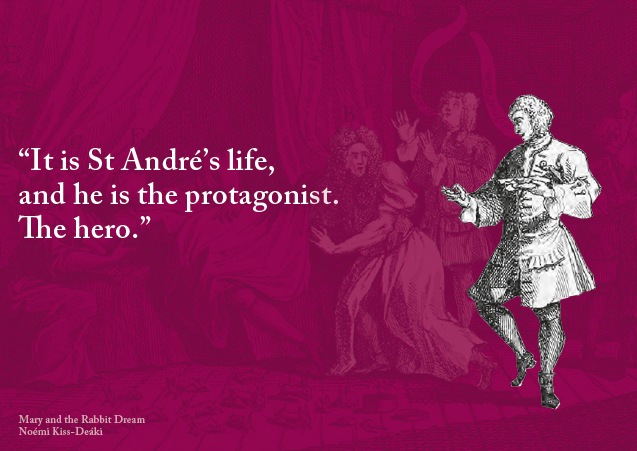
Kiss-Deáki’s version of the story, told in a piercing, surgical narrative voice, focuses squarely on the power dynamics in eighteenth-century England that shaped the whole ludicrous and miserable experience. Mary and the Rabbit Dream is in the first instance a story of the desperation of the eighteenth-century rural poor set against the vast privilege of the wealthy: we learn on the first two pages that the Duchess of Richmond, also a resident of Godalming, can afford to spend 12 shillings on a new coat for Cosima, her pet monkey, while Mary labours in the fields for one penny a day. This injustice is at the root of the fraud. Ann Toft’s scheme to earn money from Mary’s rabbit-births is born not out of natural mischief, but from her desire to ‘set the system on fire’.
Eoghan Smith reviews Mary and the Rabbit Dream by Noémi Kiss-Deáki.

Casings
They buried the man with two men digging in ten-minute rotations while two others stood watch with rifles. The rest remained in the blown-out bunker submerged in snow with smoke breathing out a shell hole in the ceiling. I, among these men. I, with only my camera. I sat by the burning fire in the center of the bunker with the coat of the dead man around my shoulders. Two men on either side of me sat with hands out over embers—laughing. They laughed as though we were not stranded in the middle of the somewhere within nowhere.
A short story by Robert Warf.
Trümmerliteratur: The Reading
I feel something so profound, like the world is tilting and all I have to do is hold on, hold on, hold on, and even up at the podium holding on for dear life against the words I wrote that are no longer familiar to me as my own words I break free, for an impossible moment, my eyes sweeping the audience and there she is, Marion with her verdigris eyes and so many Marions, Harrisons too and so many and even Eriks and all the dregs of me and all the terrible and shimmering and blossoming versions of me all at last and forever in no country I know.
New fiction by Nicholas Rombes.
Collected Poems
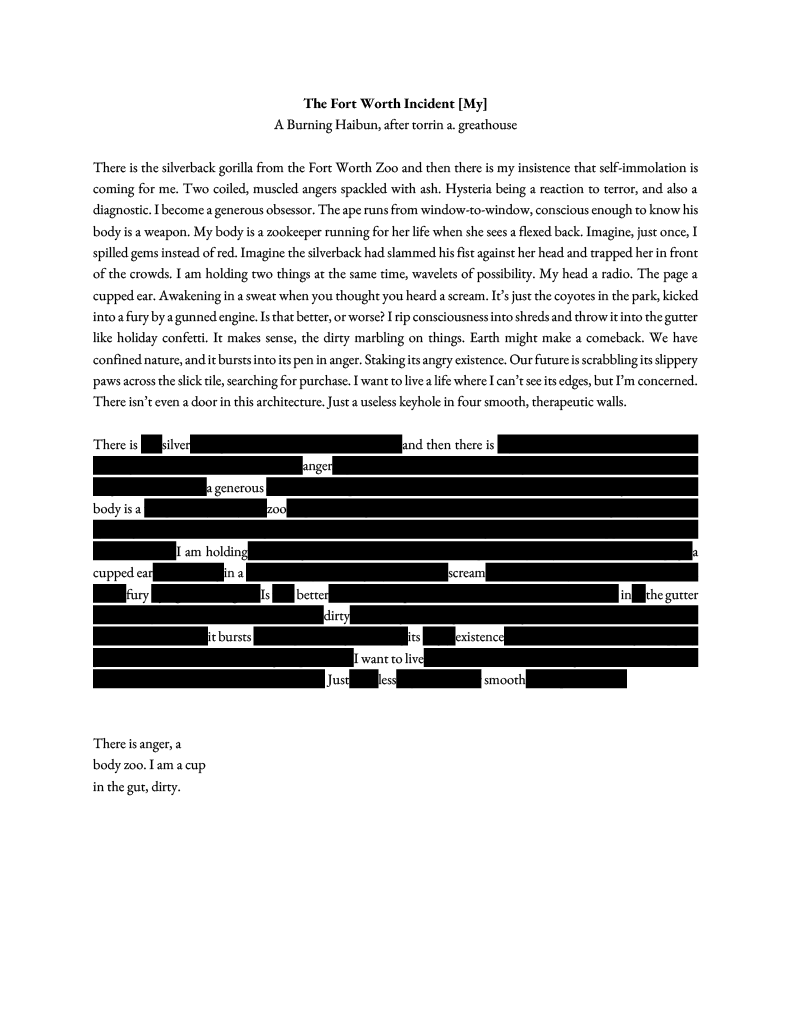
I find living in modernity, or postmodernity, or post-truth or whatever this reality is called, frequently overwhelming. There is a constant bombardment of the senses, the chatter of knowing too much, a jockeying for our attention. I think a lot of us are frozen in the headlights of life these days. Each of these poems are an attempt to find meaning amongst the noise, whether through erasure, putting on another persona, or leaning into absurd.
New Poetry by Quinn Elise Rennerfeldt.

Mother’s Nature Remembered
my lacika would like to pretend he doesn’t know me when he’s ashamed that i’m his mother, and i must admit that occasionally he’s right, at times i’m also ashamed to be his mother
when his new book was published in the spring, i didn’t even bother to ask him to sign copies for my closest friends, because he always makes faces, as if it were such a big deal to write
An excerpt from a novel by Miklós Vámos, translated by Ági Bori.
Fifty-seven Steps
I have a chip on my shoulder about men, and that’s not something to brag about, but my life turned out to be a living hell because of them, mainly one of them, but all men are the same, they’re all animals, they have dicks instead of common sense, and their dicks control them, nothing else, women know this damn well, and those who don’t, even they had some nasty encounters in their teens, I swear to god, any woman is smarter than a man, but it’s always the men who are in charge, they’re the leaders, they write the laws, they sit on boards, in the government, in the parliament, in the united nations, in the warsaw pact, oh, not there, because that came to an end, and they run women over like a steamroller, slap them across the face, kick them with their boots when they’re drunk, or when they want to bellyache about things
An excerpt from a novel by Miklós Vámos, translated by Ági Bori.

Miklós Vámos: Translator’s Note
Miklós Vámos is a Hungarian author with more than forty books to his name. He’s undeniably a great admirer of the Hungarian language and, throughout his career, has used its malleability to create his distinctive, multidimensional style. His voice is immediately recognizable, even though his novels, short stories, and various other writings often differ from each other to such an extent, stylistically and structurally, that it’s almost as if they had been written by different authors.
A note on Miklós Vámos by his translator, Ági Bori.
Fever Dream Wedding Procession
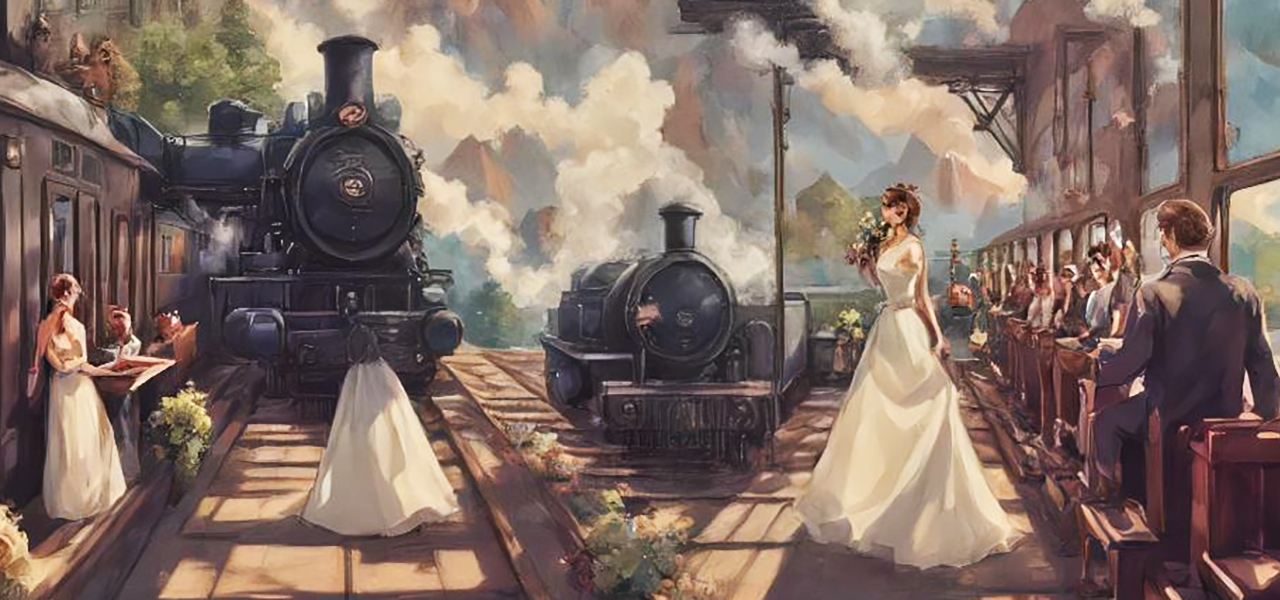
All aboard shouts the conductor to no one in particular since everyone has already boarded the three-car train headed to nowhere, or rather to the end of the line, which really isn’t a proper station just where the train stops, but not really the end of the line since we have to ride back because there is only one station and that means the end of the line is also the beginning of the line and it really feels like we went nowhere at all, this being one of those trains that takes you to a place and that place is a train station, but we are headed to a wedding, and the wedding will take place soon, as soon as we arrive, the wedding procession that must hurry because the wedding should start in a few minutes, but also doesn’t have to start in a few minutes since all the guests are on the same train, waiting patiently to depart the station as the conductor shouts all aboard…
A short story by Martin Piñol.