
By D. W. White.
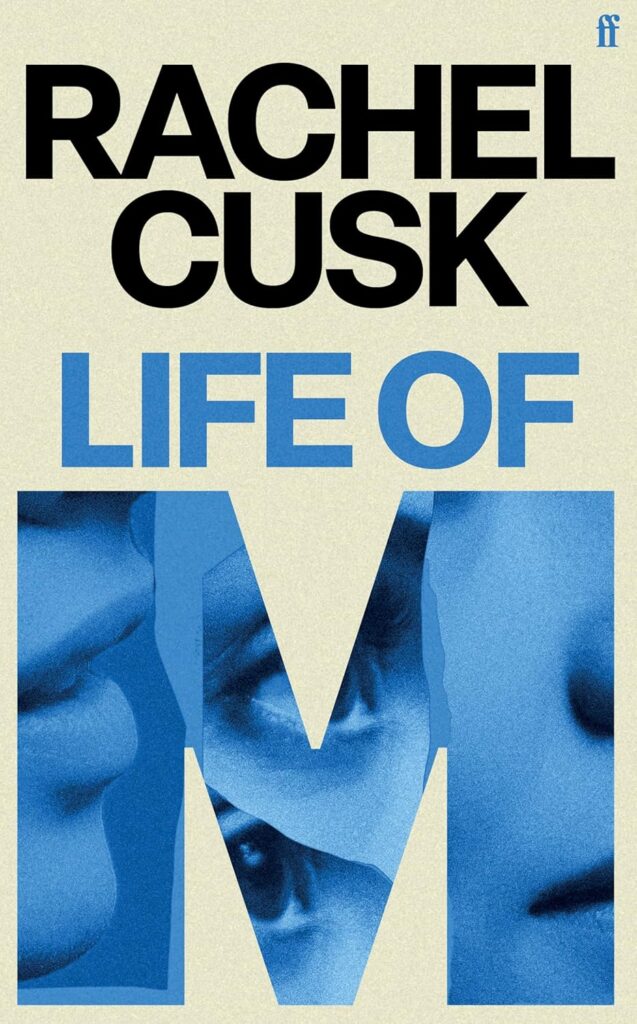
Rachel Cusk, Life of M (Faber, 2026)
There is a famous — if you’ll find some generosity in your definition of that operative word — interview that Rachel Cusk once did with The New Yorker, following the release of Kudos, the third instalment of her Outline trilogy. This was in 2018. At the end of a response about the nuances of Faye (the protagonist), Cusk tacks on the line, “I’m not interested in character because I don’t think character exists anymore.” Naturally, the interviewer Alexandra Schwartz followed up a couple times on this — it makes for a great article title — and critics and commentators have been running with Cusk’s comment ever since. But as with most interesting things, there’s more going on than appears at first glance. Instead, she seems to be getting at something else, a something that surely does permeate her later-career work, although perhaps not in the way popular criticism has maintained. Thus we might start here, in an interview from a near-decade and three novels ago, in discussing Cusk’s most recent work, Life of M, which (like all her fiction) has in fact quite a bit to say, and do, about character.
This latest work is in some sense “about” a movie star; at any rate, it’s the angle that Cusk’s publishers (understandably) and critics (less understandably) have worked in their selling and reading of the book. It’s an approach that misses rather more than it captures, however, especially when leading to interpretations of the book that posit Cusk’s project as one uninterested in, say, character — or even in being a novel at all. One thing to say from the outset is that we’re not going to talk about movie stars, either generically or specifically, in relation to Life of M; or about which particular movie star might have waltzed through the cosmic background of Cusk’s own writing process in crafting it. We’re not interested in fame, here; we’re interested in art — and it’s been a very long time indeed since those difficult neighbours shared an address.
In her essay “Mr Bennett and Mrs Brown,” Virginia Woolf reminds us that “if you hold that novels are in the first place about people, and only in the second about the houses they live in, that [Edwardian method] is the wrong way to set about it,” while discussing the convention of getting at a fictive person by describing all about their house and neighbourhood and familial lineage (207-8). The issue for Cusk, one that becomes her point of compositional departure in Life of M, seems to be that she sees current novels again as writing first about houses, and wants to reorient things. Her unease towards stability in personal identity — at one point in the 2018 interview she says that she sees personality traits “as more oceanic and as things that you can enter and leave in certain phases of your life that aren’t completely determined by the fact that you’re Jane and this is your life” — means she wants to find a way to depict characters in her novel that are similarly mutable. So how to, in effect, render this “oceanic” view of experience; and what else might Life of M be concerned with?
As much as the novel is ostensibly focused on a movie star, its true focus is the writing of that movie star’s autobiography, which is being done by our narrator — who is not the movie star in question. This, obviously, is unusual. Life of M is above all an account of artistic process, or rather creation, and specifically what it looks like, now in 2026, to enter, armed with the ancient tools of the artist, a world that so fervently resists the unified display of human character long required for the depiction of humanity. If people themselves are no longer definable in real life (so Cusk’s argument goes), how are we going to be able to make art that has stable, recognizable people in it? This anxiety over subjectivity is a metaphysical one as much as a moral one: can we actually get to the core of another person (be it a fictional character or a friend in real life or even ourselves), and if so, should we? This ground is one that Cusk has been contending in this latest epoch of her career, and if her novels have become progressively more “experimental” it is because she continues to trust in the avant-garde as an internal — and ontological (as formal) — solution to external (epistemological) doubts. In other words, if the novel coheres, if its internal logic checks out, then it can adequately respond to (defend against) the uncertainties inherent in the external world of people and things.
Life of M locates this standpoint in its first sentence: “A little while ago, I told the actor M that I was thinking of writing her autobiography. She liked the idea. She’s a good sport. Would you just make it up? she said.” By starting off with an autobiography of another person, a term which is definitionally nonsensical (and obliquely quite funny), Cusk is locating her project within these recent obsessions that have latterly marked her novels: subjectivity, reality, and art, admixed with this scepticism about the ability of the artist to capture the lived experiences of another. The metaphysical and the moral — the can and the should — are right there in the first sentence; how is our first person narrator going to write someone else’s autobiography (how would you do it?), and what entitles them to do so? This is the manner by which Cusk reifies the reservations she has about life out in the world — the ones we’ve been (re)interpreting from her 2018 interview — into a novel, the very thing one would think is verboten given those reservations; the very thing some critics understand her to be (attempting) not to do.
But a novel this very much is, even if it manifests as playfully sinister as Descartes’ inventive demon: “It was as if I had been asking her to simulate pity when she was trying to escape her own diabolical knowledge, the knowledge that it was pointless to believe in the story of a life,” our narrator says, about a moment when she’s told M about her partner’s illness (15-16). What does it mean, for a narrator to make such a claim early in their story? If nothing else Life of M is brusquely upfront and thereby Cusk’s most meta-narrational work to date. This bent runs throughout, bleeding appropriately into the mechanics of the first person point-of-view when the embedded autobiography begins to unfold: “Talking to a friend, M is made aware — as she often is — that her life runs in a contrary sense to other people’s” (25-6). The anxiety of rendering someone else’s interiority is overcome with the audacity of style. This is our first break in the wall, the first moment where the ontological (the narrator’s creation of the fictive world) overcomes gaps left in the epistemological (knowing the life and mind of another). The bulk of the novel consists of richly scenic moments “from” the autobiography, a supercharged showing-over-telling à la the superstructures of someone like Lucy Ives. Of course Cusk here is not so much interweaving found writings as much as moving into the embedded account of, well, the life of M:
It is a terrace above an olive grove, with a view of the sea. The low walls of the terrace are made of rough block-like pieces of stone whose chalk- and earth-toned colours and pitted faces give an impression — though an indeterminate one — of age. The floor is tiled with large modern porcelain slabs. An abundant climbing plant foaming with scented pink flowers grows up and over the far-end wall. The tormented shape of a large eucalyptus tree rises behind the terrace and during the hot afternoons shades its centre.The terrace is level with the tree’s mid-height, so that from certain angles it appears to be held in its twisted shaggy arms. Down below the heads of the olive trees stand massed like a waiting crowd. Beyond them lies the silent sea, so calm and opalescent today, retaining white light on its surface so that it attains a mysterious solidity. In the distance the shapes of other islands retreat one behind another. (66-67)
These passages of sustained scenic immersion are not only a Cuskian staple but, in their nouveau roman-esque flavor, constitute within Life of M the distinctive style of our narrator herself, who emerges in this manner as we go along; most of them appear in this rather matter-of-fact manner, which adds to the sensation that they’re organic “field notes.” The book therefore establishes M’s emergent autobiography as its narrative-narrational foundation, positing it as internally coherent, a result of its cosmopoiesis as much as Jay Gatsby’s tragedy or Lolita’s beauty are to the narrators of those novels. We learn quite a bit about our narrator — and her character — as she plays the same instrument, if not the same songs, as any other first person world-creator. The manner in which she writes M’s autobiography is who she is, vis-à-vis the internal workings of the novel.
To make the point explicit as, evidently, it’s been hard to see: just as in the Outline trilogy, the manner in which our narrator tells this story — the details she gives and omits, the disparate stitches of the autobiographical tapestry she reveals, the information about her own personal life she withholds — are her characterization; that is what it means for a first person narrator to be a character in a novel; what she tells us and who she is are formally isomorphic. This is not new, nor is it elusive. In fact, the parallels to Outline’s Faye are rather pronounced; both are unnamed for all or the majority of the novel, both focus on scenic immediacy as the centrifugal manoeuvre for spotlighting a sense of place as antecedent to human agency (that is, the sense we get in both novels that where a character is somehow shapes who they are — or, more accurately, how they’re rendered by the narrator), a persona that is at its clearest when discussing art, and not relationships (with others or with herself). In a word, this is character-making in a novel, and Life of M very clearly has a protagonist who is conceived of by the novel(ist) as such. She doesn’t look like conventional characters in mainstream literary fiction (happily, for we’ve more than enough of that) — and she specifically doesn’t present as a female protagonist in the way, it is obvious, critics want her to — but she is a character, and Cusk intended it to be the case.
Thus, as in the rest of her career, in Life of M Cusk begins with novel itself, as an art-object, and the various things it might be able to do. She then pushes on these capacities, asking the novel to do more, to extend its range and scope. Whether it “works” or not (whether we like it as a novel; whether and to what degree we find it to be a compelling artwork) is another question, and not an unimportant one. But whatever else she is by now, Cusk remains undoubtedly an artist, and while she increasingly seems discomforted by what that might mean as her career progresses, she nonetheless continues to assert her work as artistic, first and foremost. This latest novel puts those questions at the forefront, asking how an artist might be able to continue to practice their art even if it’s morally indifferent or worse, and even if it claims insights into the world, and the world of other people, that it can’t ever know. The novel enacts this creative process as much as it is “about” it; that is, it does the thing that happens in its “plot.” Her starting point is a separation; Cusk begins from an assumption that art and reality are distinct and, following Plato, possibly dangerous to each other — actors from an arthouse film, our narrator contends, “were not trying to mimic reality, or perhaps they were unable to mimic reality. Perhaps reality has not yet been sufficiently falsified for its retrieval to seem worth it” (168). But unlike Plato, Cusk and Life of M alike see art as fiercely, furiously, fundamentally worth it.
The people who know us, our friends, understand this about us. They understand that we don’t have the same relationship to our lives or the lives of others as they do. They understand that if something goes wrong for us — if there is any kind of personal emergency — it is to some degree a public emergency also. It is a crisis of form, reality recording itself on us rather than the other way around. (19-20)
This cleaving of reality from art, against the pulsing background of an ongoing ontological crisis in subjectivity, fashions an account of artistic practice, and of the artist in the world, that seems to generate the inherent problems of art as both insurmountable and an imperative to go on. This happens, as we said, both in the book and as the book; Life of M is a novel primarily concerned with form, another way of saying it is thus a novel by Rachel Cusk.
One that forms something of a second trilogy alongside Second Place and Parade, in its shared concern with artists and their place in the world; although the reading of Life of M that I find myself drawn to places it as a diptych with the latter. Where Parade first elided and then disintegrated ideas of narrative linearity, profiting a radical understanding of what art might be and what power it might have to render (unto) the world, this follow-up continues in a similar compositional vein while seeming to turn its attention towards the status of the artist in the world, less as praxis so much as identity. Of course the concept of narrative linearity has long gone out Cusk’s window, but the manner in which Life of M achieves it feels more insouciant than her recent novels; in a way it’s messier, more ad-hoc, more indicative of the creative act itself. Above all — and to the dismay perhaps of some — this is a novel that feels quite comfortable in its own skin, understanding its internal goals and setting about to the business at hand. Cusk herself, in that interview with The New York Times, says that her work in the novel deals with those who are “a part of contemporary consciousness,” and that “if my job is not to go into unexplored areas of contemporary consciousness, then I don’t know what it is.”
The sense of living, and therefore radical, exploration is palpable; the quote also serves as a reminder that the novel is intensely interested in inner life, despite outward appearances. Because the other, related but distinct, aspect of art and the artist that Life of M wishes to investigate is what it means (what it looks like) to live as an artist in the contemporary world. Our narrator subtly introduces this thread at the very beginning, while she more overtly introduces us to the movie star in question, telling us that it was “hard not to feel ugly next to M. Part of it was the ugliness of experience… Her difficulty lay in her distance from the random violence of insignificance.” The narrator also tells us that she had “never learned how to make experience easier” for herself, setting up the divide between her and M that will run the length of the novel (2).
Both M and the narrator are presented first as objects, then as people. (This is the tack that the New Yorker review, among others, follows). They’re presented as component parts within a socio-cultural system — that postmodern thrust we hinted at earlier and which will recur below — that nonetheless, and stubbornly, retain a subterranean individuality. The point that the novel is making is about the distance between how it appears to live as these people versus how it is. There is obstinate humanity present in this worldview, beyond the facade erected by the matrix of inputs spun by modernity. In M’s character the novel makes a statement about celebrity and the vacuousness of fame, the empty centre that lies at the middle of a well-known person(a); this it what Cusk is getting at in the interview. With the narrator’s (far more robust) character, the focus shifts to the life of the artist, and their separateness from a world they are forever seeking to depict. “It might be said that creative people were people whose childhoods hadn’t ended,” she says; being creative “was like being a dog that keeps running away from its violent master. For a while it runs free … but in the end there is nowhere else for it to go but back home” (11).
As we said a moment ago, this vision of the artist is both laudatory and self-immolative; the artist is driven to create in a way others cannot because they are unable to live in the way others can — and driven by what? Mad ego seems just as likely an answer as divine vision; and who says they’re mutual exclusives. In order to create, the narrator says, the artists “have risked health and happiness, order, security. Other people have cared about and preserved those things… They haven’t taken the risks we have taken” (20). The Romantic belief in the artist is a deeply held conviction in Life of M, one that can account for its worldview and internal architecture. The artist is a social outcast, a misfit, one who literally objectifies the world and the people in it by realizing them as a conduit for the needs of their craft. The artist is also, however, a visionary; one who has sacrificed something for the greater good and who obstinately refuses to give in. While their personal relationship with society feels strained and muted, it is the artist who imbues the world with a more profound human expression, a chimeric blend of wallflower and conduit.
This account of the life of the artist is not necessarily original or groundbreaking; I’ve been calling it a Romantic one in part because it feels a bit like something out of Werther, and overall is an understanding that feels familiar. In Life of M it seems to locate the nervous energy of Cusk’s ambivalence towards her craft; this animating question about how a writer can presume to render other people in a world where other people have no fixed identity is one that strikes at the heart of the relationship between the artist and her world. The figure of the celebrity, on the other hand, as represented by M, is in some ways the inverse; M is presented as the outward sum of her fixed positioning in given situations, with very little interiority at all. Our narrator, conversely, while lacking many of the outward indicia of society — including most obviously a name — is a relentless creation machine, producing scene after scene of her fabricated autobiography in swift, evocative prose which, by novel’s end, perhaps relates to its ostensible subject matter only contingently.
Her attempt, then, is not to “dismantle the novel” but instead leverage the novel form to capture and express the artistic questions that arise antecedent to it. If it doesn’t look quite like the novels that we’re used to, that is because the approach is a new one; successful or not, there is a legitimate novelistic goal being sought. The autobiography of M is an internal fiction, and part of the book’s grammar is to present those scenes from it as generative products of the narrator, which may or may not be related to a “real” autobiography within the context of the novel, and which really doesn’t matter either way. The point is the act of creation, not whatever is created.
All these stressors cash out, of course, in point-of-view; that sibylline place within a novel’s compositional inner sanctum where Life of M (and all of Cusk’s novels) is at its playful best. In one “scene” from the autobiography, M is at some sort of pre-production meeting, high powered and stiff:
There is a pause while someone gets up and goes to the sideboard for coffee. This is irritating: they can get coffee in their own time. I is generally understood that the coffee is there merely to symbolise the element of ritual that ought to underpin human gatherings. The scraping of chair legs and the humming noise of the machine and the rattling of teaspoons — he has actually presumed to put sugar in his coffee — is grating. Obviously it is forbidden to touch the pastries. (95)
Arguably the strongest moment in the novel, the insouciant blend of heterodiegetic and homodiegetic narration — the way it shape-shifts between first and third person while maintaining a unity of purpose and intra-textual rules — is typical late-period Cusk, resonant of Outline. The (imagined, internally-fictitious) inner voice of M bleeds into the (embedded, prima facie artificial) pseudo-third person narration, as crafted by our narrator. It’s also wry and full of the type of immediate-voice characterization that Cusk does best. To be sure, there are far fewer such moments in Life of M than in the trilogy or the works since; I myself would have been pleased to see more. But the internal cohesion is there when our narrator slides into M’s (fabricated) consciousness via the trademark Cuskian first-person free-indirect. The fact of celebrity shows up here, accelerated through narration as is her habit, in realizing a famous person as a product of the projections of someone else (our narrator), standing in for that index of innumerable socio-cultural factors that make up personhood. In other words, a Modernist novelistic method to arrive at an exploration of postmodern angst.
And what is that angst? In that same New York Times interview Cusk also said that Life of M “had to be letting surfaces speak.” What exactly this means we’ve perhaps orbited so far in this paper; one being slanted as superficial or “not a novel.” We’ve been doing some circling, that is, of this way in which Cusk is attempting to work out a postmodern sensibility in this novel, via a fundamentally Modernist method (viz. sustaining a commitment to form as the animating impulse of the art-object). For the Stanford Encyclopedia of Philosophy, a postmodern sensibility mourns “the fact that knowledge is no longer principally narrative” — due, essentially, to the onslaught of information generated by the computer age — which results in a loss of a “continuous meta-narrative” that “breaks the subject into heterogeneous moments of subjectivity that do not cohere into an identity.” We also see a capitalization of information (as distinct from, and replacing, narrative-based knowledge) to tyrannic effect, such that “whatever cannot be communicated as information must be eliminated.” A relentless drive for information — facts and data — which ruthlessly excises the gaps between such points that we might otherwise term “context.” The upshot here might be an understanding of personhood which is so diffuse and fragmented as to struggle to exist at all.
This certainly does sound a lot like the central anxieties found in Life of M. How far one might be able to take such an assertion is debatable (dubious?), but as background knowledge I find it enlivening to a reading of the novel. Cusk’s skepticism towards subjectivity, and her account of it in the book, feels to me postmodern, not only in the particulars we’ve glossed just now, but in a more general sensation of near-dystopian disquiet that appears in a fair bit of contemporary fiction. The unnamed narrators, the vague-yet-precise settings, the bits of scenic immediacy that ruffle against a linear whole — these are features of the modern novel to varying degrees (and varying success) and is surely a large part of why most commentators seem to think there is a such a thing as postmodern fiction at all (I’m personally not convinced). Cusk, as she tends to be, looks different on the page than her peers; for one thing, she’s much more interested in the form of the novel than most, and has always looked to vector the things she wants to say about the world through the medium of her art.
So where does all this leave us? What is is that Life of M wishes to say about the world, where does it fit in the context of the author’s career? On one level this is simple, and a certain version of the mainstream critical response to it: Cusk is looking to do something else, she’s “restless,” we might say, or her books are, or Wayne Booth’s implied author version of her is, or whatever. Personally, reading Life of M and writing this essay at the end of a years-long process of working on a book-length study of her novels, I find it slightly more “interesting” than “great;” I think it’s a very effective novel on its own terms, but I can see the ways in which it holds the reader at arm’s length, and I am more taken with what it does to the arc of her oeuvre than anything else. That said, it’s in many ways a remarkable novel that perhaps achieves more by what people aren’t saying about it than what they are.
In a now-obscure treatise on Hamlet, the nineteenth century railroad operator Edward Payson Vining makes a bold and stirring argument about the elliptical main character of that famous play, and how it is that we know him:
With other writers, their characters are frequently but embodied qualities, moved by one emotion. The heroine is the embodiment of love, and lives but to love, alone. The good are supernaturally good, with scarcely one contrasting vice, and the villain are creatures of crime whom no remote can reach…in Shakespeare’s works alone do we see that tangled web of which human lives are composed: weakness and strength combined; light and shade; a thousand conflicting motives in inextricable confusion, driving their victim to and fro; and among them all we see the man, a creature of as marked individuality, as complete in his humanity, as the fellow-beings among who we move. (11-12)
Vining’s overall argument is, quite possibly, deranged, but he’s not wrong about Shakespeare’s felicity with characterization. It strikes me that this is the type of character(ization) Cusk is talking about; this is against whom her rebellion is waged, in Life of M and elsewhere. And this is the tangled web she has been reaching for, since probably the beginning; certainly since Arlington Park. This latest novel continues that thread; there are novel-things happening here, and maybe we don’t like them or even want to read them — but there they are, stubborn and ongoing.
It’s a strange book, born of a certain worldview and a certain attempt to render that vision; it is propelled by a belief in the necessity of art, even if all the world’s devils — including the artist herself — are in confederacy against it. For those of us who share that belief, what more can we ask? What more, besides an artist continuing to try, to ask questions of the world and, in lieu of an answer, to throw against its implacable walls the endless gesture of creation? I know one thing: if there’s a life after art, I don’t want to live it. I can think of one novelist, at least, who agrees.
References
Alter, Alexandra. “How A Highbrow Novel Became Celebrity Gossip,” interview with Rachel Cusk. The New York Times, Aug. 20, 2026.
Aylesworth, Gary, “Postmodernism”, The Stanford Encyclopedia of Philosophy (Spring 2015 Edition).
Cusk, Rachel. Life of M. London: Faber and Faber. 2026
Rothfeld, Becca. “Rachel Cusk’s Protest Against Personhood,” The New Yorker, Aug. 16, 2026.
Schwartz, Alexandra. “I Don’t Believe Character Exists Anymore,” interview with Rachel Cusk. The New Yorker, Nov. 18, 2018.
Vining, Edward Payson. The Mystery of Hamlet: An Attempt to Solve an Old Problem. Philadelphia: J. B. Lippincott & Co. 1881.
Woolf, Virginia. “Mr Bennett and Mrs Brown,” quoted in The Virginia Woolf Reader, edited by Mitchell A. Leaksa. Pp192-212. London: Harcourt, Brace, Jovanovich. 1984 [1924].

ABOUT THE AUTHOR
D. W. White is the Founding Editor of L’Esprit Literary Review, Prose Editor of West Trade Review, and Publisher of Indirect Books. He received his Ph.D. from the Program for Writers at the University of Illinois-Chicago and is currently a faculty member in the MFA Program at Roosevelt University. His first book of criticism, Rachel Cusk and The Art of Narration, will be published in November by Indirect Books. He lives in Long Beach, California.

