
Adriana Hunter interviewed by Tony White.
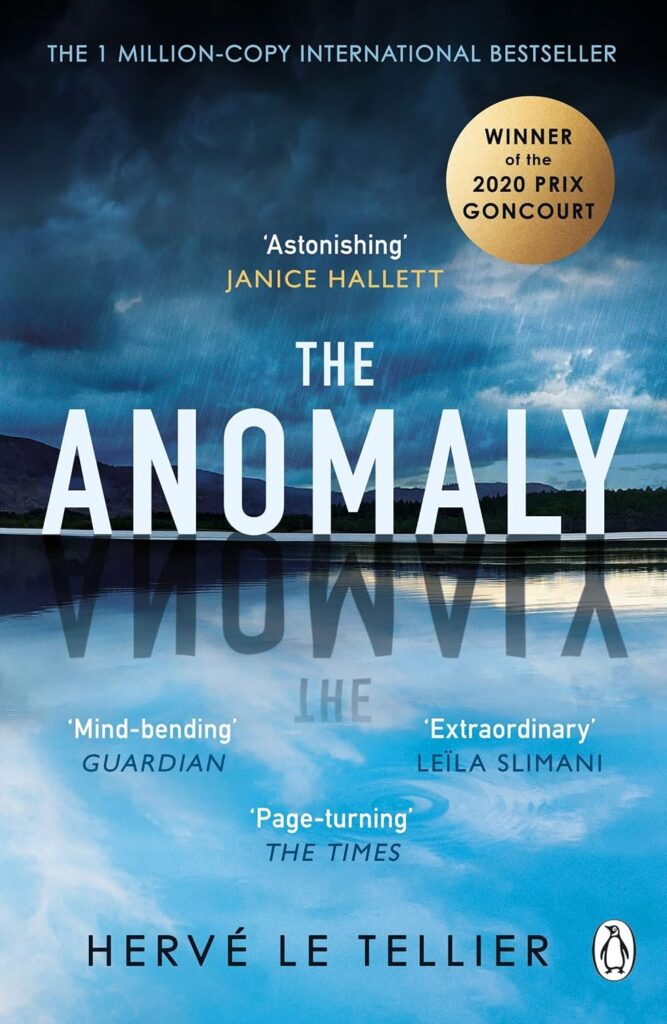
The ceremony for the Arthur C Clarke Award 2023, honouring the best science fiction novel of the previous year, was held in the redesigned crypt of St Martin-in-the-Fields off Trafalgar Square in central London. A hundred or more of us – authors, reviewers, journalists, prize judges, editors and publishers: book folk – came together in this dramatic location and saw author Ned Beauman accept the Clarke Award for his fifth novel Venomous Lumpsucker (Hodder and Stoughton, 2022) with a crowd-pleasing speech that wittily played off real and imagined tensions between literary and genre-fiction camps — bravo! I was however slightly more excited that French author Hervé Le Tellier’s Prix Goncourt-winning novel The Anomaly, in Adriana Hunter’s English translation (which I’d reviewed for the Irish Times the previous year, and which itself performs across literary and genre categories) was on that year’s shortlist, and that Le Tellier and Hunter were both present.
Hervé Le Tellier is currently President of the avant-garde writers’ group Oulipo. As is well known, the Ouvroir de Littérature Potentielle – Oulipo for short – was founded in Paris in 1960 by Raymond Queneau and François Le Lionnais. The group’s main function remains to devise and promote the use of ‘constraints’, i.e. literary games, restrictions, and strategies of various kinds, whether ludic, mathematical, typographical, grammatical, etc. – that might potentially create new works of literature. Well known examples of Oulipian works of course include La Disparition by Georges Perec (1936–1982) a novel famously written without using the letter ‘e’ – a ‘lipogram’ in Oulipian terminology. While Harry Matthews’ (1930–2017) Selected Declarations of Dependence used a ‘mandated vocabulary’ exclusively comprising the words that make up 46 English language proverbs; and Christine Brooke-Rose (1923–2012) wrote her 1998 novel Next, a story set among the homeless, without using the verb ‘to have’.
But what is the status of (and how provisional) are the resulting works once the book (let’s say) is in print? When translating novels written using constraints, do you translate the constraint or the outcome? For example, when translating Perec’s La Disparition – its English-language title was A Void – Gilbert Adair reproduced the lipogram: the absent ‘e’ being the novel’s defining feature. But there are different approaches, and in Le Tellier’s case The Anomaly is unusual for being an Oulipian work that also functions as a mass-market ‘airport thriller’ – which imperative might be a further, more centrifugal constraint. After the ceremony, I ask Le Tellier’s translator Adriana Hunter what her position is: does she translate the constraint or the result on the page? ‘In fact,’ I suggest, thinking ahead, ‘can I interview you about translating Oulipian texts, and about translation in general?’
Hunter agrees.
‘Work is pretty manic at the moment,’ she says, when I write to follow up, ‘but yes, I’d be very happy to answer some questions via email.’
*
3:AM: What brought you into a life as a translator; how did you start out? And how does a typical translation engagement come about today?
Adriana Hunter: Translating feels like what I’m here to do and I sort of stumbled into it in my early thirties. I’m a fluent French speaker and was working as a freelance writer when I came across a devastating French memoir that I wanted to share with readers of English. After some very amateur pitching and a lot of rejections, the translation – The Disappearance by Geneviève Jurgensen – was commissioned by Flamingo. I’ve now translated more than 100 books. I still pitch books to publishers but it’s a lot harder than it used to be and most of my work happens when publishers approach me with a project.
3:AM: Are there key moments for you when translating a major work?
AH: There aren’t really key moments, just lots of little eureka moments along the way when a sentence I’ve been wrangling with suddenly falls into place in my mind – usually not when I’m tussling with it at my keyboard but doing something mundane like weeding or walking the dogs: you don’t even know the brain’s still mulling but it comes up with an answer. One pleasing moment is the final read-through: I usually leave a translation to ‘rest’ for a month so it becomes less familiar, then I print it out and sit down and read it as an English book. It’s an opportunity to discover it all over again… and to sort out last minute niggles.
3:AM: Does the task of translating ‘feel’ different at varying stages or levels of resolution (e.g. moments of extreme focus; when you feel you’ve successfully created an equivalent unifying voice; or where you perhaps begin to have a more expansive sense of the whole work)?
AH: When I’m actually translating it feels quite intense, the verbal gymnastics can be a workout and that gives me a buzz. The final read-through is a step back, a more relaxed, objective experience.
3:AM: What are the most difficult moments?
AH: There are two types of difficult moment, one I love and one I don’t. The good type is when the syntax is really hard to render palatably in English, or there’s a word game; these are challenges and they’re fun, the best bits. The bad type is when the original text is lazy or clichéd and then there’s a dilemma: if I say ‘my heart thudded in my chest’ or ‘suddenly’ AGAIN, that makes me look like a bad, lazy writer. But how much am I allowed to drift from the source text to improve it? (Answer: I allow myself to drift.)
3:AM: Thinking back to my own experiences of having novels translated, and the to-and-fro of questions and clarifications. When you’ve worked with an author more than once, as with Le Tellier – especially when constraints are involved – is that back and forth any different? Do you save up questions for the end?
AH: I prefer to pester my authors as little as possible, although they’re almost always receptive to queries and generous with their time. So, I rarely approach an author before embarking on a translation and I’ll save up my questions to the end after I’ve exhausted other avenues. If there’s a turn of phrase or expression that I’m unfamiliar with and can’t tease out with online research, I’ll check with native French-speaking friends first. If they say it’s not a standard expression, I’ll go on to ask the author about it. If it’s a set expression, then I’ve avoided hassling the author for nothing and also avoided possibly looking incompetent. I’ve worked on enough of Hervé’s books to have easy exchanges with him, but I wouldn’t want a new author to feel anxious about my competence as a translator simply because I’m not familiar with a particular expression.
3:AM: There have been several profile-raising initiatives over the past decade or so, building on things like the former Independent Foreign Fiction Prize and the slowly evolving International Booker Prize, including Women in Translation Month founded in 2014, and the campaign to name translators in reviews, etc. There have been some notable books on the subject published recently, particularly by women writers: Dancing on Ropes by Anna Aslanyan (Profile, 2021), This Little Art by Kate Briggs (Fitzcarraldo, 2017), Fair: the Life-Art of Translation by Jen Calleja (Prototype, 2025). More generally, have attitudes towards literary translation changed in recent years?
AH: Literary translation certainly has a higher profile now: many more publishers put the translator’s name on the cover, and more reviews name the translator. The English-speaking world is still more resistant to books in translation than readers are in other countries, but translation has become less niche and more mainstream. Translations of, say, Henning Mankell and Elena Ferrante have been ‘accepted’ by readers of English, opening the way for other works in translation.
3:AM: You have translated several books by the French novelist Hervé Le Tellier, including his first novel Enough About Love (Other Press, 2011), the Prix Goncourt-winning The Anomaly (Penguin Michael Joseph, 2022), and now your recent translation of The Name on the Wall (Other Press, 2025), which brings to very moving life the ephemeral traces of a French Resistance fighter. Enough About Love was the first Oulipian work you translated. It’s a charming, cosmopolitan and very French novel about extramarital affairs amongst bourgeois intellectual couples: one character is a novelist, one a psychoanalyst… It‘s also formally playful: from press clippings of death notices, to a list of purchases, and so on. Did that playfulness and the resulting fragmentary style pose any particular challenges?
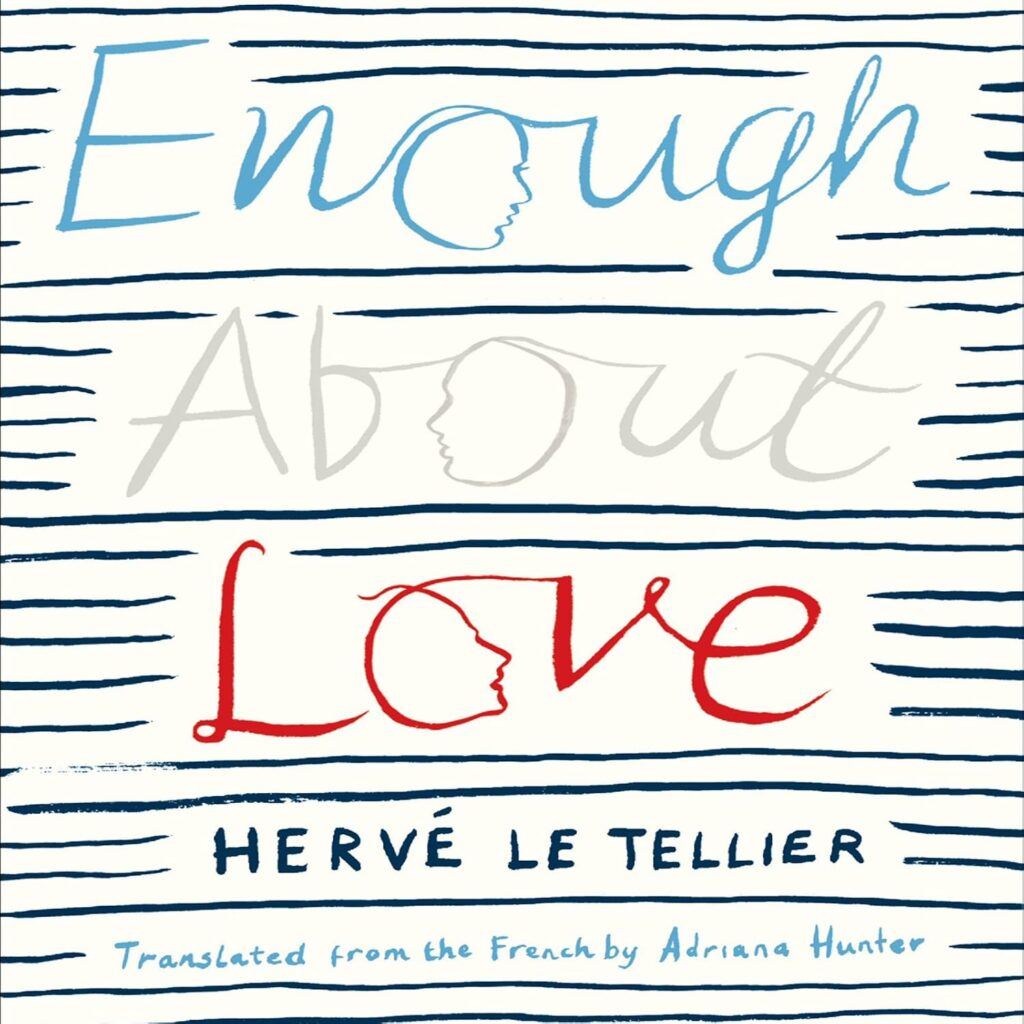
AH: The translating process itself is necessarily fragmentary: even if you’re working intensively under time pressure, there’s a limit to how much you can do in one sitting. If I go over my limit, I start writing bilge and it takes longer to correct. So, within reason, it doesn’t matter if a text is fragmentary because at any one time you’re focused on that fragment. Ideally, each fragment should be long enough to get a proper handle on it and of course at some stage you need to step back and consider how all the fragments work together.
3:AM: The most apparent and compositionally satisfying Oulipian constraint in Enough About Love is that the novelist character is writing a novel that also has six protagonists, which is, we’re told, based on the successive moves in an historic game of a particularly arcane variant of dominoes… This provides a central mise en abyme, although it may be a feint or an homage to other explicitly game-derived Oulipian works. However there are also moments where the reader will recognise certain traces – abrupt turns, or syntactical and thematic eddies, expansions, and accelerations in the surface of the prose – which imply the presence of further constraints. But if so, Le Tellier is not letting on, and there’s nothing as overt as a missing letter. The Anomaly plays its Oulipian cards even closer to its chest. But again, ripples in the prose, and big intertextual echoes in scene and action suggest the presence of further constraints and appropriations, though we are not told explicitly.
AH: Yes, I think Le Tellier puts many constraints on himself other than those that are made explicit. Surely, it’s a deliberate stylistic exercise when he switches genre and/or narrative voice between chapters, going from, say, an urbane, detached third-person narrator to a manic first-person rant. And isn’t he playing (with us and for his own amusement) when he elegantly shoehorns a chunk of arcane information about some obscure topic into a book?
3:AM: Of course ‘play’ can be deadly serious. The Name on the Wall is a powerful book for example, and there’s more than amusement at stake?
AH: This is an interesting point. Playfulness needn’t imply flippancy, and an author’s playful or self-challenging devices in constructing a text can perfectly legitimately serve a serious topic, as in the case of The Name on the Wall. Oulipian constraints are intended as triggers to unlock potential (that’s the ‘po’ of Oulipo) in writing. It’s also worth saying that The Name on the Wall has depth and breadth despite its brevity. It tackles some dark and harrowing subjects but is also a portrait of an era that fewer and fewer people now remember; the ‘arcane information’ helps to build that portrait.
3:AM: No personal preference or value judgement implied either way, but what is your position on translating Oulipian texts: do you translate the constraint or the resulting text on the page, or some combination of both?
AH: I definitely translate the resulting text on the page. It’s back to the ‘po’ of Oulipo: these devices unlock potential. The resulting book is an entity in its own right and I respect that. Perhaps I’m robbing English language readers of the opportunity to spot a constraint because I myself haven’t identified it and reproduced it in translation. If Le Tellier ever said that he’d worked in a particular way, such as using the famous N+7 device, I would respect that in my translation (the more constraints the merrier for me, it ramps up the level of challenge), but so long as a device isn’t flagged up, I’ll be true to the finished writing.
3:AM: What are you are translating at the moment, and what’s coming out next?
AH: My latest translation to be published is The Stars Shine Brighter (Other Press, 2026) by the French-speaking Palestinian journalist Rami Abou Jamous – a moving and sometimes shocking account of life in Gaza since 7 October 2023 and of the author’s determination to protect his young son from the realities of their experiences. I’m currently in the final stages of edits on the ambitious and compulsive Four Who Saw the End by Abel Quentin (Europa Editions, 2027), which has been a lot of fun to translate: it’s long but pacy, intellectual but funny, sardonic but humane… and extremely timely in its concerns about climate change.
3:AM: Finally a question for the Oulipo enthusiasts: are there any recent Oulipo books that you’ve enjoyed reading in French recently?
AH: I’m currently reading Choses que je croyais perdues (Things I Thought Were Lost) by the Oulipian writer Clémentine Mélois, (L’arbalète/Gallimard, 2026) which (at the time of writing) has been shortlisted for three literary prizes: the Prix Goncourt 2026, Prix Femina 2026, and Prix des Deux Magots 2026. It starts with the simple premise of a young woman packing up her apartment after a break-up but evolves into a moving and profound exploration of the nature of memory and how inanimate belongings can be repositories for our identities. I wonder whether the author set herself the constraint of building relatable anecdotes and thought-provoking meditations around both the most banal objects, such as a pair of tan boots, and the most arcane – Kugelhopf cake mould, anyone?
ABOUT THE INTERVIEWER
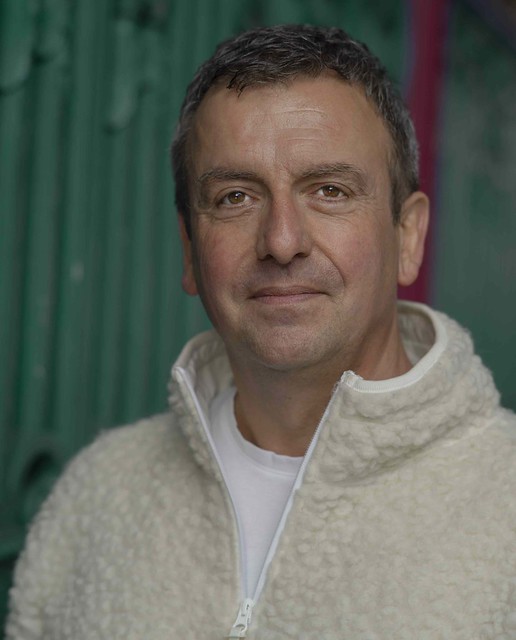
Tony White is the author of novels including Foxy-T and The Fountain in the Forest. A former writer in residence at the Science Museum, he is currently RLF Fellow at Royal Holloway University of London, and an associate lecturer on the Creative Writing MA at Birkbeck University of London. White presents the monthly books programme Literature Live on Resonance 104.4fm. His latest novel, Phantom at the Feast is published by No Exit Press, which will also reissue The Fountain in the Forest in December 2026.

