

A Walk
First thing: you. That old void in your head. It’s winter. The sun is an itch in your eye. There’s construction, of course; the sound wakes you as the streaky slam of your loosely hinged door concurs with the recognition of some meathead from Staten Island bent grimacing over a jackhammer that shatters the sidewalk and with it any hope of civility for the day, or room for thought, normotension, tinnitus-free ears—no, this probably prejudiced Italian who likely shares Nonna’s basement with his wife is shuddering and quivering above the destruction of the little patch of land that has had more ground broken than anywhere in the world besides some nameless city block in Gaza—proving your conspiratorial landlord right, all building projects in the city are scams, snow jobs for the mafia or the liberal elite or whites—he—Greek—somehow considering himself exempt—colluding to ensure everyone under the table is getting theirs except you and him—
A short story by Charles Hawes.
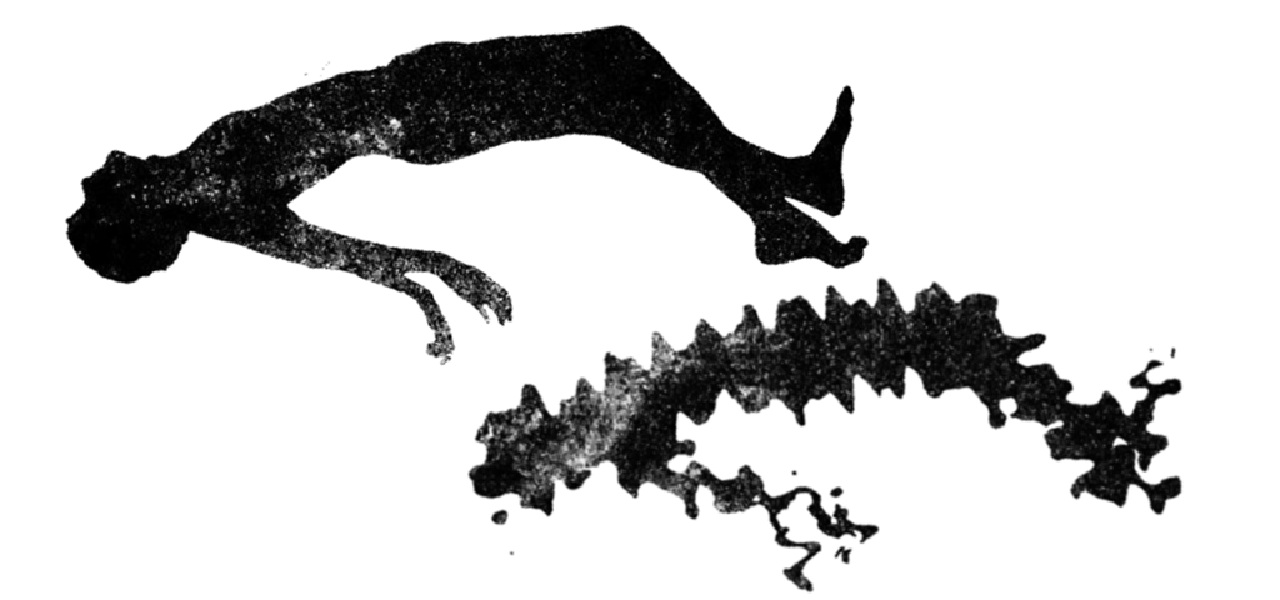
A Series of Emotional Reactions
REACTION # 1: THE SONG, SHITTY REFUGE, BY ABSOLUTE FUCKING COWARDS
Nervous exultation. A conviction bordering on mania that says this is reality and always has been, even if you couldn’t see it. A desire to do. More importantly, a feeling that things can be done. As I hit Avenue du Parc and crank up the volume, I feel a youthful sense of significance blooming in me like the spring that will not arrive for at least a few more weeks. I’m the subject of a song, a character in a book or a movie, and everything I do is charged with meaning—even these endless failures and humiliations.
A short story by Glyn Rebl.

Ulysses with Finnegans Rising: An Interview with Andrew Gallix
Andrew Gallix arrives at my apartment just off the rue Beaubourg in the 3rd arrondissement of Paris at 4pm on a bright May 1st bank holiday. Like many a former punk his sartorial style in middle age verges on the mod. He wears a brushed cotton jacket, and a blue and white striped shirt, navy blue jeans and a pair of black Campers. Blue eyed, greying hair tightly cut, with a tuft at the widow’s peak, he speaks with a mild southern English accent, the emphasis on certain words revealing the very faintest underlying of French. For a deeply literary man, he is broad shouldered and barrel chested, the sort of build that would be an asset if there was any trouble outside the pub, or after a book reading. During the soundcheck I ask him to introduce himself. “Je m’appelle Loren Ipsum,” he replies.
Gerry Feehily interviews Andrew Gallix.
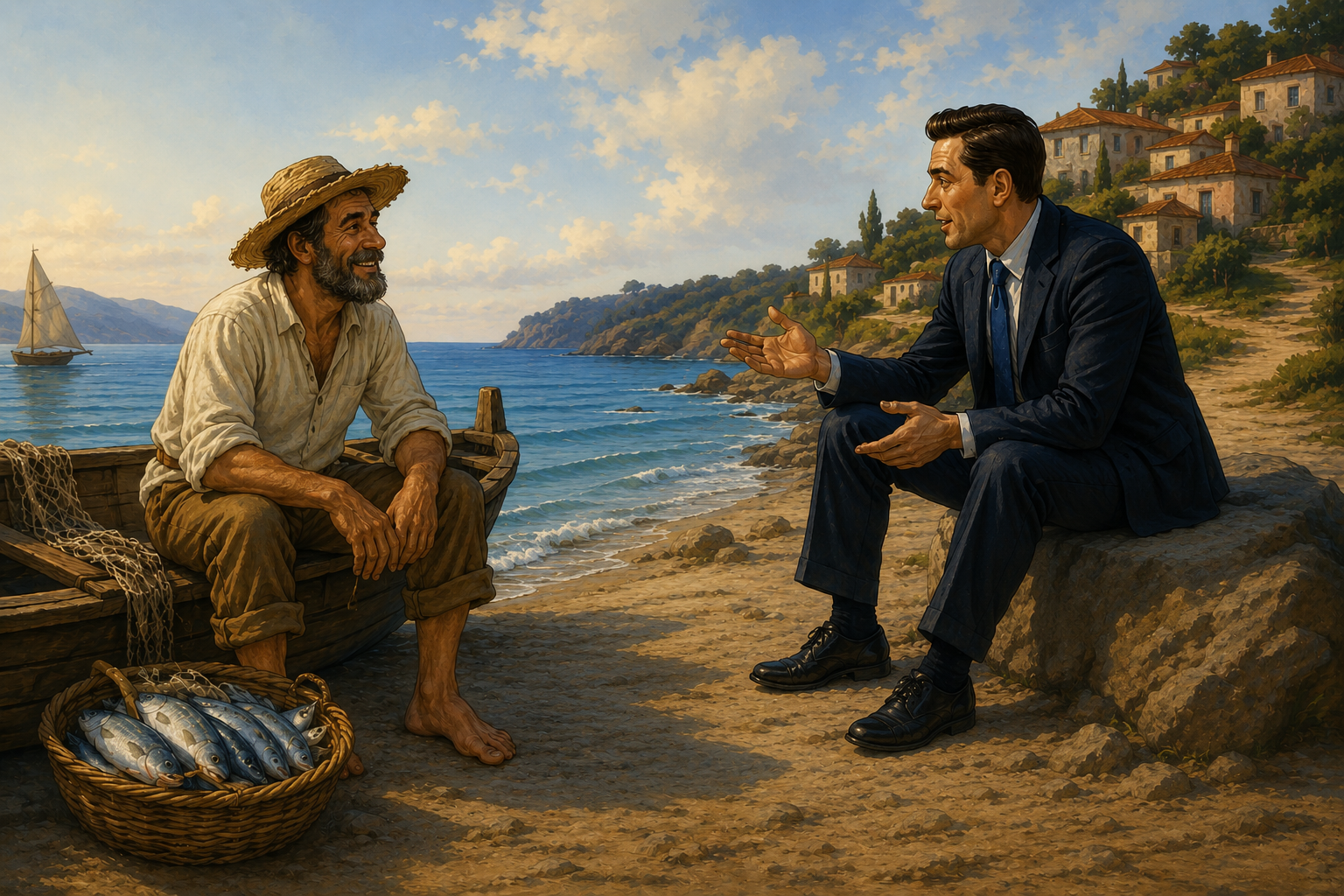
The Fisherman and the Businessman Revisited: Neglected History and Interpretations of a Trendy Parable
Coelho was certainly right to think that that ‘classic Brazilian story’ was ‘also present in other cultures’. I think of Adela Peeva’s documentary Whose Is This Song?, exploring the history of one popular Balkan folk song and the emotional claims of authorship and ownership of it made by laypeople and musicologists alike in just about every country in the region. I would be fascinated to know more about the genealogy of the story of the fisherman and the businessman, and I’m sure there is far, far more of that genealogy to be uncovered, especially if we expand it to include those Buddhist and Russian incarnations that Albion alludes to (but does not provide citations for), and other classic folk tales with noticeably similar characters and themes, like the one La Fontaine tells as ‘The Cobbler and the Financier’ and the one the Brothers Grimm tell as ‘The Fisherman and His Wife’.
Benjamin George Coles revisits and reinterprets the parable of The Fisherman and the Businessman.

Diamond Life
Two years later, it was quite the surprise to see Dahlia Diamond’s ‘Single’ status update on Facebook, complete with Divorce Party photos. Champagne at the Bowery Hotel bar with her besties and high fives with smirking, handsome men. Digging further online, I found a mention on a minor gossip site: ‘Stylist-to- the-stars Dahlia Diamond divorces jewellery designer Hunter Hennequin, brother to fashion giant Nelson Hennequin, citing irreconcilable differences.’ In her own words: ‘We still love each other and shall remain the best of friends. We continue to support each other in our work. Hunter is a rare talent.’ I couldn’t fault her diplomacy, but ‘rare talent’ was a stretch when attributed to outrageously priced silver pendants of naked girls riding dolphins and wolves. Whether he outsourced it or not, Hunter’s metalwork wasn’t even up to par, and all his clients were celebrities Dahlia had styled. I could only imagine her regret in signing a prenup.
Read an exclusive extract from Diamond Life by Anna Maconochie.

Protocol for a First Date
1. Wear clothes.
a. Also:
i. Bullet-proof glasses.
ii. A PM2.5 filtration mask.
iii. Shoes suitable for riding your e-board and, if required, running.
2. When you reach the coordinates, tuck your e-board under your arm.
3. Look for a wall of thriving Pandorea Pandorana climbing the metal mesh we installed.
4. Brush away the native vine to find the elevator door with a faded staff only sign.
a. Resist the urge to assess the vine’s moisture levels or tend to it.
5. Once inside, enter the number sequence listed in the location file and the elevator should descend.
6. Walk down a long concrete corridor. The entrance to the bar is through an industrial fridge door. Wait for your date outside.
7. As your date approaches, visibly dab the sweat from your nose and have a captcha on your device ready.
a. The captcha must be so complicated that it is approaching abstract art.
b. Your date may have up to ten attempts.
c. They may be a decoy. Do not give them any identifying information until they have passed.i. If they are not a decoy, they will feel reassured that you have taken such precautions.
A short story by Karina Ko.

Living the Fairy-Tale Life: Paula Rego, Psychoanalysis, Taking Flight
Whether we go to therapy or art or other ritualistic practices that prise open the dark stories dancing around in us all, we end up in the same strange place, I think, with versions of these characters and their stories. I wrote my novel as my own kind of fairy tale, simply because life itself is full of these magical, strange characters — but it was not until coming face to face with Rego’s fairy tales that I understood the point of it all — to allow the weirdness, however discomforting. To allow a sort of sickness to be aired and so cured, perhaps.
Christiana Spens on the Munch Museum’s Paula Rego retrospective, psychoanalysis, ballet, and The Colony, her new novel.

Orpington to London Victoria #13 – George Berger Column
Bromley hasn’t changed. Petts Wood has got worse, if anything. Reform are hovering on the edge of winning the next election and here’s the human and vibrational evidence, in two pubs that are so different from my local pubs in Seaford. And it would be very easy to get depressed if I lived in these parts. I wonder if this makes me some kind of snob, and decide that if it does, I’ll just have to live with that. Embrace it, even.
George Berger reaches the end of the line. Again.

Hell of Solitude
In the epigrammatic essay ‘Art and Other Matters’, Akutagawa mentions Cézanne, but it’s Satie I think of. Hell of Solitude – the grim title is misleading – is Satie-esque: surface simplicity meets technical complexity, playfulness and utter seriousness walk hand-in-hand, brevity is a delight, evanescence a risk of life, and form to be used capriciously. Both artists refused to engage the world on anything other than their own artistic terms, and posterity is now able to recognise their value.
C.D. Rose reviews Hell of Solitude by Ryūnosuke Akutagawa.

Quincy the Calvinist Turtle
Richard Varma, the illustrator, draftsman, and muralist, died of natural causes earlier this year in Wichita, Kansas. Varma is perhaps most notable for his collaborations with Sirin Volokhonsky, better known as Professor Metzinger, the children’s author whose bizarre public appearances often overshadowed the sad, whimsical lyricism of his work. They began their collaboration in the early 1960s. The whereabouts of Metzinger’s final manuscript were unknown to most for nearly a quarter of a century. A malevolent rumor persisted that it was destroyed along with its author in a Hungarian prison riot. Others buoyantly claimed that Metzinger had managed to smuggle it away via a sympathetic guard, moments before his death, like in a Hollywood melodrama. But Varma’s own passing has revealed a mundane, yet pleasant, truth. The manuscript for Quincy the Calvinist Turtle, Metzinger’s last known piece of writing, was sent to Varma a few weeks before Metzinger’s death.
A short story by Avee Chaudhuri.

Silly Dance, No Mercy
He did a silly dance in a bar, a dance so silly that it had no regard for choreography, ego, or social order. At the afterparty he talked about civil religion, his gentle head at rest on the cushion of a sunken couch. Hours later, over the laps of their friends, their eyes met –hello– and a passage appeared leading to a light, empty plain. The silence of the place fell through them both with the weight of a sky. Woah! The air was cold, but the kind of cold that reminds you this is the real world and something indeed might happen. Gail had emerged from a private room of shock and all of this cannot be the case, this cannot be the case—to here. For Tom, it was the same. They sat face-to-face, eyes wide. There is no way to describe any of this because there is no way to describe any of this—that is the point of where they were. Gail and Tom still thought understanding and escape were the same thing and they had found it. Actually, mutual understanding is a trap or loop. Sorry, I’m getting ahead of myself—my bad! That evening was followed up by a stream of inevitable years until Tom, for reasons that amount to self-preservation, went away.
A short story by Emily Featherman.

Hesitantly Surfing the Looming AI Tsunami (Part Two)
This is not my voice, it’s a choppy kind of montage voice, with sales pitch style meets reddit. And, of course that is because Grok sucked up all of reddit and is used mostly by corporate employees. Nonetheless, this answer — this output — does raise a big question for me. If Grok, an AI that is owned by a company (XAi – CEO Musk) can deliver a pretty accurate critique on data centres and the politics of AI companies buying influence over small nations, from a perspective that is close to my own — then this is beyond ironic. As XAI requires data centre expansion for Grok and for the expansion of all AI related enterprises run Elon Musk. So, really what is the value of this ‘critique’? Are these not just useless words, performative protest, cooked up by an AI that requires data centres that are guzzling up fresh water and land as we speak.
Graham Rae interviews Ewan Morrison and Grok.