
By Ben Roth.
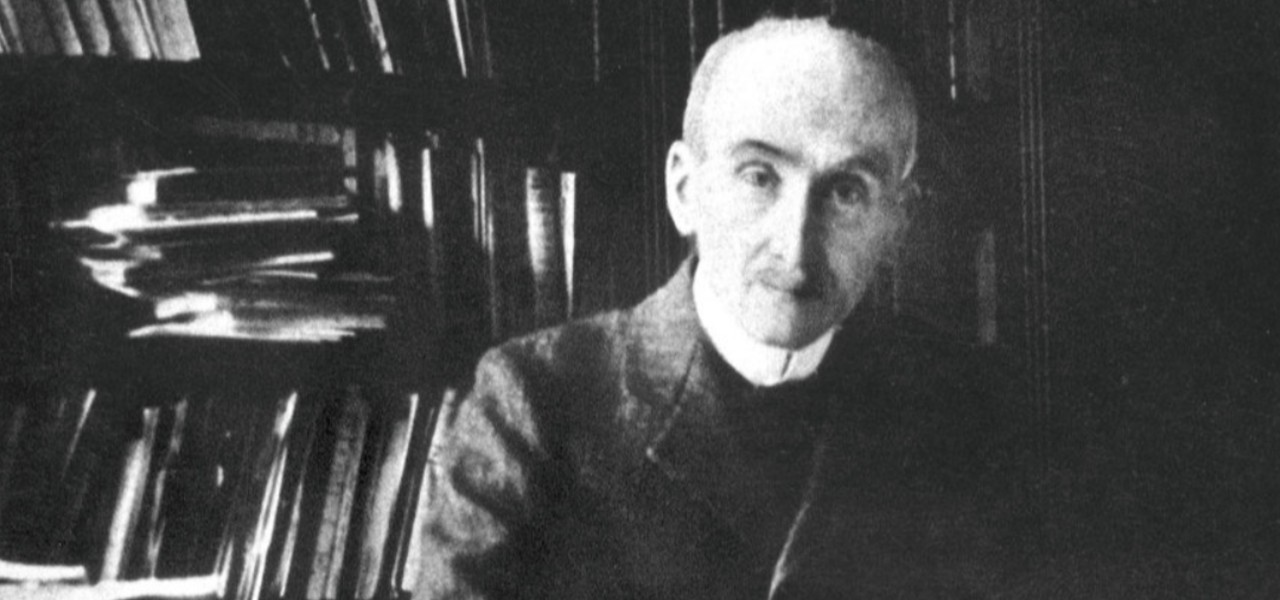
The following fragment was found only recently among Henri Bergson’s Nachlass. Written in his hand on a loose leaf of paper folded and tucked into an obscure volume from his library, it has been overlooked by his literary executors and archivists until now. Having consulted with a number of leading Bergson scholars, we conclude that it was never incorporated into any of his published works. For context, however, several of these experts noted that whereas an interest in paranormal phenomena might seem embarrassing to us now, it was not at all uncommon among respectable thinkers in Bergson’s day, including Marie Curie and William James, who investigated such phenomena with curiosity and skepticism, rather than treating the possibility with withering dismissal. Bergson’s reflections here almost certainly relate to his acquaintance with the Italian medium Eusapia Palladino, likely dating the fragment to approximately 1906. Translated from the French.
Suppose that there were certain human abilities—I decline to call them merely mental, lest all the problematic assumptions of the Cartesian philosophy be imported at once—by which the gathering of thought and concentration and will might move matter, with the addition of only one further condition. This condition being not the familiar (though inexplicable not only to the dualists but inadequately captured by the idealist and materialist philosophers as well) realization of will in the movement of the human body (my will raises my arm, my arm raises my glass), but instead that condition of fully sincere and passionate belief: one’s will (here I cannot say “mine,” as I have never discovered such an ability in my own experience) raises one’s glass into the air directly, no more defying gravity than does an arm and hand, but countering force with force, here that force formed by an adequate strength of belief, rather than muscle.
Again I say suppose. Descartes was correct indeed that a properly philosophical turn of mind, and its modern manifestation in true scientific understanding, must be animated by skepticism. But could it not be that with such skepticism what we gain in understanding on one front we lose on another? Because suppose not only that there were such abilities, but further that just as belief multiplies the force of one’s will on the world, dis-belief divides and diminishes it. Were all this the case as, I am speculating, it could be, we might expect testimony from true believers of their abilities to rearrange the world with will alone—yet within a set of limitations. First, if belief is one of the forces of physics, only as yet not understood by the physicists—indeed not understandable by the physicists until they effect a reproach with the metaphysicians—but only one of many forces, then belief should not be expected to be infinite in power. It might move but molehills, not mountains. The most plausible testimony of true believers would thus be of actions dismissible as baubles: bent spoons, etc. Those thought to be directing the paths of monarchs and nations, or the sun and rain, should still most reasonably be judged delusional. But, second, if dis-belief too is also a force, then, most significantly, even the truest believer would be unable to ever demonstrate any such ability in the presence of a disbeliever.
So long as we are supposing, let us unspool the implications of these speculations a few turns more. One can imagine that those in possession of such abilities would want to see them recognized by others, if only to confirm their own soundness of mind, but also that recognition would be available only from those who already believe and so whose evidenceless opinion carries the least weight. Any attempt to convince the disbelieving would fail due, definitionally, to their very disbelief! Thus would a liminal space between initiates and the open-minded become the site of shadowy experiments. We might expect, too, that abilities would be inconsistent and variable: candles guttering rather than definitively flaming or being extinguished, tables dancing rather than levitating at length. Putting my own recent personal observations together with this theoretical hypothesis, I venture that belief and disbelief are not positive and negative numbers on one and the same spectrum, but instead forces contrary, yes, but not of the same type: any modicum of disbelief seems capable of countering any aggregation of belief, no matter how great. Thus does one skeptic silence the seance. But what abilities (to move the great stones of Giza, or at least those on the Plain of Salisbury?) might a people truly unanimous in belief achieve? Does this all ring of casuistry? But can one prove the casuists wrong?
I do not believe myself to possess any such abilities, though that is perhaps to say that I do not possess them because I do not believe myself to: the direction of the arrow of causation, as the more thoughtful scientists describe, can be misread. Instead, the sense in which my own experiences are perhaps relevant is that I have yet to unlearn as fully as I would have wished my early Cartesian schooling. Where his meditator takes on a method of withholding belief in the absence of certainty, indeed believes only what can resist any possible grounds for disbelief, should not a better skeptic instead aspire to neutrality? If I could train myself to occupy such a mindset, could I observe what heretofore my mindset might have been the very counterforce to? I note, however, that whatever powers the will might potentially possess, it does not possess the power to bring about belief. I discover that and what I believe or believe not; I do not—cannot—choose it. Thus if, because of the strength of their belief, some can will motions, even if only slight, in the world that the rest of us cannot, they would seem to find themselves having been graced or damned (such language now seems not inappropriate) with such abilities—not having chosen them, not being able to foreswear them.
I find myself in a thicket and will have to revisit these thoughts another time.

ABOUT THE AUTHOR
Ben Roth teaches philosophy at Emerson College. Among many other places, his fiction has been published by Santa Monica Review and North Dakota Quarterly, his criticism by AGNI and North American Review, and his academic writing by the European Journal of Philosophy and The Journal of Aesthetics and Art Criticism. He has been recognized for excellence in teaching by Harvard’s Bok Center and nominated for a Pushcart Prize.

