
By Steve Finbow.

Tony White, Phantom at the Feast (No Exit Press, 2026)
The morning is a grey monotony, all that writing about dead televisions and the sun shining having no alternative. What one finds in London is that the buildings precisely match the colour of the weather, and if there is wet asphalt outside, then there is a decommissioned police station lurking somewhere for some reason. In London, one sees the nothing new adjacent to the nothing familiar. An uncanny city full of ghosts and the projections of its future cyber citizens.
Detective Sergeant Rex King does not move, at least his body remains still, sitting before a steel desk – the mass-produced furniture, a flat-packed metaphor for the police procedural. And, for this detective, it is the “readiness-to-hand” reality of a heavy brass horseshoe, totemic relative of the more mundane glove, bus ticket, cracked phone, bent key, beer can, broken necklace, smashed watch, parking ticket – the “presence-at-hand” clues that normally litter a crime novel. For Sergeant Rex King, the clues he usually parses are more of the linguistic kind: “Relax, free, each, foreseen, horseshoe, breakthrough, Red Sea, Rosyth, globe trotter, rook, titans, town planning, resemble, obsolescence, utterly, reheat, clip, three-foot, hack-saw, taxi rank, bacon, arboreal.” For this is not your average thriller, this is your exceptional experimental crime novel.
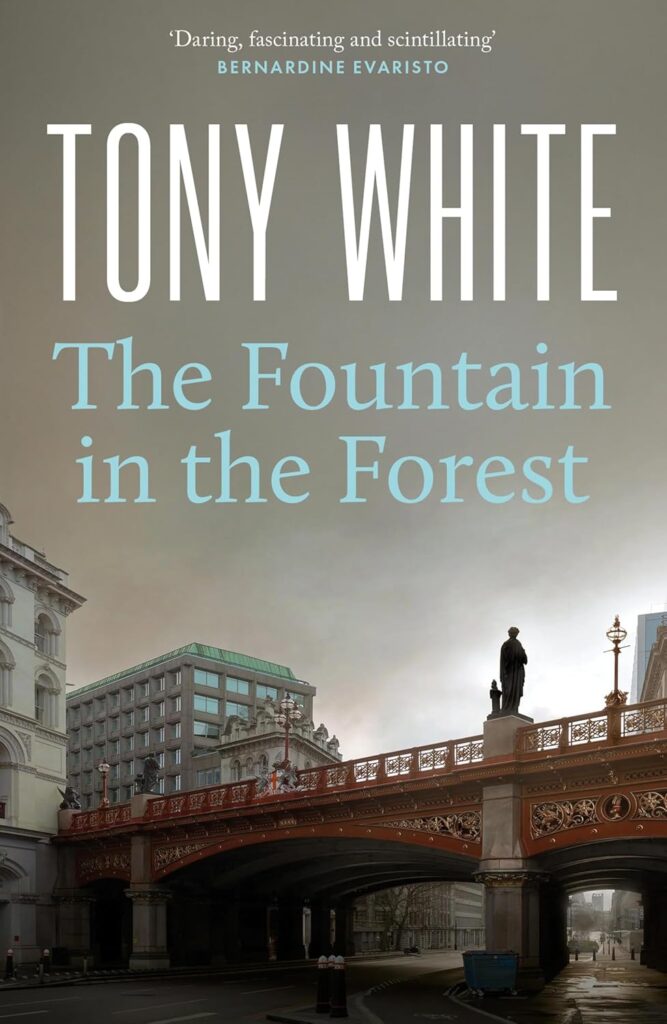
For Tony White to write a sequel to The Fountain in the Forest, to merge the avant-garde with the whodunnit, and to base his novel on the investigation of a murder in London, is to purchase a soft pink friable eraser – much like Wallas in Robbe-Grillet’s The Erasers – and to rub out much of what has gone before in crime fiction. The clues – like the brand of the eraser – are effaced and the walks through the chartered streets, searching for a specific texture, a specific clue, merely returns one to the point of origin but one that is also and always the point of departure. The geography of the metropolis is a topography of the imagination, the streets are the gyri and sulci, and King’s trajectory – and White’s narrative – are only so because of the synoptic and systemic structures inherent within them.
To reveal the plot would – like Henry James’s insistence on the retelling of dreams – lose a reader. But then, James may never have said that, and the sentence I have just written is a false clue – a read herring. However, as a main storyline, the Home Office insists that artificial intelligence should replace the human detective, that an algorithm can bypass the grime and solve the crime, even if there is no excitement involved in doing so – but seeing as AI continually hallucinates and is built on the sycophantic Asimovian rule of pleasing its masters, then all criminals may become aggregations of Cesare Lombroso’s phrenological profiling and phantasmal cartoon characters created by Albert Hofmann reimagined by Pixar. The bureaucracy desires (in that cold-shower-masturbatory sense) to erase the human, to rub out the variable. But what it does not reckon for is that humanity is – mostly – a dark smudge that remains beneath the most clinical formalism.
King’s horseshoe – the pages of the novel – have a weight that belongs to another decade, both objects return us to a past in which community matters, society exists, and people still give a fuck about other people. But White does not overdo this; the CND symbols and demos, the 2011 UK riots, the historical societies, are integral to the crossword grid squares of the narrative as much as the police officers and the human traffickers. As D. H. Lawrence noted: “The novel itself lays down these laws for us, and we spend our time evading them. The man in the novel must be ‘quick’. And this means one thing, among a host of unknown meaning: it means he must have a quick relatedness to all the other things in the novel: snow, bed-bugs, sunshine, the phallus, trains, silk-hats, cats, sorrow, people, food, diphtheria, fuchsias, stars, ideas, God, tooth-paste, lightning, and toilet-paper. He must be in quick relation to all these things. What he says and does must be relative to them all.”
That noise – what is it? Is it the novel’s tremulations on the ether? Or is it the National Crime Agency’s advanced AI terminal humming and whirring? A machine of human construct that’s only raison d’être (resistor d’être?) is to process data lines in order to reveal what the human eye misses. And so White creates a parallel London, a site of doubles and duplicity in which the human and the algorithm (who is the symbiont?) are reminiscent of China Miéville’s The City and the City in which the citizens of Besźel and Al Qoma occupy similar geographical spaces that are two different and distinct loci, their existence (their haecceity) is only so if they rigorously unsee the “other”. The computer program is trained to unsee the anomalies, to partition reality into neat, legal categories – the future is Kantian. But King cannot unsee: “When you were investigating pure evil, crimes that really shouldn’t happen but you were watching them happen over and over again, an unseen yet pervasive and statistically – sadly – wholly predictable tide of sexual violence lapping away just beneath society’s surface, something had to give, and sometimes that something was you.” But there are many unseen things – unseen prey, unseen cicadas, unseen events, unseen sheets of white A4 paper, unseen blackbirds, unseen water, unseen phones – as if White is reifying, thing-making the world as an alternative to the de-thing-ification of the digital.

The lever-arch files are real, their materiality sits before King as a kind of bleed from the past; and that past is the space and place of the death of society, the 1984–1985 Miners’ Strike – a cold case that the power structure wants to keep buried. And like the twin cities of Besźel and Al Qoma, the history and the architecture overlap; they occupy the exact same physical space as the human corpse – at once absent and always present – two distinct eras breathing the same air but metabolising the oxygen in different ways: “Rex knew that a former Home Secretary had admitted to holding back thirty files relating to the Miners’ Strike, even as they were rejecting calls for an ‘Orgreave Inquiry’. And those stated thirty files had presumably been just the tip of the iceberg, the thirty that they could get away with admitting to the existence of.”
David Peace has also mapped this territory in GB84 – all of it in the dirt, in the strike, in the dark. There is a Marxist progression/retrogression here in which no events are separate, they are the same event, injustice repeating across forty years, an incantation of institutional corruption, of the abuses of power; an indelible memory of the destruction of community and family that cannot be broken or appeased by a computer program producing a procedural report. History is not an amalgamation of facts, it is a rhizomatic and qualitative multiplicity of emotions, feelings, and living connections. The past is the phantom at the feast, the future is the regurgitative effects of how we analyse the past. But as White knows and as D. H. Lawrence insisted: “The business of art is to reveal the relation between man and his circumambient universe, at the living moment.”
Despite its knowing experimentation – or because of it – White’s narratology is vacuum sealed. Yes, the plot advances and expands, but there is a tight rein, an understanding of pressure. Detective Chief Inspector Lawrence vanishes. A missing person – a misper. One thinks of Anton Vowl in Perec’s A Void – a void so total it twists linguistic form, subtracting a vital glyph and forcing narration to curl around a constant gap – behold an unseen wink to Oulipo. Without DCI Lawrence, the department begins to stall, time slows down, one of the binary functions is glitching.
White and his protagonist know the streets of London – and, like in Mrs Dalloway, London is one of the main characters in this novel. Soho – its psycho-metamorphosis from gang-ruled, red-light, seedy establishment, and Italian delis to the centre of digital entertainment – like King’s memories, still holds enclaves of the authentic: “And now here they were, eking out their first-anniversary celebration for a few more days with some extra treats. Yesterday Annie had picked up a cake from Soho patisserie Maison Bertaux, a local treasure to which Rex had introduced her one cold, dark winter’s afternoon. And tonight they were having a takeaway.” The past haunts the book, the London of Chris Petit’s Robinson or the multi-layered, mythic ruins of Michael Moorcock’s Mother London, or the time-shifting echoes of Iain Sinclair’s White Chappell, Scarlet Tracings. Phantom at the Feast – like London – is built on top of its own ghosts – The Fountain in the Forest. Every alleyway, every sentence, is an archive of financial fraud, human trafficking, pornography, and the mappings of storyline in the previous novel. Every brick in the city, every word on the page, retains the vibration of the past, one can still hear The Clash’s 1985 busking tour – a ragged, acoustic ghost trailing through the concrete poured over the corpse of punk.
King remembers his time as a spycop, a different name, a different purpose. He infiltrated the radical groups, became a shadow among shadows like the unnamed detective in Derek Raymond’s He Died with His Eyes Open. Like that detective, King spent his nights absorbing the identities of the casualties, listening to the voices of the dead until his own reflection in the dark window became unfamiliar. The boundary between the hunter and the collective trauma of the state is thin, easily punctured – the Factory is the state – Raymond’s unnamed detective has a similar ethos to that of King: “Most people live with their eyes shut, but I mean to die with mine open. We all instinctively try to make death less difficult for ourselves.” But whereas Raymond’s detective has a Cioranesque attitude: “Every day you amass knowledge in a frantic race against death that death must win. You want to find out everything in the time you have; yet in the end you wonder why you bothered, it’ll all be lost,” White’s King has a resigned vitality: “When was he ever supposed to have the time to file this stuff? It was tempting to simply chuck the lot in the bin. In the unlikely event that there was anything really important in here, and some vital task that had gone unactioned as a result, someone would soon make a fuss. You could guarantee it.”
King’s Bergsonian élan vital – his desperate quickness – means that, rather than kicking down doors and Millwall bricking suspects, he waits, seized by a particular hesitation, a profound reticence reminiscent of Jean-Philippe Toussaint’s anti-detective novel Reticence, in which the traditional momentum of the mystery genre is short-circuited by a profound, pathological inertia. In Toussaint’s and White’s hands, the procedural mechanics – clues, observations, the looming threat of surveillance – are stripped of their kinetic function and converted into a pure, agonising phenomenology of delay.
The typical detective novel relies on a cascade of active deductions to force open a narrative; here, however, investigation is re-envisioned as a slow, entropic freeze but not to the point where AI’s cryogenic formulations cannot be undone, thawed, and re-autopsied. Michel Foucault notes that the Panopticon’s ultimate triumph is to make power automated and disindividualised, a permanent gaze internalised by its subjects – this is also a perceptive description of the novel and novel writing. King becomes both the instrument and the prisoner of this apparatus, shifting from an agent of the state to a dociled captive of his own hyper-observation, memory, and compassion. Like all great crime novels, the truth is not a revelation, it is a gradual calcification of options and the sovereignty of facticity.
White sees the future as a pure Baudrillardian simulation where the real has been entirely substituted by the signs of the real – the emboldened words are the arbitrary and the arbitration: “Run-around, Hobbs, enable, hydrant, numb, scorn, soluble, aspirin, nasal, hurrah, apostrophised, looks, Eamonn, Basil Rathbone, sheet, Botha, on shore, chamber, rosette, indeed, avow, ormolu, Atlanta, sweat shop, opossum, social.” In the future, the detective no longer solves crimes, but merely maps a pre-established circuit of information – a hyperreal apparatus that requires no actual criminal, only a clean algorithmic grid, rather than the messy business of the horseshoe-filled gob: “What was it about this investigation? You could hardly call it a mess. That was the problem. It was too neat. He might as well have been abducted by aliens.”
Phantom at the Feast is a site of resistance combatting the dystopian horizon of the AI literary industry: a future in which all fictions are merely mechanical maps, pre-established circuits of dead information, hyperreal apparatuses that require no actual act of writing. Against this algorithmic flattening, the novel – and this novel in particular – stands as a site of stubborn, human friction, or as D. H. Lawrence put it: “The novel is the highest form of human expression so far attained. Why? Because it is so incapable of the absolute.”
*

ABOUT THE AUTHOR
Steve Finbow’s forthcoming works are In Extremis: the A to Z of Francis Bacon (Infinity Land Press), The Disorder Diaries: Chronicles of Neurological Conditions in the Arts (Iff Books), and the novella House of Contagion (Incunabula).

