Ewan Morrison interviewed by Chris Kelso.
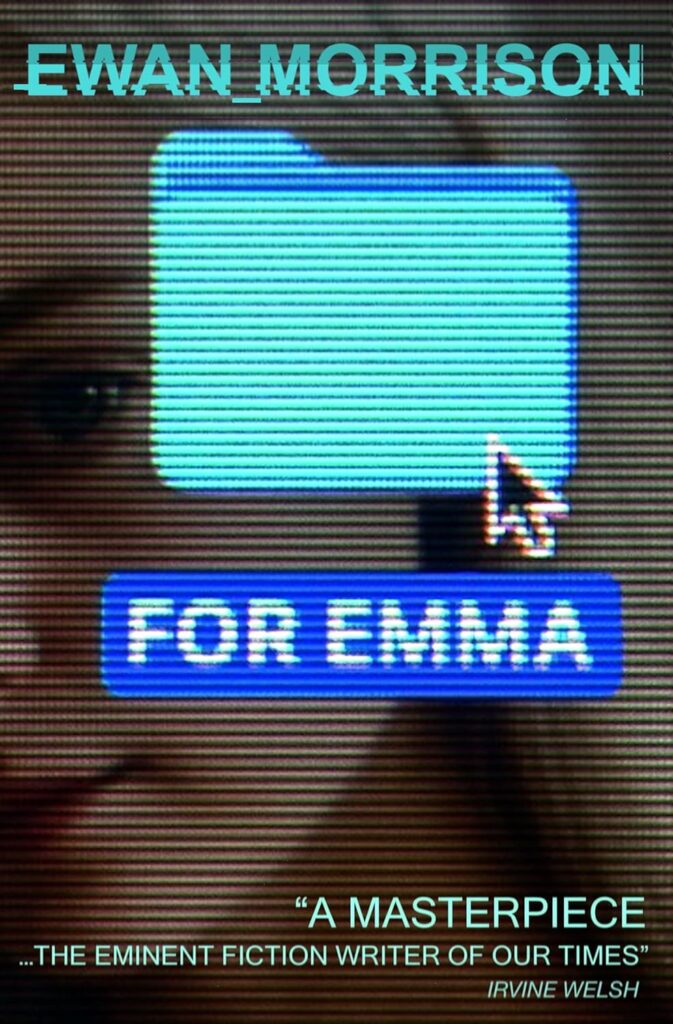
Ewan Morrison has spent a large part of his early writing career as a stoic cultural agitator. Morrison’s glacial intelligence and apostate attitude towards the popular milieu made him something of an enfant terrible in the Scottish literary scene (along with writers like Irvine Welsh, Graham Rae, Ian Banks, Laura Hird, Duncan McLean). Now, in the Late Spring of his career, Morrison is finally ‘Finding Time Again’ – wiser, tougher, more determined than ever, and fuelled by a renewed personal manifesto of human empathy. His new novel For Emma is a compression of this latest shift. Morrison gives us Josh, a domestic terrorist cored of his rational faculties by a world which haphazardly seeks to dehumanise him. The final thread frays loose when Josh loses his daughter, Emma. As T.S Eliot reminds us, ‘humanity cannot bear much reality’. In the Age of Anxiety, Morrison is exactly the kind of artist who can lead us through the fog of war.
*
3:AM: For a while now, you’ve been writing lovely little think-pieces focusing on the bleeding edge of technology on your X account, but this new novel still feels like something of a departure for you – on the surface For Emma is a paranoid tech-thriller-cum-revenge-fantasy, but the subtext seems profoundly concerned with the hollowing out of the human spirit. As a result, the book feels more cautionary. Of course, a lot of similar themes and preoccupations are explored as with your previous work, but would you agree there is a kind of ‘haunted’ dimension to this novel?
EM: Yes, you put it very well, the subtext of the novel is profoundly concerned with the hollowing out of the human spirit. But, I think this has been going on in my writing for over twenty years – since I made the short film ‘I Saw You’, which was a reaction to city-wide street CCTV and the ways we internalise the surveillance state that is there ‘for our safety.’
It is just that now, many technological and human-control processes are coming to a head in our cultures and the hollowing-out is happening to all of us. We could list many symptoms of this, the growth of AI which is preying on and destroying culture, the growth of managerialism again aided by AI, which is reducing our lives to numbers in controlled systems, the rise of bio tech and big pharma interventions within the human body, the expansion of facial recognition technology and pre-crime systems that predict who will commit crimes, the criminalisation of free speech under hate speech laws. I could go on with many more examples, but the essential thing is that all of these technologies join together and support each other and what we call the hollowing out of the human spirit, I could equally well call the rise of authoritarian managerialism or the reduction of human life to systems management.
3:AM: Is this something you’ve been worried about for a while? It sounds like you’ve had this rattling around in your mind for a long time.
EM: Back in the 90s I was worried about this and most of the writers and analysts I read (Bauman, Baudrillard, Debord, Ellul) were warning about the coming of globalised technological managerialism as a new all-controlling form of authoritarian governance. A fusion of state and big tech that we could call techno-fascism or the techno industrial complex. Most of my early novels and stories were really a kind of anarchist or libertarian quest to find other ways to live that were beyond the control of the growing technologically enabled human-management systems. So Swung was about swinging, Menage about a ménage à trois, then there was perversion and long distance love, hippie communes and collectives – all wild attempts to break free of planned lives that are controlled by systems.
3:AM: You’ve got me thinking about Burroughs. It reminds me of that bit in The Soft Machine, when we discover citizens are reduced to comatose lumps of protoplasm – they become a kind of human Playdough for the tyrannical elite. Obviously, we’ve previously worked together on the ‘Burroughs and Scotland’ project, and this discussion around ‘systems of control’, strikes me as a very Burroughsian preoccupation. That’s hardly revelatory, but do you think this should always be a motivation for an artist – to assemble against these systems, to resist the hollowing out of the human soul? There seems to be a comorbidity there between these structures in place and the slow liposuction of the soul.
EM: Yes, Burroughs was a huge influence on me as far back as my late teens. His Nova Convention, his cut-up technique and wonderful audio readings and his theories of how to escape systemic control. Even in my later books, Nina X and How to Survive Everything, these have protagonists who are trying to break free from systems – so Nina is about a cult escapee and How to Survive Everything is about a group of survivalists who live off grid. I suspect what you’re sensing with For Emma is that my long, manic search to find alternative ways of living has come to a conclusion. For Emma is the first of my books in which ‘the system has won’. In this case it manifests as a daughter, Emma, a scientist who has a Big Tech AI chip inserted into her brain and who dies, like a lab rat in a death that is then covered up by the Bio Tech corporation, Big Tech and the state. So, the techno-state has won, the struggle is over. Her skull, literally in the novel, is hollowed-out, as the computer chip kills her living brain and leaves dead grey matter. There’s a line in the novel where her father, Josh, is watching over her in hospital and the results of her brain scan MRI show a black emptiness inside her skull, where Emma’s active brain once was. The pains he feels after, he describes as ‘emptiness in my chest’, ‘ a hollow ache’.
3:AM: I suppose an artist’s worst nightmare is this ‘hollowing out’, such is the intensity and connection to the creative impulse; to be once so full of visions, then suddenly bereft of a single original thought. This is how these control systems achieve the ‘hollowing’ effect, by processing the creative landscape into a streamlined intellectual wasteland.
EM: And there is ‘The Hollow Men’ by Eliot, that sense of having been defeated by systems, in his case by war. So, yes, I think Josh is a hollow man, an anti-hero, a man struggling with deep emptiness after the death of his daughter Emma and unlike all my other anti-heroes, Josh is beyond belief in escape or in an alternative society or way of life, no, he is defeated, utterly and humiliated by the system that covers-up the truth about the CEO and the corporation that killed Emma. From that hollowness, Josh has only one option he can see left – suicide, but a suicide in which he ‘takes the evil with him’ – a suicide-murder, or homicide-suicide. The book, which covers the 30 days before his act-of-justice, his bombing, is really an exploration of a character struggling against hollowness, emptiness, in a sense he is saying to the corporation who killed his daughter, you have hollowed me out and so I have nothing left to lose, take this empty heart, this aching empty body, take it in a million pieces as I spread my emptiness to you.
3:AM: Do you think everyone feels the toll of managerialism? Like the protagonist in For Emma, do you envisage a broader, social reaction of violence?
EM: I do feel that many of us are feeling defeated by systems and that we are losing or have lost our sense of autonomy and freedom. We are feeling managed, limited, controlled, under surveillance, and as a result, I think our civilisation is on the verge of an eruption of extreme violence, vigilantism and terrorism. It may even have begun. People are reading the Unabomber manifesto again, people are taking an interest in insurrections and (perhaps fetishised) in suicidally violent terrorist groups like the Weather Underground and Red Army Faction for the first time in decades. Even this week a medical insurance company CEO was hunted down and killed. I have a strong sense that people are feeling suffocated and trapped by tech systems, by social engineering, we are feeling like lab rats in experiments we never agreed to and didn’t see coming. There is so much tension and rage below the surface of society and Josh, I think, is a manifestation of that. Of what happens when you take everything from someone. When they have nothing left to live for, then they also have nothing to stop them killing others.
As for the haunted feel of the book, part of this is literal, in that it comes from Josh being haunted by the voice of his daughter, Emma, throughout the book, and that has a kind of melancholy poetics to it, the way memories erupt. But I also think that the sense of haunting has developed from ideas around ‘Hauntology’- the sense that we live in a trapped or frozen time in which technological systems are rapidly advancing around us, but our culture, our freedoms and our sense of autonomy are regressing and shrinking. This all comes from Mark Fisher, who I’ve become really interested in and whose insights and analyses I’m trying to push forward.
3:AM: For Emma feels like a future-memory in many ways. Inevitable and tragic. And there is a genuine sadness at its nucleus which feels different to the lonely, jaded nihilists of your Menage, Distance, or Swung. Does that reflect a different type of nihilism, a new stage of it?
EM: Nihilism has grown from a fringe thing to become dominant within our modern societies over the last twenty years. In some ways nihilism has spread so widely and doesn’t need explanation today, it’s become so normalised even among teenagers. I’ve written about this in an article called optimistic nihilists which examines the growth of this variant among Gen Z kids today. We can say that nihilism is the belief that nothing has any meaning, that life is without purpose, and this expands outwards into different forms of nihilism.
In existential nihilism, we concede that the universe is indifferent to human beings and our attempts to create meaning are futile. In epistemological nihilism we accept that nothing can ever truly be known. In cosmic nihilism, we accept that all organic life is a pointless accident in an indifferent and valueless universe. In political nihilism we expose and try to destroy all the ‘social constructs’ of systems and institutions. As Bakunin proclaimed ‘Our task is terrible, total inexorable and universal destruction.’ Then there was the Nihilist Nechayev, whose Revolutionary Catechism inspired Lenin. He said, ‘The revolutionary is a doomed man. He has no personal interests, no business affairs, no emotions, no attachments, no property, and no name… All the gentle and enervating sentiments of kinship, love, friendship, gratitude, and even honour, must be suppressed in him and give place to the cold and single minded passion for revolution.’
From this we get aesthetic nihilism, in which we claim that beauty is a construct that has to be mocked and taken down, like the Futurists and Dadaists who declared ‘Let everything be swept away … no more of anything, nothing, nothing, nothing.’ While in Metaphysical nihilism we claim that truth and meaning and purpose are all impossible.
When you are a nihilist, as I was, there is a certain kind of self-sustaining scorn that comes with the lifestyle, a certain kind of superiority that emanates from being a sneering nihilist who scoffs at all the pathetic deluded little people out there who cling to their values and traditions. Life is a joke, hahahahaha, the nihilist says, and we laugh at everyone who thinks they have an answer or any values. I say this as a former or recovering nihilist, who finds that, to quote The Smiths – ‘the joke isn’t funny anymore’.
After twenty years of writing about nihilist anti-heroes, people who are anti-establishment and who try to live without values or goals or big T truth – I reached a kind of dead-end and had to look at what this anti-belief system that I and my characters had been trying to live with really is. There is a fun phase to nihilism, it’s the stage of anarchy and punk, the joy of singing ‘No Future’, spitting in the face of conventions that feel oppressive – drawing a moustache on the Mona Lisa. This is the early liberatory phase of nihilism and most people never make it past that point. But if you go deeper into nihilism, as I couldn’t stop myself doing, as it is a kind of vortex that sucks you in, this worldview in which nothing has any value or purpose becomes demotivating, and this is something that the characters of Josh and Emma fall into in the novel.
Emma asks ‘why’ of everything – and Nietzsche once said that the definition of nihilism is the failure to answer the question why.
Why work, why eat, why save money, why believe in your country, or any political party, why have a home, why have a relationship, why read, why care about your own future? Why not reject everything? After destroying the ground on which other people stand, you realise you have also just destroyed the ground under your own feet. You realise you are like that Coyote in the Road Runner cartoons, you have stepped off the cliff and are standing on thin air – and then you fall.
3:AM: I suppose there is your own predisposition to that kind of viewpoint which we must consider.
EM: I’ve had two very hard periods in my life in which came about through getting stuck in the ‘nothing matters’ mindset, obsessively reading Schopenhauer, Nietzsche, Cioran and Zapffe, all the nihilists, and circling in cycles of suicidal ideation and distraction. I grappled with addiction as distraction from the aimlessness of having nothing to believe in, and fell into deep depression. Yes, fell is a good word for the way it feels. I had to confront the negation and suicidal ideation that has plagued the characters in nearly all my books and deal directly with questions of purpose in life, after coming to the realisation that I, and my characters, really can’t go on living without belief in anything anymore.
So, in a sense, you are right, the earlier books were about the playful negation stages of nihilism, the rebellion and rejection of society and this book has crossed the line into the consequences of all that, just as our society has accelerated into widespread nihilism. This is not a sad book as much as a very serious one, that tries to answer the question ‘Why?’ Why should we live? Why should we care? Why not kill ourselves?
Nihilism today is causing the political and cultural tremors we feel under our feet in the manifestations we see from ‘Black Pilled’ ‘Doomers’ and ‘Incels’ to Black Pilled far right militias, from ante-natalists to trans-maxxers, cyber-communists and transhumanists with their beliefs that all human limits must be breached. Nihilism is at work across both sides of the polarized spectrum, from trolling and Incels committing suicide and high school shootings, to activist groups burning churches, tearing down monuments and attacking, censoring and silencing people who they see as their enemies. ‘All values are social constructs,’ this nihilist logic goes. ‘There is no truth, only your truth versus our truth… So you must be destroyed.’
In the book, I dig into how the growth of 21st century nihilism has also been greatly facilitated through technological progress. Gurus of Silicon Valley now openly state that they are ‘building a machine to replace God’ and many now see technological progress as a new secular religion. Technologists and ‘Dataists’ believe that if we follow science, and harness the power of big data and artificial intelligence, we will be able to construct a technocratic, scientifically managed ‘sustainable’ utopian society. The transhumanist movement is also predicated on the belief that by merging man with machine we will be able to transcend human frailties and, at some point in the future, defeat sickness, suffering and death through becoming Post-human, then the A.I ‘singularity’ will be achieved, and all questions answered by an all-knowing omnipotent artificial mind. At first glance, technologism seems like a powerful new faith to supersede nihilism.
However, this, new ‘belief’ is really just a symptom that breaks our connection to truth and accelerates the destruction of values. From techno-theology, Nihilism proliferates in every direction. All our lives are now mediated by smart tech, in everything we do – from shopping, to eating, to dating, to working – we rely on apps to make choices for us. Smart tech monitors our bodies, our transport and our homes and polices the language we use; the internet trains us to crave distractions and offers us endless dopamine rewards. Social media fragments our concentration and offers us so many pieces of info to believe in that we end up believing in nothing – the infinity of digital ‘content’ choices produces meaninglessness. In this state, the fragmented, non-binary, plural and temporary replace the unified identity and the trans-person emerges as the forerunner of the transhuman. ‘There is no such thing as male or female’ queer trans activists protest, ‘all definitions are oppressive constructs.’ Again, being a ‘destroyer of all values’ becomes an identity in itself. Hiedegger, Ellul, Bauman, Baudrillard, and Postman all warned us of the role technology was playing in accelerating nihilism and social fragmentation.
In the book, Emma, the young scientist, attempts to solve the problem of her father’s nihilism and depression by joining the techno religion, and it is a tragedy, because it is the wrong way out.
When constructing stories and characters and asking myself questions about purpose and goals, my experience confirms what psychologists like Frankl, Haidt and Yalom have been telling us – that human beings need ‘meaning and purpose’ in life, otherwise we become ill. We are ‘pattern seeking apes’ ‘meaning seeking animals.’
So, yes, the new novel is the first of my books that sees nihilism as a huge problem and looks for an answer to it. Josh is haunted by his dead daughter but also haunted by the lost futures he could have had with her. The imagined technological innovations in the novel as well, are variations on hauntings, as are the lost stories of all those human lab rats in the story whose deaths and lives have been covered up.
I should also say that I was deeply immersed in Hauntological music when I was writing the book – Burial and The Caretaker, people again who had been found by Mark Fisher and who he worked with. Great artists, who are trying to express the sense that we are trapped in a time of reboots, rehashes, remakes, sequels and prequels — time has stopped and we live now among the ghosts of the 20th century.
I’d say the death of Mark Fisher also haunts the book. He was one of our only visionary guides to help us through this time of technologically induced stagnation and he died by suicide, at the age of forty-eight, in January 2017. There is a sense that he gave up, that the lucidity of his critique and perhaps his sense that we cannot stop technology, might have contributed to what killed him. I thank Mark Fisher at the end of the novel. His historical analysis, his predictions, the culture he loved, the music of Burial that he introduced me to; all these things were with me daily as I was writing, so in a sense he and his death haunted the book too.
3:AM: The intensity of parental love is an overarching phantom in For Emma – especially the specific dynamic between a father and a daughter. I’m curious if you mined anything from your own experience of fatherhood? As a dad to a young girl myself, I really related with the irrational, over-protective, highly vengeful impetus behind Emma’s father. It felt like a very specific nightmare scenario that only a father could identify with. Am I way off base here?
EM: You are actually spot-on. Yes, For Emma is probably a book grounded in ‘every parent’s worst fear’ and in my experience of being a father of two kids. People who haven’t had children have probably never had nightmares in which their infant child slips from their grasp and falls from a cliff, drowns in water, tumbles into a threshing machine, is run over by a huge truck – and they are just out of reach and you are helpless to save them. You wake suddenly, bolt upright, sweating and screaming aloud. This has happened to me on maybe three occasions, and it’s probably a perfectly healthy reminder from the subconscious to not let your infant out of your sight – stay alert, danger is everywhere. Of course it continues as your children grow, but you learn to give them a bit more space and freedom, to trust them around water, cliff edges, roads and threshing machines, and even around potentially toxic friends. And still there are some parents, who never let go of that anxiety, and never let their kids have any freedom.
So, yes, the premise of the story is that Josh, a divorced father, who has in many ways lost his daughter, Emma, already, loses her with completely with the finality of her death. He couldn’t save her, and he just can’t accept it, or get over the loss, he doesn’t even want to ‘get over it’. He’s haunted, there’s that word again, by all of the moments in their life together as father and daughter that he could have ‘saved her’.
There are forks in the road of life, in which he could perhaps have – if he had only known that her life choices would kill her at the age of twenty-eight – encouraged her to choose differently. She died in a Silicon Valley brain chip experiment, but weren’t there times, he reflects obsessively, when he could have discouraged her from going into science – when he could have accepted a partner she had who would have led her to move away from America – and would Emma ever have even started on her solitary passion for science, if he and her mother had never divorced and he had become so absent from her life? Maybe she would never have become a hyper-cerebral child if he’d just been able to answer just one of those questions she’d asked him about life and the universe when she was seven.
So, within the story, as Josh moves forward with the plan to avenge Emma’s death, and he hears her voice in his head, he is drawn back to obsess over his life with Emma, to try to discover the moment when it all went wrong and in which he could have saved her if he’d just behaved differently.
The question of ‘being a father’ here is also interesting, because Josh is a Generation X parent and he clearly has no role model who could teach him how to be a father. We discover that he was the neglected child of hippie parents, he never knew his own father and was raised by a mother who moved from one belief fad to the next (new ageism, Buddhism, sexual liberation) and from one partner to the next when he was a child. So Josh is not troubled by any of the more traditional problems of ‘the role of the patriarchal father’ – the ‘conservative, authoritarian and rule based dad’ which we see in the fiction of the baby boom generation, who so often tell their liberation tales of struggling against oppressive parents. No, Josh was born in the early 70s, into the laissez-faire, anything-goes ‘freedom’ of a mother, who was more concerned with her own liberation from values than she was with parenting. So Josh, as he has grown into adulthood, has had no idea how to be a parent to Emma. He doesn’t have rules or values or beliefs or traditions, he’s busking it. In her early years, she plays ‘the why game’ with her dad – Why do you have go to work? Why do we have to brush our teeth? Why are we alive? And Josh finds to his shame that he has no answers for her. This develops over the years until Emma, becoming a super smart teenager, calls him on it. ‘Let’s face it dad, she says, you’re a total nihilist.’
There’s a sense that he’s never known how to parent her, never had a belief system or value system to base anything on, and part of the tragedy of the story is that Emma in turn rebels against the nothingness and aimlessness that has overwhelmed her father, and this is what has drawn her into physics and neuro-physics – she wants to answer the Big Why for herself.
Back to your question though, yes, this was something I took from my own experience of parenting, and I was very much like Josh – “The Nihilist Parent”, the parent who believes in nothing and cannot even answer his child’s question ‘why are we alive?’ because to answer ‘I don’t know’ or ‘perhaps all existence is just a mistake’ would be to depress and demoralise the child. The parent who bluffs it for the sake of the child, who pretends they have answers when they actually doubt even the ground on which they stand. The parent who lives in fear of the child’s inevitable question ‘what do you believe in?’ and then the terrible one that follows “well, if you can’t find any meaning in life, then why did you and mum have me?’
In some ways you could say that For Emma is a tragedy about a nihilist parent who loses his child because she goes off to try to find the ultimate meaning for herself.
Actually, if it’s OK with you I’d like to share some sketched ideas, that formed the backbone of some chapters in the book but didn’t make it into the final pages. These are thematically too “on the nose” for fiction, but they say something about the problems of the Nihilist Parent:
I could have told your ever so curious seven-year old face that I was a nihilist. I could have taught you that the word Nihil means nothing. That not only did I believe in nothing at all, but my nihilism had grown into a kind of virus inside me that attacked all the beliefs of other people. It had become routine to shoot every single belief system and every believer down. It had made me quite isolated throughout my twenties, people found me judgemental and negative, but it had become a matter of pride since my thirties, to destroy the illusions of others. Nothing, I believe in nothing. Nihilism had been fairly commonplace among my generation, we the disillusioned who made a point of spreading our nothingness. What has value? What is beauty? Does love exist? No. Most of the cultural heroes of our generation had been nihilists too, Cobain, Foster Wallace, Seymour Hoffman, Winehouse, McQueen – overdoses and suicides all.
I could have told you, as you stared out at the freeway and we listened on the stereo, to an indie music star who we worshipped in our teens and who blew his brains out, that once you start deconstructing the ground others stand on, and watching them fall into the pit of nothingness, it is only a matter of time until you deconstruct the ground you yourself stand on, and like the fool sawing off the branch on which he sits, you’re fated for a fall. I could have told you that nihilism destroyed all sense of future goals and commitments for me. Why get married? Why have a career? Why have kids? Most of my generation used drink and drugs, promiscuity, affairs, perversions, addictions, even hobbies to distract our eyes from the void we were hovering over.
But I couldn’t tell you that, Em. And at that time, maybe you were as old as eight, I was struggling with the problem myself. Your mother said I was depressed but it was much more than that. I was sick with nothingness.
On that drive home to your mother’s house, I couldn’t have told you the truth, couldn’t have said, ‘Even as your father, I believe in absolutely nothing, darling. I don’t believe there is any purpose for mankind, let alone any kind of God, no reason for any of us existing at all. I don’t believe in progress, or equality or good or evil or morality or customs, I don’t believe in beauty or truth. I think that we evolved by accident, our conscious minds became over-developed and so our brains make us ask why, why, why of everything, but there is no ultimate answer to why we are here. No other animals ask why. We’re super-smart apes that don’t know why we exist, and it terrifies us, so we make up religions and belief systems and political systems to give ourselves some purpose in our puny and meaningless lives, because unlike the other animals on earth we find merely eating, shitting and fucking to be hollow and pointless. And even if we do discover something to believe in, our species will only be able to live on earth for another million years or so anyway, and then, as you know from your science books, the sun will expand, the oceans will evaporate and all organic life on earth will be extinguished. So, not only was our entire species existence without purpose, it too will vanish from history, history itself will vanish and that also will have been a pointless waste.
Who would throw their own daughter into that bottomless pit? There was no child rearing manual, no Doctor Spock for nihilists. Can you imagine, ‘The Meaningless Parent’ ‘Teaching your children disillusionment.’ Yes, it is quite funny, but in reality I needed a solution. To borrow a phrase from one of Grandma’s many self-help books, I had to ‘fake it till, I made it.’
No, Em, I couldn’t have told you these things, because with your child eyes you might have asked why, why, why, and then arrived at the question ‘is my life meaningless too, dad?’ ‘if you think so then why did you and mum have me?’
And if you had asked that, I would have had to have lied to you, made up some fiction, because in truth, when I was depressed like I was back then when I should have been teaching you how to read, how to swim, I had no answer other than one which would have terrified you.
‘I conceived you because I had to believe in something, darling, or I would have drunk myself to death.’
How could I have said that to your seven-year old face?
‘I made you my only reason to live, darling.’
How cruel to be a parasite on the life of a child like that.
But what could I teach you? How could I say to you, don’t hit other children? Sit up straight? Don’t pick your nose. Tie your shoelaces. Study hard. Do you see what a torment it was to me then, for you to always ask why? why? Why should I be polite dad?
‘Because you have to be good?’
‘Why?’
‘Because it’s what’s expected and because if you’re good and everyone else is good then it’s better for everyone.’
‘Why daddy?’
‘Oh fuck, I don’t know, and I don’t care, cos everything on this pointless planet is going to die anyway.’
Do you see how close you came to triggering the nothingness? So many times, Em.
Was I a fake father?
As I say this was a thematic sketch, not an actual sample from the novel. It poses the question that lies underneath the book, more directly than fiction should, but I’m happy to share it here because it reads better than trying to explain this philosophically.
In terms of the emotional texture, as always in my stories, I felt I had to try to capture a lot of the camaraderie and secret rituals found in family life, the private languages and goofy games played by people who love each other or have to endure each other in close proximity. So, in the novel, there are nicknames and puns, running gags and forms of teasing that Emma and her dad, Josh play with over time, and most heart-breaking perhaps is the sense that they are really, very much alike, united by some shared ‘dodgy DNA’ as Emma says.
I felt I had to go into this painfully private intimacy, some inspired by variants on my own life, because I had to try to get inside Josh’s skin, to feel what it was like to lose his daughter, once, twice, three times and then finally with her death. It had to hurt. So there is an interplay between sentimentality and total repulsion, just as in the book he remembers a song they used to sing in his truck on the trips back to return her to her mother’s house, while at the same time, he is in hospital with Emma in her coma-care bed, and he’s struck by the visceral horror of holding Emma’s cold hand and finding no trace of life inside her eyes.
I felt it important to try through the writing to viscerally feel what that would be like. As a result it was a very emotionally hard book to write, I gave up on it several times, because it was just ‘too much’ – but I was drawn back to it, like we are to mourning, as this grief felt like an important thing to write about and to share, and I would hope that the strained love of a father who couldn’t save his child and his blind vengeful fury come out on the page.
Throughout writing the book I kept asking myself – if your child was killed by a Bio Tech CEO, would you act in revenge? Could you? Can little people fight back against huge, remote, big money systems that control the lives of billions of people?
Actually, to be more honest, I asked that of myself, what would I do if a big tech or bio tech corporation killed my daughter and covered it up so that any chance of justice would be taken from me. The answer, I think, is the book.
3:AM: Do you think AI is wholly insidious?
EM: There is this mythology in Silicon Valley today, the idea or ideal that if all the AI engineers can just scrape all the data in the world and feed it into their AI systems, trillions of bits of information, then somehow, miraculously Superintelligence will emerge. Or at least advanced general intelligence (AGI), which is the point at which computers pass the Turing Test and become as intelligent as humans.
This is the belief in Big Data; of the people who call themselves “dataists”, and most of the famous people within Big Tech, believe in this form of emergent intelligence from data. If you like, the emergence of omniscience spirit from matter. They believe that the eight billion people in the world should all work together to create the “Internet of Everything” that will feed the super-intelligence. That every living thing and every machine should all be linked to one vast interconnected system, giving an endless feedback of data from our dietary needs to our happiness scales, to our daily exercise, to our geo-location and shopping choices, to our viewing desires and our mating and partner choices – all this data will be gathered together in the vast supercomputer, which will then grow to become this sentient, omniscient brain that knows all. This machine will then measure and calculate all human needs and solve all human problems. A kind of Digital Deity will be created, and it will bring us to the promised land of a 100% planned perfection. I call it a mythology because it’s an old story that’s just taken on a new form. You find a version of it in Plato’s Republic and then in the Enlightenment and the French Revolution. This idea of a Utopia, built on pure reason in which every human problem will be solved and its solution planned for and enforced. You find it again in Communism – it was the Soviets who first dreamed up the idea of the social super computer, and in fact you find people today, who think that the only thing that caused communism into collapse in the USSR, was that they did not yet have an intelligent enough computer that would itemise every object from every potato to every pencil to every condom to every tractor in one vast calculation for the happiness and productivity of everybody. This is a utopian mythology, and I studied utopia for the last decade, I don’t think there’s a utopia I haven’t read – and I’ve discovered that they are all flawed and all doomed to fail, precisely because the one thing they do not take into consideration, is human nature. In fact every Utopia must by necessity demand that human nature is a myth, that our true nature is empty or malleable – ‘blank slate’ – otherwise the idea of utopian social engineering would collapse.
The people who inhabit these Utopias, whether they are written by feminists or anarchists, or Marxist or libertarians are subhuman because it is impossible to have a perfectly planned society, filled with real existing humans with our complex desires, and our hatreds, and our greed, and our selfishness, and our competitiveness, because with all these vices we bring from history, and from our DNA, we will destroy that Utopia in no time at all. So every utopia that has ever been written from the 16th century to the transhumanist and ecological utopias of the last few years, every single one of them excludes, real human nature and real existing humans. The outcome of this in real historical terms is that whenever human beings attempt to build a utopian society – and every Utopia is the enforcement of a single plan for everybody – then this means that those people who do not fit the plan have to be silenced, then they have to be re-educated, and if that fails, as it always does, then they have to be gotten rid of. So every utopia wether, it is on an island or a lost land, or on a planet in outer space, has to have alongside it, a large Gulag or prison and the execution centre for all those who did not fit the Utopian plan. What is so dangerous about AI and the transhumanist utopia is that these believers in the Big Data Superintelligent machine that will solve all of our problems, have come to realise The main problem getting in the way of their Big Tech utopia is human nature, so the dataists, the transhumanists and the post humanists now write openly about the need to alter human beings. Literally change the species.
The DNA needs to be altered through eugenics so that we lose our competitiveness and our viciousness, our licentiousness and our greed and our propensity for violence. If you read a transhumanist theorist like David Pierce (co-founder of the World Transhumanist Association and author of ‘the abolitionist project’) you’ll see that his plan for pacifying, the species involves completely bio-engineering humankind, augmenting human beings, with technologies that restrain us from committing acts that cause pain to others, and not only that, his plan is to do this for every living species on the planet – that is 1.7 million species. Pain and suffering must be erased in his plan for the “abolition of suffering in all sentient life” and the only way to do it is to stop tigers from killing and eating other animals, to stop parasites from feeding on the brains of other species, to stop big fish from eating small fish, to stop viruses from attacking living cells. Everything must be modified by nanotechnology, by genetic alteration and by the meticulous plan of the super computer that will know everything and have every answer to every problem.
Put forward in this way, you can see that there are people who believe that artificial intelligence will bring about a utopia which will necessarily involve the extinguishing of the human species and every other species and the replacement with modified ‘improved’ variance on the species. This is genocide and a vision of hell and we can only imagine how such things would go wrong if they were ever implemented. Also, we can see that this is really the dream of genetic improvement and eugenics that emerged with the Nazis. Let us not forget that the Nazis were one of the biggest utopian movements of the 20th century. So I’m very much against the idea of the AI supercomputer that will solve all of our problems, and I’m against the means by which Silicon Valley believes it will achieve the supercomputer through turning every living thing into a data generating entity that will feed the supercomputer with all the information on everything that lives, eats and breeds. It is a mythology which is basically attempting to replace the old dead God of Christianity with a human-made God. It is a heresy if you are a Christian, but it is also the invasion of religious thinking into science if you’re a scientist. If the emergence of this superintelligence is the justification and end goal of all experiments in artificial intelligence, then I am against it, and I would if pushed become a luddite, and yes and I would plant a bomb within the building in which such a vast computer was being housed. Just as Josh plans to within the book. The other reason I’m against artificial intelligence is that I know it will not work and that nonetheless our societies are all being channelled into this dangerous lie. It does not need to work for example for us to head down the trajectory of the planned society and of eugenics.
Already, we know that Large Language Models (Chat GPT, Claude, Llama) are not a pathway to AGI or super intelligence, but that doesn’t stop the investment market euphoria around artificial intelligence that has investors pouring billions into these technologies and also tempting the desires for greater control harboured by the social engineers. These technologies will not achieve sentience or even human level intelligence, but with them we see increasing human dependence on these technologies and also we see the lowering of human intelligence to meet the machines halfway and the riseof surviellance technologies to gather all this data. If you look at the way that large language models work, there are so-called ‘machine learning’ is within a bell curve. They aggregate and take all the information available, and they sample the information from the middle of the bell curve – so they are creating averaged-out information, mediocre, middling. And the more we come to depend upon Large Language Models for writing our emails for us, for writing synopsis, for planning the workforce, for agricultural planning, for conferences, for scheduling, for medical pre-diagnosis, for facial recognition and pre-crime assessments – the more mediocre and average and mediated we become. Our AI machines are levelling machines that make us more stupid and more dependent on them. Not only that, but after companies like open AI have failed to even get on the pathway towards AGI and Superintelligence they have turned to the biggest way of making money that they can, which is to sell their technologies to the military. This happened in the first week of December 2024.
So these AI technologies with their lofty justification of creating a super intelligence Utopia, are actually just creating super-surveillance societies, where targets for arrest and targets for interrogation and killing are calculated by artificial intelligence systems that troll through our social media to – as the military AI system Palantir defines it – “maximise human target”. An AI will decide if you live or if you die. And these AI are only 80% reliable and they hallucinate and make errors in identification. So, in the name of this lofty Superintelligence that will save us all, we have instead a dependence on machines that police us, control our behaviours and turn us into beings that are less human and more machine-like.
Even Elon Musk commented on the anti-technological manifesto of Ted Kaczynski, the Unabomber, saying that “his ideas resonate” and that the Unabomber may have been right in his diagnosis of technological society. I find myself in agreement with a lot of what Ted K says in ‘Industrial Society and its Future’- especially when he talks about how our dependence on technology dehumanises us and through feedback loops leads towards tech acceleration. He also talks well of the ‘surrogate activities’ we engage within to fool ourselves into thinking that we have human agency, when in fact our lives are ordered and controlled by ‘systems’. I don’t agree with his techniques for fighting back, but I find it impossible to disagree with his diagnosis and his call for human agency and autonomy. It’s hard to disagree when he says, “The system has to force people to behave in ways that are increasingly remote from the natural pattern of human behavior” and when he says “Because of the constant pressure that the system exerts to modify human behavior, there is a gradual increase in the number of people who cannot or will not adjust to society’s requirements: welfare leeches, youth gang members, cultists, anti-government rebels, radical environmentalist saboteurs, dropouts and resisters of various kinds.”
Out of all the anti-tech luddites and lone avengers I studied, it was the writings and the tragedy of Ted K that had the biggest impact on me in writing this novel. He developed a critique that I’d known from Marcuse, Debord and Ellul, swung it away from capitalism towards technology itself, and helped me become a luddite probably. Yes, the line has been crossed and we have to at least restrain these technologies before they destroy our agency, while at the same time understanding that Ted K’s violent solution has only led to an increase in the technologies of surveillance and control.
I didn’t even get into the ways in which AI is destroying the arts, and how the AI start-ups would be nothing without the art and writing that they steal and scrape. That’s a big issue for another time, and I’m active in fighting against it and supporting the rights of artists.
3:AM: I spotted some interesting nods to Jungian Synchronicity and elements of Lacan’s psychoanalytic theory throughout the entries of Emma’s father. How important is it to shade in your work with these philosophical connotations?
EM: That’s interesting because if they are there, I didn’t consciously put them there. If there’s Lacan and Jung in the book, it might be because I was grappling with Freud’s later ‘pessimistic’ works at the time of writing and he was the well that they both drew from.
I recall when I wrote my first book of short stories back in 2004, I had a certain realisation that one of the problems I, and others had with my film scripts, was that they were ‘squeezing in theory’ (back then, when I was a filmmaker, before I became a full-time writer – I was also obsessed with Baudrillard, Debord and metafiction). So, this realisation in writing short stories around 2004, was that I didn’t have to squeeze ideas into fiction anymore, that in fact, it was wiser to keep them out and to let the stories speak for themselves. This was liberating, to ‘let the ideas go’ and just to try to truthfully describe the emerging social realities on the page. So back in 2004, I was writing about swingers and various forms of sexual experimentation. Was that influenced by my reading of Marcuse and Bataille? Hell yes, but I realised that no matter what you write, even if you just write about unscrewing a pot of jam, or going to the toilet, or shopping, some trace of your politics and philosophy will be in there whether you like it or not. They are like a tone, or an underlying way of seeing things – a mood, like neurosis in Woody Allen or melancholia in Krasznahorkai.
Whatever you are reading or thinking about as you write, will find its way into your text sometimes on subliminal levels. This can be psychology, sociology, philosophy or anthropology, but rarely ever other works of fiction. So, for example, two academics have found traces of the sociologist Zygmunt Bauman in my book Tales from the Mall. Bauman wrote some of the most powerful texts on consumer culture and globalisation (back in the pre-Clinton days when the left was very much against globalisation). I didn’t quote Bauman in the book or describe or illustrate his theories, but the very fact that I was willing to dedicate years of my life to the study of the facts and fictions around global shopping malls was itself a kind of Bauman-esque experiment. Inspired by him. He set the chemicals up and I mixed them up and tested them on humans, imaginary and real.
I think that if a writer writes from the position of a burning question that they must ask and tries to answer it through the form of a novel itself, then the books, films, situations and ideas they are exploring as they write will come to inform and be a kind of subconscious level to their book. If you, become obsessed with theories of transhumanism for example, say in the works of Ray Kurzweil, the chances are that you will frame your fiction in such a way that it grapples with AI and ‘the digital singularity.’
With For Emma, I think it’s fair to go through my reading list and see that I was obsessed, and in fact still am, by the questions of mortality, death-denial, nihilism, and with the very modern ways in which we now use high technology as a surrogate religion. By this I mean, technology now promises us immortality and the coming of a super-intelligent all knowing mind that will solve all of our problem- a digital deity, an AI God.
So, on the morality and nihilism front I was soaking up Peter Wessel Zapffe’s The Last Messiah; Nietzsche’s Will to Power; Freud’s Civilisation and its Discontents; Schopenhauer and Cioran – the arch pessimists, and there was one book which scared me and which I kept coming back to – The Conspiracy Against the Human Race, which is a kind of overview of anti-natalism by horror writer Thomas Ligotti (interestingly it also inspired the speeches of Rust Coehle in HBO series True Detective). In terms of how death shapes cultures, I was deeply immersed in The Denial of Death and Escape from Evil by Pulitzer Prize winning anthropologist Ernest Becker. All of these books, I have to say are terrifying when you take them together as they frame the problem of nihilism – and ask what if there is absolutely no purpose to life, and our species is an accident that will soon end. I had to, in a sense get to the very bottom of that question to see where Josh and Emma would end up in my story as I decided that this was really what their big problem was: a father and daughter both struggling to find a meaning and purpose to life. A father asking if life has any purpose after the pointless death of his daughter.
By the time it came to writing the story, all these writers and thinkers who formed the bedrock were forgotten as I focused on the problems of Josh and Emma, but by the fact that Josh is planning to commit suicide (at the end of the 30 day countdown in the book) and to potentially kill others, and indeed maybe even innocents in the process of his revenge suicide, begs the questions asked by the nihilists. What if morality is just a myth, a fragile little human delusion? In that sense, absorbing these thinkers has given me the courage to attempt to wrestle with their problem – a problem that our entire civilisation has been grappling with since the 1860s and that is still unsolved. If people we love are indifferently destroyed and the universe cares not one jot, then why endure it, why not kill yourself, and why not take others with you when you go?
So, all the reading and thinking I do, helps me frame the question the novel must ask. And novels have a specific role to play which is inherent in their form, which I at least, find is the best way to grapple with big questions about how we should live. Novels, I think, are humane hybrid ways to deal with the big questions that philosophers and sociologists and anthropologists and psychologists and scientists can’t answer definitively or on an existential level, in the flesh. And the human mess and disaster these thinkers create, also gets once again sucked back up into the form of the novel.
Taking a note from Kundera, I do believe that, historically speaking, the novel discovered the subconscious before Freud did, (and phenomenology before the phenomenologists), it is better at understanding psychology than modern psychiatrists and the novel is a kind of time travelling and inter-human device for exploring life’s possibilities. After all, Nietzsche and Freud both read Dostoevsky. So, in that sense, all of these thinkers in all their fields from psychiatry to anthropology and philosophy have been grappling with Dostoevsky’s question in The Brothers Karamazov, from 145 years ago, in 1879 – “If there’s no God, all is permitted”. We are all the great, great grandchildren of the first nihilists.
And of course, the technologists today, they present themselves as the people who will find the answer to the question of life’s purpose and meaning, Elon Musk even openly says that we live in nihilistic times and are lost and aimless, but that Space X and the colonisation of other planets will be the great solution. He even calls planet colonisation – a new religion. I think though that this isn’t solving the problem of nihilism at all, it is just spreading the problem further into the universe, kicking the can down the road. Technology is not the answer to our aimlessness and lostness, it only accelerates our inhumanity. We have to find meaning and value in each other, and that is maybe the tragedy at the heart of the novel.
Read our 2009 interview with Ewan Morrison by Andrew Gallix.
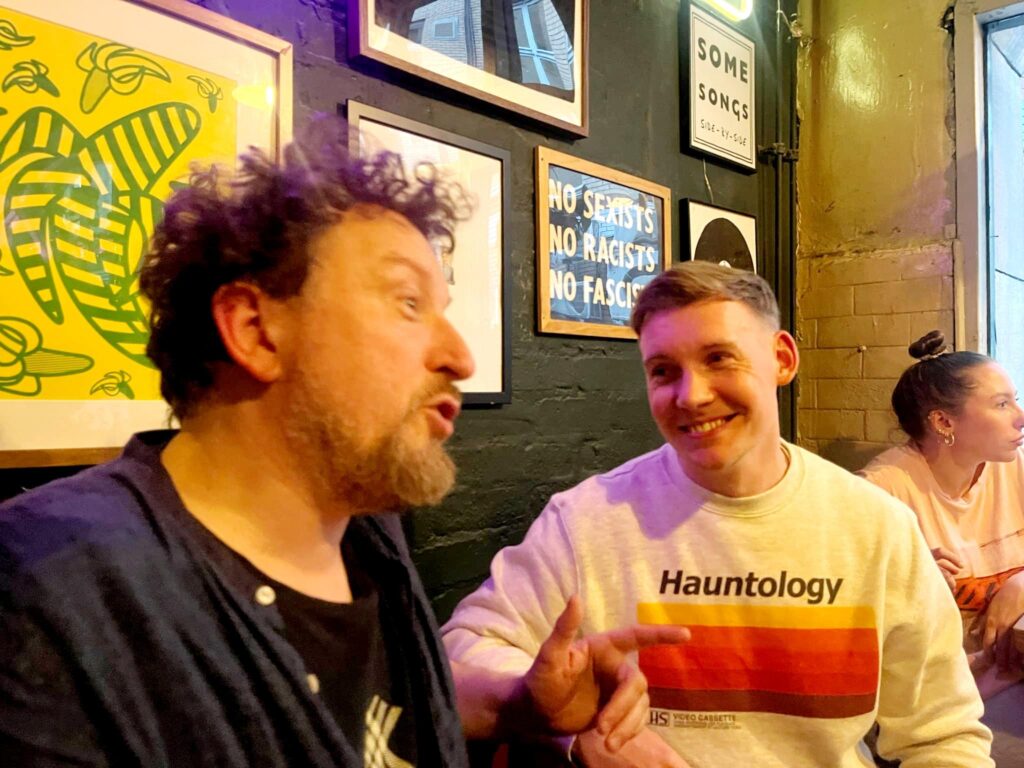
ABOUT THE INTERVIEWER
Chris Kelso is an award-nominated, multi-translated writer, editor, and illustrator from Scotland.

