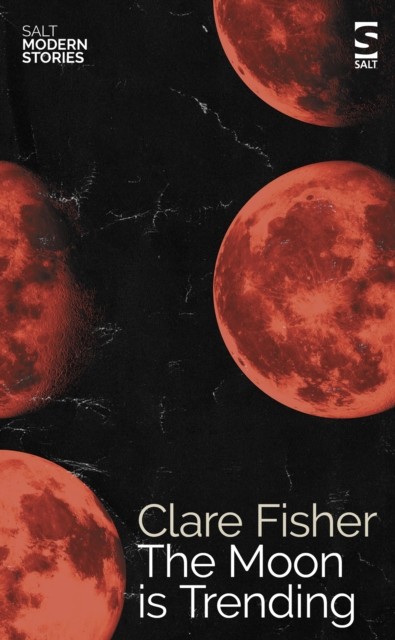
The Moon is Trending
The wordplay and structure of the stories excel in mirroring the meta-fragmentation of post-Internet/mobile/gaming life and late capitalist work modes, and the new, often distinctly odd, human behaviours that result from them. Many of the stories go into multiple asides before reaching their conclusions, capturing the sort of constantly interjected communication we now live with, the frivolity and baffling choice of infinite consumerism, information and distraction, and how these change the way we experience ourselves via our wandering concentration spans. In the first story ‘WTAF’, which starts with the titular sentence ‘The Moon is trending’, multiple stories run alongside and interrupt each other, each struggling for attention from the reader and the narrator.
Giselle Leeb reviews The Moon is Trending by Clare Fisher.

Never Have I Known a Single Goddamn Thing
Curtains part to reveal a ruminant fop, and the bland metal folding seat he seems to have poached from the vestibule. Lit by symmetrical overheads, the man straddles his chair in reverse, facing the audience with his arms laid atop the backrest. “Never,” he says, slowly standing upright, “have I known a single, goddamn thing in my entire life.” The catchphrase triggers wild applause, which fades as the player saunters downstage. “As a child,” he says, “I gazed into my future and found it wanting, hamstrung in essence from the get-go. It’s said that the nursemaids heard a wolf-like howling behind the oaken doors of my room each night, yet by the time they attended I would be dreary and cowed, and of course unrepentant.”
A short story by Eric Olson.

Minute 9: Largo Viaje
In the popular imagination, dead babies go to heaven to pray for those left on earth; they become tiny lawyers, representatives and advocates of those lucky or unlucky enough to stay behind. In this idea, and Violeta’s lyrics, which she picked up from conversations with people in bars and plazas during her travels through Chile, there is a belief in terrestrial reincarnation, similar to that of certain Eastern religions. Each death is mysteriously linked to the seed of new life; substance becomes abstraction, which in turn becomes substance. In the ninth minute of Largo Viaje, these themes are condensed or foreshadowed in the anguish or stoicism of a miniature portrait of 1960s Chile.
Jessica Sequeira on Largo Viaje.

Orpington to London Victoria #8 – George Berger Column
I’ve not written an introduction to any of the other chapters in this journey, but I fear that without one here, I might never get through it. Because this is the most emotionally difficult thing I’ve ever had to write. I feel, in turns, self-indulgent / exposed / vulnerable / open to disdain, criticism, even ridicule / overly negative / as though I may tread on others’ toes. Sometimes misguided. Sometimes just wrong. And yet, here I am. Writing it. Without obvious recompense of any sort. So, with what reason? I’ve been putting off writing this for months. I’ve started it a hundred times, mostly in my head, but occasionally on the computer. I’m frightened of the emotions it will churn up. I guess this is PTSD in action. Because what I’m about to write about is certainly the most traumatic thing that ever happened to me. How are you expected to fit that into mere words?
By George Berger.

Thermals
Dan dies and bathing obtains an implicit richness wherein, Nora tells me, a sudden onrush of water coursing over her shoulders obscures such feelings of grief and shame and insurmountable regret as have beset her these last long lonely months, showering, the water, hot as she can stand, and then hotter, reddening her skin and deforming that conical burl of sinew radiating up off her neck like a cartoon’s idea of pain, a column of steam ascending the frosted shower stall, a thick fragrant air, scattering as it rises, the stall’s panels grimed, spotted with boogers and hair and shards of hard mangy soap, all these bodily flickings, bits of me, bits of everyone, our whole family unit, Nora tells me…
A short story by Rod Moody-Corbett.

All This Was Dreamlike, Yet Real: On Witold Gombrowicz’s The Possessed
In his own Kind of Testament written in 1968, one year before his death, Gombrowicz expressed his yearning for the days ‘when Rabelais wrote as a child might pee against a tree, to relieve himself.’ He knew, of course, that those bygone days ‘when literature took a deep breath and created itself freely’ were long gone. So we can only be grateful to him that he had the impudence to follow Rabelais’ example: an ageless youth writing lightly of mature subjects, honest to the point of shame, regardless of the odds stacked against him.
Leonid Bilmes reviews Witold Gombrowicz‘s The Possessed.

Embrace of the Dream: The Work of Tina Mion
Mion takes things out of the shadows. Largely unnoticed by art critics, she is an example of an artist who offers a body of work that we must reckon with on our own without being told by the art world what to look at, what to think, how to assess. Mion’s work reminds us to consider how we overlook ourselves and forget to consider not our aspirational dreams, but the dreams that come to us in sleep and hallucinations, the dreams that emerge in our darkest times.
Lia Smith on the artist Tina Mion.

The Infinity Line
That Nissim should be on a bus, alone, just completing one rotation of the David Hacohen roundabout, a sheet of blank paper folded once in his fingers, is an inevitability he is forced to accept. It is no accident that the pen is dropping now onto the paper, easing out ink for the sake of an idea not yet fully formed, dripping bullet-points and clauses, figure-skating over the frozen lake where snow has already settled, noting and notating. Crossed lines ease in the purpose of erasure—the more deletable items are consumed by black puddles. Nothing can be surprising within the space of this page, in this bus, in Nissim’s mind (“addled by genius”: the words of his mother), in the images at the windows, in Haifa on the other side of the glass—nothing surprising outside of the ultimate surprise that is the existence of everything. So, lowering a bucket into that mind of his: “No more surprises.”
A short story by Joe Bedford.

Minute 9: Three Days of the Condor
Turner, to the contrary, is no drone. His musical theme is jazzy, spontaneous; it clashes with the static-like white noise of the computer’s scanning device, its spinning tape reels and nonstop dot-matrix printing. Forever late to work, Turner prefers — like Bartleby the Scrivener — not to become a smoothly functioning cog in a mechanism that he perceives as alienating. Across a New York City whose streets are dominated by hulking cars and trucks he rides a Solex, the French motorized bicycle ridden by Jacques Tati in the 1958 anti-mechanization comedy Mon Oncle.
Joshua Glenn on minute 9 of Three Days of the Condor.

A Passion for Writing
Perhaps, one of the biggest problems of our “narrow-minded times” is the policing of language, content, and subject matter by invisible committees (whose own privilege might not stand up to a great deal of scrutiny) which appear to have decided what can and cannot be said and by whom. This would perhaps be less troublesome if it hadn’t also contributed to the dreary chokehold of ‘lived experience’, and the grey snowball of autofiction. Most seriously, it has contributed to shoulder-sloping fearfulness and self-censorship which are the last things that should hamper the writer’s imaginative reach.
Ben Richards reviews The View From Poacher’s Hill by The Seal Club aka Alan Warner, Irvine Welsh and John King.

Linguistic Figures and Tales
Does it grate because I noticed it, or did I notice it because it grates? Both, which is to say, the latter! But then I’ve always thought when a figure of speech, a linguistic turn, etc. becomes noticeably omnipresent, consuming, and automatic, it is best to avoid them, e.g. “imbrication,” “parse,” “weaponize,” etc. to cite but three examples originating from relatively different milieu.
Steve Light on turns of phrase.

Fictions of Masculinity
Men’s bodies in this book, like their minds, are battered and bruised, often intentionally. It illuminates the reality of the strange “mythic realm of wrestling”: men throwing themselves around for other people’s — usually other men’s — entertainment. Reading the book, you realise how little this type of masculinity is seen in modern literature and wider culture.
Jonathan Aldridge reviews Wes Brown‘s Breaking Kayfabe.