
Chris Kelso and Ewan Morrison interviewed by Graham Rae.
“Cos I’m a 21st century digital boy I dunno how to live but I got a lot of toys Ain’t life a mystery, yeah?”
– Bad Religion
It’s a tedious cliché to now say that technology has advanced too rapidly for us to keep up with, so I might as well say it again. I remember seeing the first Space Invaders machine in 1979 and it being the absolute apex of technology, to a 10-year-old at least. Shooting bleeping astro bastards in the transplanted Japanese electronic night sky! The late 70s was the time when the tech tsunami started to build and build and build. The next near-half-century brought us an endless quick-moving gallery of video recorders and home computers and CD players and video game systems and CGI movie technology and home entertainment formats and mobile phone cameras and webcams and websites and stunning medical technology, and on and on, each new wave instantly rendered obsolete and obliterated and replaced by the next. No sooner had you bought something than you had to buy it bigger and better again, forever-buying utopian capitalism in action. Not so great for the wallet or peace of mind, though. By the turn of the 20th century, the current abrasive halfwit tech gold rush madness overdrive was in full flood, and it hasn’t let up for a nanosecond. The internet instantly changed life forever for the whole planet. We’ve been gleefully, (un)happily lost ever since, alluring new waves of madness and greed and idiocy coming and going and toing and froing mourning, noon, and nightmare. To quote Cannibal Holocaust, a cautionary tale about introducing seductive exploitative technology to Stone Age natives (whom we are analogous to, at least in relation to our shiny glittering electronic gizmos), at the end, just before the main characters are killed and eaten in the jungle, “We’re screwed, we’re trapped, we dunno where we are anymore!” And it’s only getting worse.
The last few years have brought breathless public pronouncements from agenda-waving Western governments on the giddy headrush-inducing benefits of a technological advance that nobody even fully truly understands. Artists are rightly up in arms about their work being ‘scraped’ (which sounds horribly abortion-like, to me, cold automated dilation and curetage for the modern impersonal era) by AI online, which can replicate and pump out their work instantly and for zero recompense. No wonder artists are depressed and scared and angry and disgusted. It’s all just pure deranged psychotic idiocy. Grim warnings about the bought-government-lauded AI revolution destroying countless jobs float free and easy and frightening in the contemporary air. Artificial Intelligence is going to save and destroy humanity. Or save and destroy parts of it. Or save and destroy none of it. Or it may all just be the greatest damp squib in history to come along since the net was going to kill physical books a mere quarter of a century or so ago, and the Y2K bug was going to turn life and society upside down forever.
A great modern debate is underway, and it seems the cautious, sensible voices are losing. And what they’re losing we can’t even afford to think about. Or can we? Does anybody know? Or even care? Does it even matter? Is everybody too overwhelmed by several decades of tranquilising self-referencing home entertainment to even rouse an occasional narroweyed dissenting grunt? Or are the electronic anaesthetic balms working their sneaky rebellion-quelling hypno-magic all too well? Rampant, all-devouring obstructive paranoia grips the world, from sea to shining seizure, governmental self-appointed gods maybe watching our every drone-marked move. Quite apart from the very obvious detrimental effects to the net-insanity-and-banality-gripped psyches of millions of people, the economic and environmental costs haven’t been researched much either. Right now, predatory American big tech companies (Google, Amazon, Microsoft, the usual money-bloated suspects) are determinedly lobbying the Scottish government about their clearly inalienable power-right to build massive data centres in this country, raising national security and autonomy fears. Not content with draining American water and energy, they now want natural resources wherever they can find and rape and reap them. And in the immortal words of Hunter S Thompson: “Fuck these people.” Let’s face it, this paradoxically-boring inane, insane, plagiaristic AI swill spill went off the safety rails a long time ago, and we’re not even that far from the uncontrolled big bang of its deceptive immaculate conception. But is there anything being done about this? Is there anything that can be done, on personal, political, societal, and global levels?
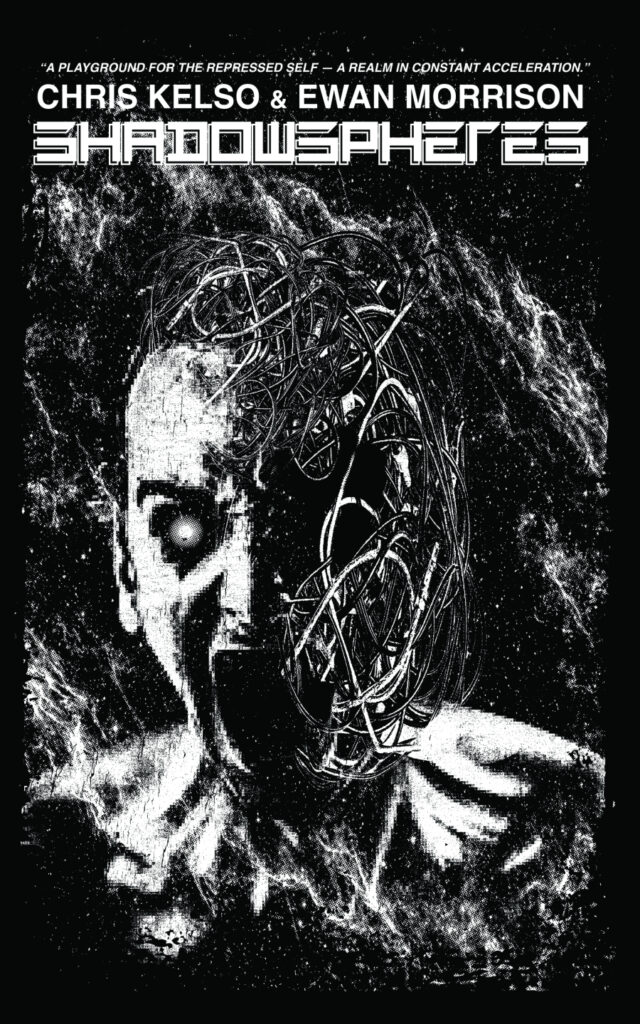
Two modern Scottish writers and trynabe future-gazers who think there may well be some answers to be had are Chris Kelso and Ewan Morrison, perusing the busy affectless AI blandscape with art official intelligence. In a moribund national cultural scene still struggling to catch up with tiresome American bluehair middle-class teenage mores imported and parroted on social media, these two critically feted scribes from the country that had the world’s first literate society have asked a few difficult future Scotland (and global) questions, and come up with some potential answers extrapolated from the explicatory data they have mined. Their new book Shadowspheres (2026, Merigold Independent, 144 pages, $25) directly confronts and grapples with questions of artistic, societal, environmental and psychological autonomy and responsibility in the modern era. They rage against what nanobot-and-sold machines of loveless electronic fury are bringing to a desperately unprepared species seemingly teetering on the verge of destruction, or evolution, or both. Shadowspheres contains non-fiction and fiction aimed squarely at excavation of the opened Pandora’s box of AI, which may ultimately be more akin to the flesh-ripping hooks-slinging Lament Configuration of the Hellraiser movies. Kelso and Morrison ask important practical and philosophical questions, answering some, raising others for further future exploration. What is very clear is that AI inquiries like this are urgently necessary. This book is a start, a training of sniper rifle sights in the info-fragments-raining present, a frowning bead-drawing of worthy targets…and a repeatedly pulled trigger finger. 3:AM asked each of the writers three questions about the book, and the current (escapable?) mess we’re in existentially. This piece is divided into two for space reasons, with Kelso’s questions to start.
QUESTIONS FOR CHRIS KELSO
3:AM: Chris, you work as an English teacher in a Scottish high school. Although you touched briefly upon this in Shadowspheres, can you attempt to identify any real and serious mental/emotional problems you see in children growing up amidst this unchecked technological madness? How do you see their relationship to tech in general? After all, there have been recent moves to ban mobile phones during the school day.
Chris Kelso: Well, first of all the supposed move to ban mobile phone never really happened. Councils allowed schools a certain autonomy to decide how best to deal with the problem, but most opted to passively punish phone use rather than ban devices outright. A complete ban is neither feasible nor would it ever realistically be permitted by a local authority – although, I’m sure there are examples of those who have piloted such schemes. There is too much red tape, too much defiance to control, to ever ‘ban’ anything a pervasive as technology. After, all this is what we wanted: convenience, entertainment, total freedom of access. These advanced computing devices are the spectres that stalk us as we wander through the dense forest at the edge of the world. The reality is that no one really wants to ban phones. We’re too acquiescent now, too sedate. Mark Fisher said, ‘It is easier to imagine the end of the world than the end of capitalism’. The same could be said about technology. The phones have whittled us down to drooling half-humans, barely conscious of the natural world around us.
There’s no doubt that teenagers are becoming increasingly sedentary, anxious, and depressed due to society’s persistent reliance on technology. I want to preface this point by saying that I think most young people remain intelligent, funny, and generally good-hearted. In 2026, kind people exist and in a majority. That said, in a large number I do notice a critical element missing as a result of their upbringing in this particular shadowsphere of consciousness. I won’t spend time talking about brainrot, regulation, or cyberbullying in forums, but it’s the commodification of their childhoods that leads to a lack of empathy, and that’s what worries me the most. They are a product vying for attention in an unforgiving, highly insidious realm. How could we have expected anything less?
Most educators take an active stance against mobile phone use in their establishments, but I spend even more time challenging the implementation of AI. People read less and now rely on AI tools for extended pieces of writing, and you can see the slow-motion death of the written word in classrooms across the country. Storytelling is our gateway to compassion and it is being eroded. And, sad as it may seem, every sector has heavily invested in this technology, making it difficult to abandon without harming the economy. So, aye, we’re trapped. We know that cultures that foster empathy and extend consciousness beyond the individual thrive, but this capacity weakens if it isn’t exercised or incentivised properly. Each one of us witnesses this decline in real time. Worse still is the mutating qualities of these devices. Young people, raised with technology, integrate it into their minds and bodies, so removing phones would be like amputating a vital organ. Phones have literally become bodily appendages. So, all this to say that children (and adults) are essentially cyborgs now – entities capable of virtual empathy through computer-mediated communication but lacking real-world empathy – and we’ll just have to deal with it. It’s hugely depressing, and I think as a species we’re guilty of allowing problems to fester to such a state of decay that there is very little we can do about them. My fear is that it’s just too late for us to revert to Luddism and ditch the tech, at least at this advanced stage of modern consciousness. The 1% won’t let us. It looks like technology and climate change will be our executioner – I just don’t think anyone anticipated that we’d happily lay our heads on the pillory.
3:AM: Elon Musk has seemingly never outgrown his love of cheesy 70s science fiction films, and he seems to reckon that everybody is going to leave the planet in his SpaceX rockets for a city on the moon. In a 1998 BBC Radio 3 interview, JG Ballard pointed out how the problems of moving large populations into space were insuperable, and that even the idea of doing so was what he called a ‘predictive mythology’; an escape velocity fantasy, basically. Do you have any general thoughts on the man and his ‘new’ retro plan, which seems lifted wholesale from the 1970s Battlestar Galactica film and series?
CK: I’d like to go on record and say that I think he is a big part of the modern problem. I doubt he has ever read Ballard or anyone remotely interesting – but perhaps he should’ve read more Ballard and less (Robert A.) Heinlein. If he had read Ballard he would have a damn sight more empathy for his fellow man. He is a boring, juvenile, selfish, hate-camel trapped in an adult body. The truth is that Mars is a launchpad to nowhere. Rather than attempting to save the planet by investing funds into programs that might help the cause, Musk suggests that we leave this deteriorating planet behind and move on to pastures new, but he is also implying that a vast majority of the population would be left behind as well. Most of us won’t be able to afford a one-way ticket to the red planet. All this chat about colonising planets is nothing to do with the average person on the street. We’re not invited! Mars would basically be a terraformed version of Epstein Island, full of tech billionaires and other tax cheats. Cunts the lot of them. Fucking up Earth before running away and leaving their mess behind. The whole Mars voyage has already been debunked anyway: we lack the technology to establish a safe, self-sustaining habitat on a planet like that. Then again, the staggering levels of naivety people show on a daily basis no longer shocks me. I’m sure Elon will have us all over for a vape and some crumpets once we’re all settled. Give me strength.
3AM: In your non-fiction pieces in the book, you call for more empathy and kindness from people, almost regarding them as passing into history. Are these emotions still held in any regard now, or are they atrophying in the evolution of 21st century digital mindsets? If they make people feel pain and compassion for others, could they hypothetically be regarded as retro, and a hindrance, in surviving an increasingly cold, inhuman environment?
CK: That’s a good question. Is it more beneficial to our survival to be cut off and unfeeling? You might be right. Perhaps the reptilian part of our brain is drowning us in stress hormones because it knows we’re on a precipice. Perhaps kindness and empathy seem like vulnerable states to be in when the world is on fire around us. I’m sure the dominant narrative that surfs the surface of the algorithm would have us believe that technology is the new safety, the new womb. Something to be embraced. Surely we have to push against that, though. Empathy is a tool to understand the world and I know that deep down that’s what we all want. We all have that in common. So, to denounce it as retro or useless would be folly. We all want to survive, but not in some desperate hellscape.
This appears to be a long document. Save time by reading a summary using AI assistant.
Part two of this article can be found here.

ABOUT THE INTERVIEWER
Graham Rae has been writing about underground and counter-cultural oddities for nearly four decades. He has done liner notes for several of the films of Jorg Buttgereit for Arrow Video. He has popped up in books like The Deep Red Horror Handbook, Xerox Ferox, Paint a Vulgar, Children of the New Flesh, and in publications like Causeway, American Cinematographer and The Poets’ Republic. His work has been nominated for a Pushcart Award.
ABOUT THE INTERVIEWEES
Scottish artist Chris Kelso is a British Fantasy Award-nominated writer, editor, and sometime musician. His works include the Dregs trilogy, Voidheads, Burroughs and Scotland: Dethroning the Ancients, and the critically feted art-horror-movie examination Possession: Dreams of Suffering and Sanity.
Scottish artist Ewan Morrison is an award-winning writer, cultural critic, director, and screenwriter. His most recent book is For Emma, an AI-themed techno-thriller. His works include The Last Book You Read and Other Stories, Swung, and Close Your Eyes.

