
By Elijah Sparkman.
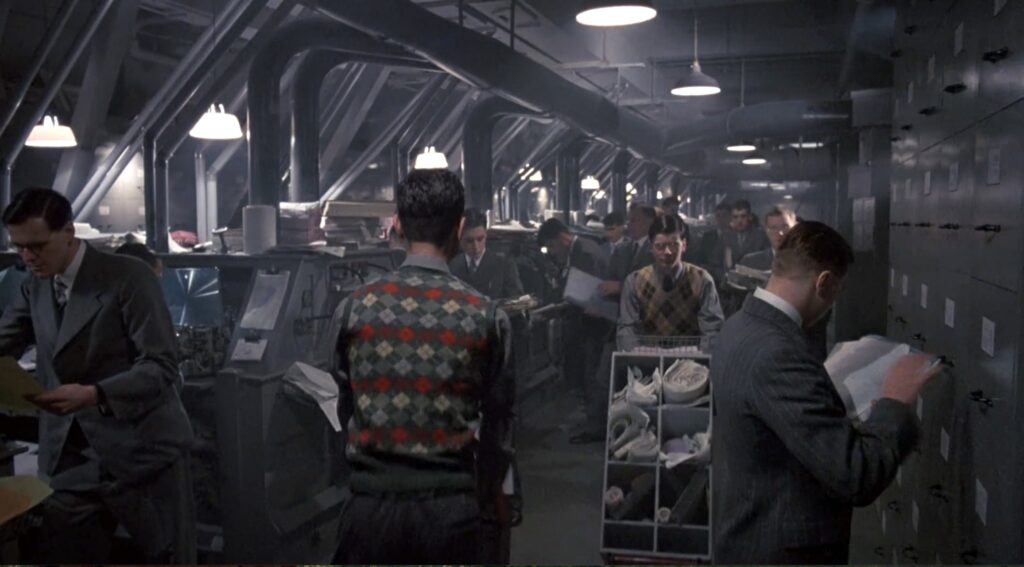
Brazil, directed by Terry Gilliam, 1985
Cut back to grey sterility.
THE DEPARTMENT OF RECORDS.
The rumble of Samba, “Aquarela do Brasil,” translated as “Watercolor of Brazil,” composed by Ary Barrosso, whose theme punctuates Terry Gilliam’s Brazil (1985) in a deep palette of tones and speeds, vocal and not-vocal.
Here in minute 9:
We follow a paper receipt from minute 8:
Filled out by Buttle’s wife (the wrong guy!) and given to SECURITY per the orders of INFORMATION RETRIEVAL.
The last scene in minute 8:
Buttle’s wife, alone in her living room, at least standing alone, her kids crying on the couch, Christmas tinsel wrapped around the film’s famous proliferation of ducts. Buttle has just been taken, violently, buttoned, zippered, in ridiculous Gilliamesque mise-en-scène. Buttle’s wife stands alone. Collapses. Camera zooms in on the paper receipt in her hand on the floor.
Cut to minute 9:
The same receipt stamped by the DEPARTMENT OF RECORDS.
Boom.
Blue.
Boom. Music. An uplifting rendition of “Watercolor” and we are off to the races, backwards, through a grey workspace, at the speed of dolly. The hustle of hustling. Of stamping and getting things done. Bureaucrats! Up one hall. White faces and ducts! and file cabinets. More detail than can be detailed here, which is part of the point, or at least the charm, of a Gilliam film, amidst all this wicked mundanity, there is entropy toward the infinite, and interesting, errata of the human.
Right?
Or maybe it’s this errata of the human that makes up the evil at the film’s heart?
Both those things are true?
None of this is true.
It’s a movie.
After reverse-tracking up the hall. Men chugging away at Rube Goldberg computers on the right, a wall of file cabinets on the left. The camera loops and reveals another hall littered with bureaucrats and paper, but does not trek down it.
Instead, the camera stops, lowers, where the body of an argyle-vested bureaucrat, wheeling a bookshelf filled with scrolls, encloses it, and the camera is lost in the black shadow between scroll and shelf, in a technique reminiscent of Hitchcock’s Rope, the effect of a continuing shot, mimicked by zooming too far into an object and back out again.
Too far into an object.
Cut to the back of the kid, kid because he’s young, Undergrad Intern age, and we follow him pushing his scroll bookshelf dolly-wheeler down this, what was it called again? DEPARTMENT OF RECORDS, pushing his scroll bookshelf dolly-wheeler forward down the first hallway, the one we just came up, until we see a bossman (Ian Holm), Napoleon in TIME BANDITS (1981), Gilliam’s previous film, standing atop a string of steps.
The bossman checks a stopwatch in front of a white-glass doorway. M. KURTZMAN, it reads, the font three-dimensional, silver-bodied and black-shadowed.
M. Kurtzman turns into his office.
And the camera turns back to the bureaucrats.
Who stop what they are doing, and if memory serves me well, the music stops too, and the bureaucrats turn on their Rube Goldberg computer monitors (Rube Goldberg because they are 32 square inches of magnifying glass overlaying a smaller, blue-tinted square of screen, above a typewriter-like mechanism, with spools of half-red, half-black ink… I just don’t know what it amounts to!).
What it amounts to in that scene, in minute 10:
Is the bureaucrats start watching a cowboy flick, and M. Kurtzman calls through the intercom for “Sam Lowry” (Jonathan Pryce), who we will come to know as our protagonist, our dreamer, who dreams of women and flying and another world, but we will not know him here, in this space yet, because he is at home sleeping.
Sleeping like my girlfriend in the other room.
Next to my office.
Where I type on my MacBook at my mahogany desk from Office Max.
Because it is 6am:
And I’m attending to minute 9:
In the silence of my office (which is why I had to abandon the analysis of sound in this scene, unfortunate, so crucial to the film! Where did my headphones go?), 6am:
Because I have to head to my co-working space in a few hours. Overbright and open-floored. I’ll send emails for the non-profit that employs me. I’ll write a newsletter. I’ll write a foreword to a beautiful book, written by children, chronicling the misadventures of pollinators at the Belle Isle Conservatory (a job I think Sam Lowry would dig?). I will sit next to a woman who calls people on their phones. And leaves them a voice message. These people are due the difference between the amount of taxes owed on the property they had to foreclose on, and the price it sold for on the market. In some cases this is a substantial amount. This is not a scam. They have until April 16 to file a report. Please give her a call back at this number.
Or visit the website.
This scene in minute 9:
Is ostensibly just down a hallway and then back up the same hallway, with a sneak peak at the next. The effect is supposed to make you feel like you’ve entered a world of infinite bureaucratic hallways. This dystopia sprawls.
But I can’t help a different feeling.
What if these are the only two hallways?
Where the DEPARTMENT OF RECORDS occurs.
That Terry Gilliam made.
Is that better or worse?
This is the only place you get to see.
This is everything you get to see.
These are the only people you get to meet.
This is everyone you get to meet.
The sun comes up through the blinds and the wooden floorboards in the house creak.
I imagine the bang from the cowboy’s gun. I watch the cowboy chug through the batwing doors of the saloon, and out into the dirt road street. Minute 10:
After his villain.
“Hi, baby, good morning.”
Her hair is covered in the dust of sleep and she has her glasses on.
“Hi baby, good morning.”
I dig my fingers into the small of her back. Her body supercharged by heat.
“How did you sleep?”
“I slept good. Whatabout you?”
Mrs. Buttle. Alone in her living room.
Collapsing onto the floor.
Alone.
Cut back to grey sterility.
Cut back to Gilliam color.
Previous essays in the Minute 9 series curated by Nicholas Rombes:
1. Nicholas Rombes
2. Alex Zamalin
3. Grant Maierhofer
4. Emma Jones
5. Des Barry
6. Lindsay Lerman
7. Joshua Glenn
8. Jessica Sequeiro.
9. Christine Hume
10. Jeff Wood
11. Alexander B. Joy
12. Des Barry
13. Marcel Krueger
14. Alexis Forss
15. Sam Ishii-Gonzales
To pitch a submission, contact Nicholas Rombes at nrombesudm@gmail.com

ABOUT THE AUTHOR
Elijah Sparkman is a writer based in Detroit. His writing has appeared in ANMLY, Sleepingfish, Sundog Lit, and X-R-A-Y. He is the Program and Volunteer Coordinator for 826michigan, a youth creative writing organization. He is a member-owner of the co-op bookstore Book Suey in Hamtramck, MI. Instagram: @elijahsparkman20

