
By Sam Ishii-Gonzales.
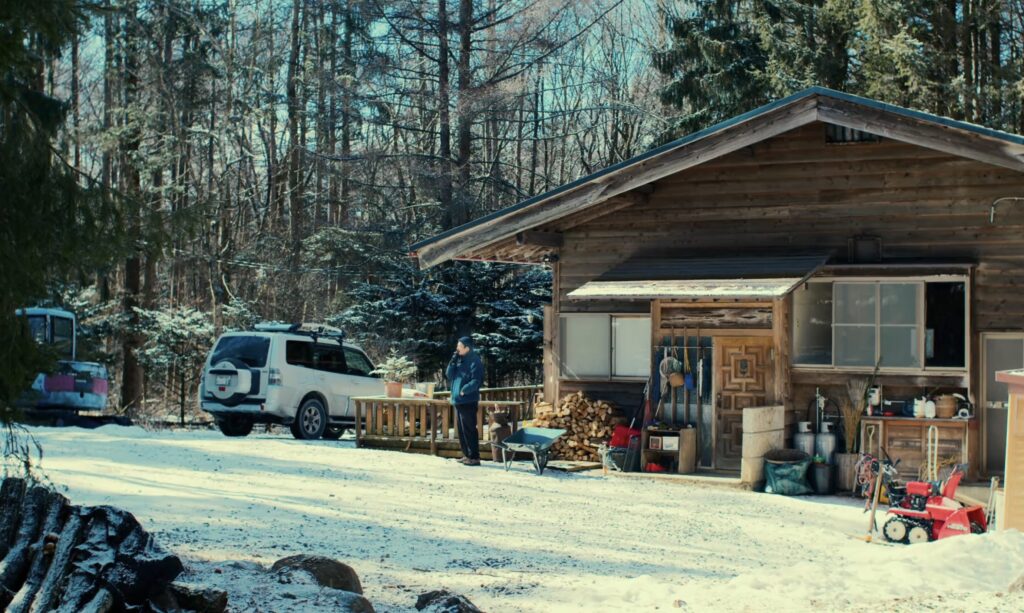
Evil Does Not Exist, directed by Ryûsuke Hamaguchi, 2023
At the ninth minute of Ryûsuke Hamaguchi’s Evil Does Not Exist (Aku wa sonzai shinai, 2023) the viewer shares, with the film’s protagonist Takumi Yasumura, a moment of repose. Takumi has just completed one of his household chores: sawing and splitting wood, loading the results into a wheelbarrow and transporting them to the area outside his home where the wood is stockpiled for future use. Having completed this task, which Takumi performs with effortless grace, he pauses for a cigarette. He takes off one of his gloves so that he can pull a single cigarette out of the pack that he has just retrieved from his winter coat. He uses his right hand to block the wind, using his left hand to light the cigarette that he has placed in the crook of his mouth. Takumi takes a drag from the cigarette before releasing the smoke into the air. He repeats this action as he absent-mindedly stares off into the distance, enjoying this brief period of rest before tackling his next set of chores.
The scene I have just described is remarkable for a number of reasons. The description I have provided already suggests there is something unusual about the opening of this film since we don’t expect the introduction of our main character – which is what occurs in this scene – to focus on the performance of such a seemingly insignificant task. The actual scene is even stranger than my description has hinted at when we consider its length, as well as the decisions that Hamaguchi has made for how to stage and pace the action. The scene of Takumi calmly preparing and storing firewood lasts nearly four-and-a-half minutes, which is two or three times longer than we expect such a scene to be presented to us when watching a film, if such a scene is presented to us at all.
Rather than using the usual editing tricks to speed the scene up or make it more dynamic, Hamaguchi does the opposite. The scene has four shots. The first two shots come closest to traditional découpage in their length (16 and 19 seconds, respectively) and in their use of camera movement: a dolly shot (in shot one), a tilt (in shot two). Shot three is not only static, the camera mounted on a tripod, but it is also positioned further away from Takumi. He is framed in the middle ground, surrounded by trees, his house behind him. Shot four does include a camera movement – a pan – but this camera movement is contained in a shot that lasts three minutes and 19 seconds. The pan, which occurs roughly halfway through the shot, is used to follow Takumi as he moves from the area when he saws and splits wood to the area where he stockpiles the finished results. The movement is away from the viewer so that the final eighty-four seconds of this scene – which is where we experience minute nine of Evil Does Not Exist – is a static shot of Takumi in the distance, in an extreme long shot (1). Rather than try to generate excitement or suspense in the viewer, Hamaguchi’s goal here is to create a sense of calm or equanimity. This is what I meant by using the word “repose.”
The opening of Hamaguchi’s Drive My Car (2021) has a vaguely similar tone to it, but it’s also quite different in the emphasis it places on the actors, framed primarily in medium shots and medium-close-ups, and on dialogue. These emphasizes are found in most (if not all) of Hamaguchi’s earlier works. Indeed, Hamaguchi in interviews has often stressed the importance of dialogue both for the director and for the actor: “words themselves are a form of directing in the sense that the words that the actors actually say become experience for them. It also helps them understand the role better” (2). It is through lines of dialogue that Hamaguchi opens up a channel of communication with his actors, providing them with insight into the world that he wants to build with these characters; it is through these same lines of dialogue that the actor makes physical contact with their character, the body an instrument for the relaying of words (which resonate or vibrate as they pass through the body and become noises or sounds).
What to make then of the absence of dialogue at the opening of Evil Does Not Exist? Not only is there no dialogue in the scene that I have just described; there is no dialogue during the first ten minutes of the film. The device that Hamaguchi has used in the past to help his actors become intimate with their characters – words – is replaced at the opening of Evil Does Not Exist with physical actions. It is through these actions alone that the actor Hitoshi Omika gains access to his character Takumi. It is through these actions alone that the spectator gains access to Takumi’s world. There is a thirty-three-minute segment later in the narrative – focused mainly on outsiders to Takumi’s village – that is closer to Hamaguchi’s earlier films, but the first and last third of Evil Does Not Exist focus on something else, something that cannot be articulated in words (3).
This dramatic change in Hamaguchi’s approach to character development – at least as it relates to the Takumi character and his relationship with his eight-year-old daughter Hana – is no doubt linked to the origins of this project. Evil Does Not Exist began as a commission from the composer Eiko Ishibashi, who wrote the music for Drive My Car. Ishibashi asked Hamaguchi if he might be interested in putting together a series of visuals that she could use to accompany her live performances. With no immediate plans following the release of Drive My Car, Hamaguchi agreed. Ishibashi provided Hamaguchi with demo tapes of the new music she was working on but even more important for the filmmaker were his visits to the recording studio that Ishibashi had set up in the Japanese countryside with her partner Jim O’Rourke. Listening to her music in the environment that had directly nourished them gave Hamaguchi a new appreciation of her compositions, especially when she opened her windows and the sounds emitting from her studio space began intermingling with the natural sounds coming from outside. It was this experience that suggested to Hamaguchi the idea of exploring what it might mean for humanity and the natural world to live in harmony with one another.
Equally important, I would imagine, to the project as a whole was Hamaguchi general impression of Ishibashi’s music as continuously developing or evolving “without ever becoming conclusive” (4). The reader of this piece will understand what I mean by this better if they have seen Evil Does Not Exist in its entirety and, ideally, more than once. Of course, the kind of indeterminacy or openness described in Hamaguchi’s quote is more easily achieved in music than through narrative film, but Hamaguchi does an admirable job of replicating the mutable quality of Ishibashi’s music. He does so by leaning into the musical qualities of the cinematic medium itself, e.g., through a careful attention to the rhythm of individual scenes, the flow that binds one scene to the next, the repetition-variation of certain auditory and visual motifs. These qualities were already found in earlier Hamaguchi films but they were relayed primarily through the spoken word, the cadence of human speech. For large sections of Evil Does Not Exist, Hamaguchi must seek out other ways of bringing this kind of musicality into play. A lesser filmmaker would rely on Ishibashi’s score to do this work for them. Hamaguchi does nothing of the sort. As with Drive My Car, there are extended sections of the film without any music at all, making the appearance of Ishibashi’s score all the more startling and effective. But even when Hamaguchi allows Ishibashi’s music to burst forward, he often brutally interrupts the flow of Ishibashi’s score to remind his audience that cinema has an ability to create its own alternative form of music through the orchestration of images and sounds (6).
Finally, let us end by returning to where we began. Having taught film for many years, I can already hear an objection to the scene that I described above from some of my colleagues and some of my students. They would say it’s too long. “We get the point of what we are being shown early in the sequence – there is no need to dwell on it for two, three, four minutes.” But is this correct? From my perspective, Hamaguchi is doing precisely what young writers and directors are told is their primary task as filmmakers: to show, not tell. And “show” not in a superficial way, but in a truly cinematic sense. Because showing something in cinema is not simply a matter of visually representing something for the camera in an instant or flash but using the temporal powers of the medium to allow the viewer to understand what they are seeing in a deeper, more profound sense. This is exactly what Hamaguchi is doing here. When Takumi pauses to light and smoke a cigarette, we are asked simply to be there with him, to feel this character’s attunement to his physical body and the natural world that envelops him (he is in the world, the world is in him). It is only by having us experience this attunement with Takumi that we can truly comprehend what is at stake when this kind of balance is imperiled, when harmony gives way to discord.
Far from having abandoned story or character development, as some might suggest, Hamaguchi has found with Evil Does Not Exist a new register through which he can explore what it means to be a narrative filmmaker.
(1) The scene that immediately precedes this one – which introduces Takumi’s eight-year-old daughter Hana – ends in a similar fashion with the young actor playing Hana moving from the middle- to background of the shot; the static camera watching as she moves off into the distance.
(2) Marshall Shaffer, “Interview: Hamaguchi Ryûsuke on Music and Movement in Evil Does Not Exist and Gift,” Slant.
(3) Having said this, it is true that it was the pleasure that Hamaguchi received from hearing the actors deliver the dialogue that he had written for them that led him to begin considering whether or not there might perchance be a narrative feature contained within the footage that he had shot for Ishibashi. Eventually, two projects would emerge from Ishibashi’s commission: Evil Does Not Exist, a one-hundred-and-six minute feature-length film; Gift, a seventy-four minute silent film with live musical accompaniment.
(4) Alex Welch, “’Evil Does Not Exist’ Director Ryusuke Hamaguchi and Composer Eiko Ishibashi on Their Unconventional Collaboration.”
(5) It was only during the third viewing of Evil Does Not Exist that I became consciously aware of how Hamaguchi was repeating, during the final thirty-seven minutes of the film, a series of auditory and visual motifs introduced during the first twenty-five. These repetitions begin with a second scene of Takumi chopping and splitting wood that is almost as long as the first one (although this time he is joined by Takahashi and Mayuzumi, two representatives of the Tokyo agency Playmode). Other motifs include: a gunshot heard in the distance; a gut-shot deer; a child forgotten at daycare; the view of a village hamlet seen from the back of a car; the ladling of fresh water from a mountain stream into large liquid containers; a tracking shot moving through a wintry forest, pointed toward the sky.
(6) Ishibashi returns the compliment when she describes Hamaguchi’s narrative like this: “With Evil Does Not Exist, there’s certainly an impression of abstractness and ambiguity throughout the film. However, what happens in it is, to me, very concrete. I think the balance it achieves between ambiguity and clarity is really wonderful. It’s something that I hope to learn from and achieve in my own work,” qt. in Welch, “’Evil Does Not Exist’ Director Ryusuke Hamaguchi and Composer Eiko Ishibashi on Their Unconventional Collaboration.”
*
Previous essays in the Minute 9 series curated by Nicholas Rombes:
1. Nicholas Rombes
2. Alex Zamalin
3. Grant Maierhofer
4. Emma Jones
5. Des Barry
6. Lindsay Lerman
7. Joshua Glenn
8. Jessica Sequeiro.
9. Christine Hume
10. Jeff Wood
11. Alexander B. Joy
12. Des Barry
13. Marcel Krueger
14. Alexis Forss
To pitch a submission, contact Nicholas Rombes at nrombesudm@gmail.com

ABOUT THE AUTHOR
Sam Ishii-Gonzales recently shifted his home base to Europe. He currently resides in Berlin but will move to London at the end of next summer. Prior to this shift, he lived for many years in New York City where he taught film history and aesthetics at a number of institutions including, and most recently, the Grad Film program at NYU. (He will return to NYU in the spring to teach a seven-week intensive course before likely leaving the US for good). Sam enjoys working with production students because their encounter with the cinematic medium is both concrete and abstract, which is also where he wishes to pitch his own work: somewhere between materiality and idea. Along with a number of film and literary projects of varying sizes and scales, he is also working on a more scholarly project entitled “Tarkovsky and Technics.

