
Tony White interviewed by James Riley.

Matt’s Gallery, Nine Elms, London, June 2026. There’s large crowd assembled for the launch of Tony White’s new novel, Phantom at the Feast. Phantom is the much-anticipated follow-up to The Fountain in the Forest (2018), White’s highly original police procedural featuring Detective Sergeant Rex King. Crime fiction is a perennial form, but as the great Maxim Jakubowski put it when he spoke to introduce White at the gallery, it’s rare to find crime fiction that’s genuinely experimental.
White’s experimentalism draws deep on the European avant-garde, specifically Oulipo, the Workshop for Potential Literature. As White described in the ‘Author’s Notes’ to The Fountain in the Forest, Oulipians like George Perec are famous for their avoidances, novels written without the letter ‘E’, for example. Others, though, like Harry Matthews worked with “mandated vocabularies”, choice registers of tightly curated language. Matthews’ pool was the constituent words of forty-six proverbs. White’s, meanwhile, is the Guardian Quick Crossword, specifically the solutions to the Guardian crosswords published during the middle of 1985. Fountain took its collective solutions from the crosswords of March 1985; Phantom extends further to June 1985. The vocabulary woven into the books, then, is indicative of the historical substratum of the Rex King project: the ninety-day period between the end of the Miners’ Strike (3 March 1985) and the Battle of the Beanfield (1 June 1985). A contemporary setting is layered on top – as is the organising structure of the French Revolutionary Calendar – but these are the events and this is the period that haunts the novels and variously motivates their protagonists.
This cross-section of form and periodicity is crucial to understanding the status of Phantom as an ‘experiment’. An experiment is a testing, a trial; it should be in the service of doing something, of making something happen. All too easily we take ‘experiment’ and ‘experimental’ to mean a certain kind of art – rarefied, obtuse, difficult for its own sake and thus distanced from the world and its concerns. White’s writing, particularly the epic scope of Phantom at the Feast is the exact of opposite of this. It’s bound up with an intimate knowledge of genre fiction, and the application of Oulipian techniques is not there to flummox, but to both power the creative engine of the writing and furnish the novel with a very particular type of historical and social material. It is as if White has taken an archaeological sounding of his chosen period and then put it to work, brilliantly, in the novel’s wider narrative. The reader gets a sense of the public language of 1985 and the extent to which it reverberates – just like the consequences of the critical events – into the characters’ ‘present’.
When White came to read at Matt’s Gallery, one heard the effect of this technique in full force. The prose was at once playful, surprising but also extremely precise in its wording. The same forensic particularity was evident in ‘Crosswords and Constraints‘, an accompanying exhibition of White’s compositional materials upstairs in the gallery’s mezzanine archive space. As any detective will tell you, everything is meaningful; nothing is without signification; even the merest hint of evidence has hidden depths. Phantom – with its central cipher of the reiterative Rex King – is a novel built out of these principles, even down to the matter of individual word choice.
I spoke to Tony White in the run-up to the launch about the background to Phantom, its main concerns and his distinctive working methods. For more, see Steve Finbow’s review of the novel for 3:AM here.
***
3:AM: To start with the obvious, Phantom at the Feast is twice as long as The Fountain in the Forest. Was it your intention to significantly expand the scope with this second book?
Tony White: The scope was baked in from the beginning of the whole project, which I initially envisaged as a trilogy. It was intended as a ninety-chapter work: three novels of thirty chapters each, covering a ninety-day period – the strange interregnum between the end of the Miners’ Strike of 1984–85 and the Battle of the Beanfield, when the policing playbook used in the former events was then applied to another section of the civilian population.
But when I started writing Phantom, it became clear that what I’d envisaged as parts two and three of the trilogy were inextricable: they had to work as a single volume. Even though the finished novel is now divided into two parts, the story filled sixty-chapters. And the title, Phantom at the Feast, came right at the end. “Phantom” was one of the last bits of mandated vocabulary. That seemed to gel with the whole trajectory and my thinking about the Clash, their song ‘Death is a Star’ (1982), and the Clash Busking tour (May 1985) which is discussed at the beginning of the novel. The length, then, wasn’t expected, it was just one of those moments where, as a writer, you have to do what the novel tells you to do.
3:AM: The book seems to move in at least two directions at once. There’s a granular, daily approach to a set of events in the personal and private life of Detective Sergeant Rex King. At the same time there’s a series of deep dives spanning generations, years of experiences.
TW: Yes. I used the revolutionary calendar and calibrated it to the novel’s ninety-day period, which organised the duration into nine ‘revolutionary’ weeks. This gave me free rein to range backwards and forwards in time, rather than simply following a series of events in chronological order.
3:AM: I thought that was one of the most impressive aspects of the novel’s structure. There are several moments in which the narrative appears to be chronological but is soon revealed to be a step backwards into the recent ‘past’ of the plot. The result, it seemed to me, was a series of loops of a sort, in which the reader is simultaneously moving forwards and backwards in time.
TW: There are several kinds of things going on there. One was the realisation that, at the time I was writing, there were still serving police officers in the force whose careers have included these big transformational moments like the Miners’ Strike. I didn’t want to focus only on police officers present; I wanted to allude to this longer institutional history. As such, you’ll have noticed that as the novel progresses, it becomes more about various kinds of memory and remembrance. At the same time, those loops and digressions were also to do with the mechanical analogue media that’s being used in the earlier parts of the chronology – cassette tapes and the like. I wanted to apply their fast ‘forwarding’ and ‘rewinding’ motifs to the text, quite openly.
3:AM: As a police procedural, it comes close to Rashomon (1950): the reader is shown events from multiple perspectives. I’m thinking here of the sequences in which Rex looks through the evidence linked to protests during the Miners’ Strike. There are paper files of contrary perspectives as well as a cache of Super 8 films and video tapes. One event is comprehensively documented but it’s a collation of different viewpoints.
TW: Yes, Rashomon is absolutely the reference point here. The crosswords were also determining these movements, particularly when things start breaking apart in the second part of the novel after a missing person case begins to unfold (quite close to home) and then goes nowhere. It was the crosswords that determined the next movement in the novel: a ‘fast forward’, if you like, and then a ‘rewind’, to before the investigation and to after it. The crosswords, then, are not just the cherries on the cake. They are the cake.
3:AM: For me, the authors who came to mind when reading Phantom, were Derek Raymond and Len Deighton, specifically because of their working-class protagonists and the detail in their novels of what we could – broadly – call admin. Neither writer holds back in books like He Died With His Eyes Open (1976) and The IPCRESS File (1962) when it comes to showing the drudge of the job and the paperwork.
TW: As I understand it, from talking to senior police officers, drudge is at the forefront the longer you stay in the force. They’re always aghast that there are chief inspectors in TV dramas out there doing the leg work when the reality is they’re behind a desk all day. So, getting that realistic image of the job right was very important, as was the status of Rex as a working-class police officer. He’s a graduate police officer. We never find out what of or what in, but class, certainly, is an important aspect in the novel.

3:AM: Class saturates the book’s language. Workplace language: both internal discourses, as it were, the officialdom of acronyms and so forth, but also the slang of it. Readers of your previous books will know this is an abiding interest, but in terms of Phantom, it’s a style that seems to speak of deep professional experience.
TW: I’ve never worked in the police, but I did work for a decade in the post office. My first police novel Charlieunclenorfolktango (1999) was written there, on the night shift, in 1996. I was trying to reflect the white working-class voice that I was hearing. Then I worked for a decade at Arts Council England, a ‘non-departmental government body’, and another very language-dependent environment. What was interesting, though, about the post office in relation to the police, is that it’s an institution of a similar age. They are both nineteenth-century institutions which have come down to us complete with a kind of residual Victorian slang, but they both remain very siloed. In Phantom, I have borough command units changing shape and amalgamating – typical twenty-first century management consolidation. But basically, you could well imagine that until maybe the 1990s, police in one borough would have had a very different kind of workplace slang than police in a neighbouring borough.
As for feedback, though, the kind of comments I get from book groups are about 50/50 as regards accuracy. People will get in touch and say, “My wife/husband works for the police. They think you must be a policeman.” The others say “My wife/husband works for the police. They say that would never happen.” In fact, there’s nothing in Fountain nor Phantom that has never happened, really. I mean, everything in both novels is completely plausible. Hell notwithstanding, of course.
3:AM: One of the most impressive elements in the depiction of Rex working on the Miners’ Strike material is the long sequence where he reads through multiple evidence files and then re-reads them, quite literally, in different directions.
TW: “Read across”, yes. I mean, I don’t know if “read across” actually exists as a procedure, but it seemed to be an obvious kind of thing to do. I do know that police statements tend follow a particular kind of sequence thanks to their own prompts. And if you think about joint enterprise investigations, how else are you going to compare them? You’re going to go and look at them across as well as down. So, while that sequence is, in effect, the most avant-garde part of the novel – it’s a cut-up poem of an hour of a demonstration during the Miners’ Strike – methodologically it’s also the most plausible.
3:AM: The phrase that came to mind for me was “informational modernism”. It was as if Rex was generating an interior monologue out of the information itself. The file started to speak. But as you say, there was nothing fantastical about it. The approach was in keeping with a rational and reasonable method of investigation.
TW: Let’s trademark “informational modernism”! But the additional thing about that sequence is that it’s a punishment. You know, it’s dawning on Rex that he’s potentially on desk duty for the rest of his career here. He’s been given a dog of a task on the fringes of an investigation into a missing person. It gradually dawns on him, and his colleagues, that he’s actually off the case. He’s in a kind of holding pattern until the outcome of his impending appearance at the UCPI (2014, onwards) the Undercover Policing Inquiry or “spy cops” inquiry.
3:AM: It would have been easy with this novel to tell the story from the perspective of someone who had been involved with a so-called spy cop. Our social moment is asking us not to trust the police. And yet, here’s Rex, the central character, someone who is very identifiable and sympathetic from a working-class perspective. But he’s also in a role that, socially and politically, is increasingly problematised.
TW: Rex probably reinforces that imperative. But I think it was essential to me that we see the UCPI from the inside and the wrong side. Rex isn’t an unproblematic kind of good guy. I had in mind the work of Javier Cercas, a brilliant Spanish writer, who along with other writers in the Spanish speaking sphere like Roberto Bolaño and Javier Marías – Mario Vargas Llosa – are/were not afraid to write a kind of expanded crime fiction about state crime. When writing about the European novel, the novel in the mode of Cervantes and Don Quixote (1605-1615), Cercas talks about the importance of ‘The Blind Spot’. The blind spot, of course, in Don Quixote is that Quixote is both completely mad and completely sane, and each side is blind to the other. That’s a very productive idea when you’re looking at policing, I think. The spy cops were conducting undercover police work, but they were also deceiving women into long term sexual relationships to maintain that cover. What’s emerged in the inquiry is that there’s no sense in which those relationships were consensual and there is, of course, a word for that: rape.
The spy cops sequence was written in 2021 or 2022. So, I was slightly having to predict what might be the trajectory and cadence of the briefings of the relevant Tranche (post-1983) which didn’t commence until 2024 (the UCPI proceedings are divided up, mostly chronologically, into ‘Tranches’, and within that into ‘Phases’ and/or ‘Modules’ – so looking ahead I guesstimated a wholly fictional ‘Phase 4 of Tranche 2’ for Rex), the type of preparatory questions put to those involved, like Rex. And so, I devised a series of questions for Rex to grapple with and rehearse before he goes and gives evidence. But these were completely fictional. I mean, I have no idea if these types of questions are ever asked or if these statements are produced spontaneously. It turned into a way of saying a great deal more about what Rex was doing in the role than we could ever see in action. It’s another example of the novel’s looping structure, not unlike the ‘temporal inversions’ Tzvetan Todorov talks about in ‘The Typology of Detective Fiction’ (1966): the moments where a clue suddenly rings out, where a memory comes in or a flashback occurs. Temporal inversions are the devices that allow us to glimpse the suppressed story. And there are a lot of suppressed stories in Phantom of the Feast, hence the title.
3:AM: Judging by the novel’s afterword, I got the impression that those crossword solutions were acting as temporal inversions for you. Did they act as memory prompts?
TW: Absolutely. It was Proustian. Doing the crosswords immediately unlocked muscle memories of various kinds, actually very personal memories of the period. I remembered how I was thinking at the time the Battle of the Beanfield happened, so hot on the on the heels of the strike. It was a complete torrent of memories and associations that made me realise “this has got legs. This could be something.”
It was fairly clear, just as anyone knows who’s written anything, that if you took the words from a single crossword, you could write a short story; you could write a poem; you could write a nonsense poem very easily, but you could probably also make a coherent short story. But what I didn’t know was whether it would work at the scale of a novel. So, I did have to test it with the novella, Dicky Star and the Garden Rule (2012), which was a complete stroke of luck. I’d been trying to find a way to write about 1985 and its legacy. And I got commissioned to write something about 1986 and its legacy, this strange little period of the Chernobyl disaster. It felt like Voyager One, you know, writing about 1986 was going to get me as close to 1985 as I could get, at the time. But what I’d learn from writing this novella would be enough to hopefully justify sending out Voyager Two…
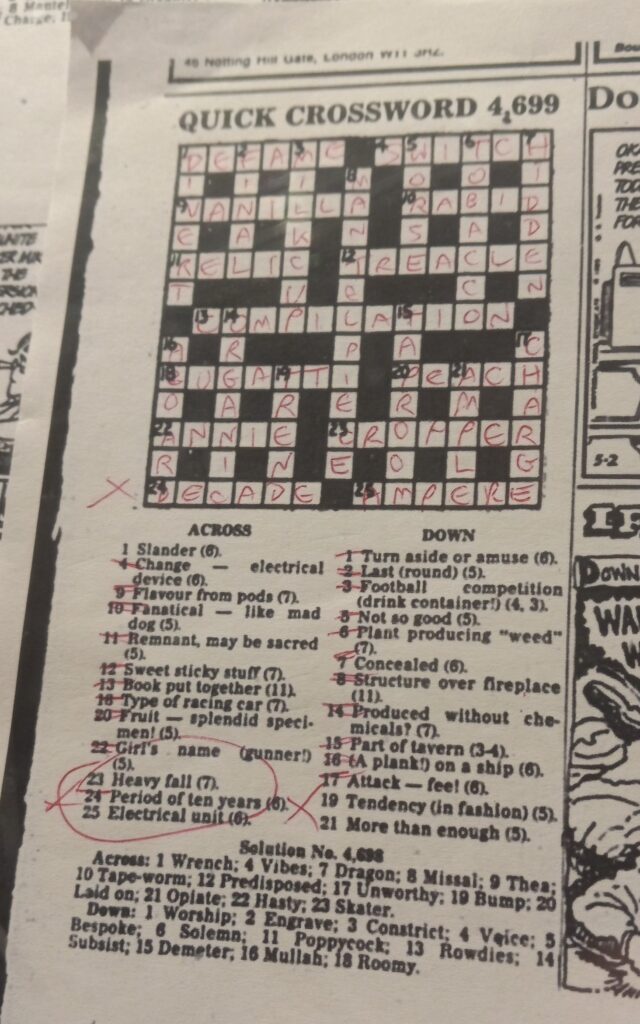
3:AM: How does that word choice work in practice? Do you see a word from the crosswords, which helps you to fill in a particular gap, in the sense of the crossword supplying the word you were looking for? Or do you notice a word which then makes you think of a particular idea, in the sense of the crossword telling you, in a sense, what to think?
TW: More the latter than the former, but a bit of both. And certainly, I had to cover the ninety days: which was seventy-odd Guardian crosswords in total. I did have to do all of them before I started doing anything else, just so I knew who the characters were, how many names I had to play with and what the locations were. Some things, I’d be dreading, I’d be dreading getting to the word “platypus”, thinking, where the hell can I get this in? But in short, it’s using the crossword solutions in the way that Italo Calvino used the Tarot in his novel The Castle of Crossed Destinies (1969-73) (and remembering that in his author’s note, Calvino describes the Tarot as a kind of visual crossword).
The only locations that didn’t come from the crosswords were Holborn Police Station and the murder scene at the beginning of The Fountain in the Forest, which was the late author, scene painter, and Atlas Press publisher Alastair Brotchie’s painting studio, the ‘paint frame’, in the back of the Theatre Royal Drury Lane, which I fictionalised as the Royal Palace Theatre. Holborn Police Station was chosen for the fact that it would be the nearest police station. If there was a shout for an incident in the Theatre Royal Drury Lane, Holborn Police Station would be the closest.
3:AM: The novel’s mandated vocabulary gave the sense that Phantom contained a personal history, which was simultaneously indicative of a much wider social history. As if Rex was a repository of many different experiences while still being a very distinct character. I wonder whether that effect also accounts for some of the residual uncanniness of the novel, the way that several characters have multiple names? They appear in different guises. No one is really, exactly, who they seem to be.
TW: I think that’s a reality of policing. Not just undercover policing. The job requires a kind of professional mask, a professional, and procedural carapace that an experienced police officer will adjust according to the situation. They’re well trained in such procedures. And I wanted to reflect on that kind of life. To come back to Javier Cercas’ idea of the ‘blind spot’ briefly, undercover police, whatever they were doing, were putting themselves in positions of extreme risk: risk of discovery, violence, and in some cases, risk of death. And they were also breaking the law. But they were doing these terrible things and putting themselves at risk because – in their eyes – they were the good guys. Rex, I’m sure, would think of himself as one of the good guys. But the evidence doesn’t bear that up, you know?
3:AM: It wouldn’t take too much of a tweak of Rex’s character to make him significantly more toxic. This is someone who is duplicitous. This is someone who has an extended, secretive personal and professional history. This is someone who is embedded in a deeply problematic institution. So, while I saw the character as charismatic, he was on the lower end of the (literary) spectrum, I guess, that leads to James Ellroy-levels of psychopathy: terrible, misanthropic beasts of men. I’m wondering whether that’s part of a general professional type as in, what it means psychologically and practically to be a policeman, or whether you were intentionally playing with an uncomfortable sense of attraction and repulsion with the character?
TW: Both of those things. That’s what makes Rex so appealing somehow. We do root for him, and that puts us, the readers, in a sort of blind spot as well.
3:AM: Going back to music of the novel for a moment, and to punk, specifically, the novel’s early references to the Clash Busking Tour seem to signify a certain kind of conviviality, a communality in connecting with one’s audience. There’s an authenticity built into it. I was thinking about the difference between both books, and it seemed to me that the Clash tour of 1985 was something of a turning point. I read The Fountain in the Forest as being about utopian desire. The communal experience of the novel doesn’t last, but the hope’s there: it’s what the characters want. Phantom at the Feast, however, deals with a world in which that experience just not possible anymore. At every level, communality is being withered away. London is being gentrified and becoming more and more individualistic. Professional cultures are disappearing. Maybe, then, the ‘phantom’ of the title refers to haunting memories of a communal politics?
TW: That’s a very subtle observation. I like that. The Rex that we encounter in Fountain is informed by the subjectivity of a 19-year-old boy. That’s kind of where we remain: it’s a libidinous young man who informs the adult Rex. Whereas, with Phantom, we begin at a time when Rex has realised he’s missed the opportunities of early adulthood thanks to his professional activities. So it’s a much more cynical Rex we spend time with. Much more opportunistic, slightly bitter. There’s a big series of shifts that happen at the beginning of Phantom, which reflect those changes in character. And in the second part, we shift into a different register still, which is to do with remembrance: people dying. That gets us even further away from the ‘phantom’ that you’ve identified, the optimism of the revolution.
3:AM: Is there is there another book for Rex?
TW: There is, yes. I’m not going to say what it is, but yes, I’ve started another one. I did promise the trilogy.
3:AM: I could see Rex being interviewed for a police TV show. Maybe that’s the next one? Rex on the pundit circuit?
TW: Yeah, Rex sitting on a panel at a crime fiction festival: “It’s not Dixon of Dock Green out there anymore.”
***
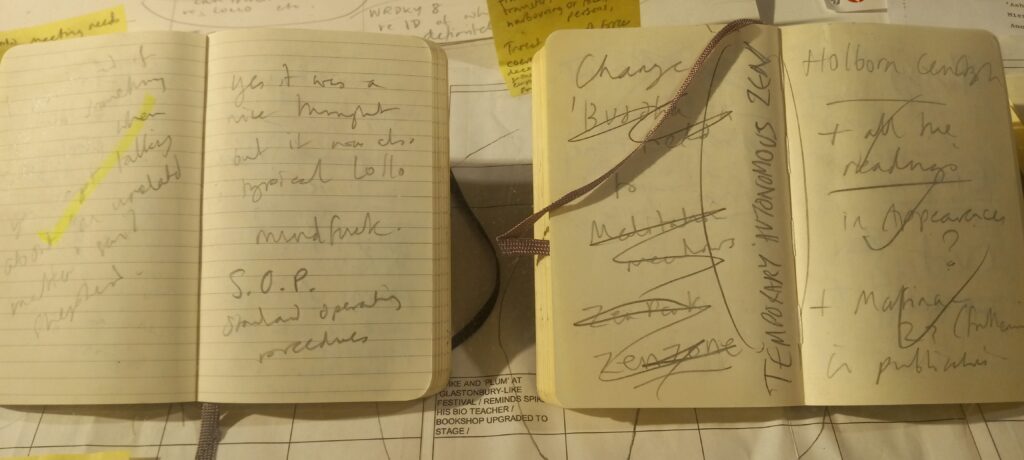
The archival display, ‘Tony White, Crosswords and Constraints: notebooks, plans and ephemera from the writing of the novel Phantom at the Feast‘ was at Matt’s Gallery, London, 25 June–10 July 2026.
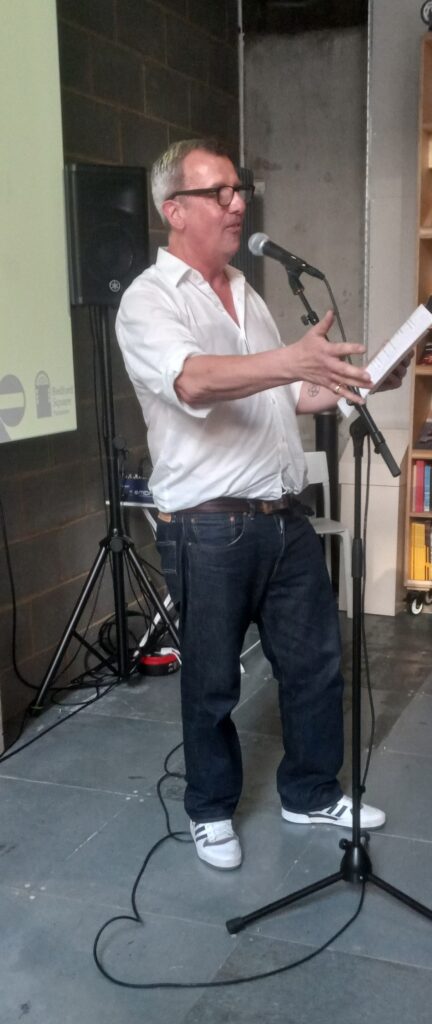
ABOUT THE INTERVIEWEE
Tony White is a Royal Literary Fund Fellow, based at Royal Holloway, University of London. He is currently an Associate Lecturer in Creative Writing at Birkbeck, University of London and at the University of Essex. His seventh novel Phantom at the Feast is out now from No Exit Press.
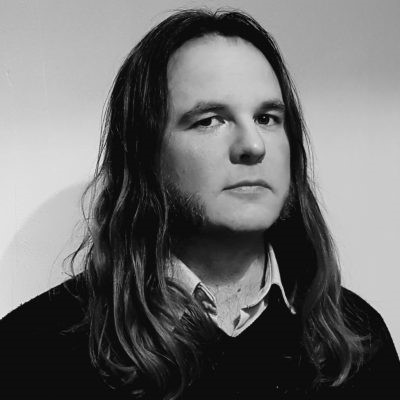
ABOUT THE INTERVIEWER
James Riley (above) is a writer and academic at the University of Cambridge. He is the author of The Bad Trip (2019) and Well Beings (2024).

