
By John Tottenham.
“Do you need a bag?” I asked, and received no response.
“D’you need a bag?” I asked again, and again received no response.
I tried again, a third time.
This time, the customer looked up from his texting. “What?” he said.
“A bag,” I said. “Do you need one?”
“What kind of bag?” asked the customer, a clean-cut young man with facial hair and neck tattoos.
“Do I have to describe the bag?” I said.
“Is it a paper bag?” he asked.
“Yes, it’s a paper bag,” I said, and handed him a brown paper bag.
He walked off, looking put out. Perhaps he had wanted me to bag the book for him.
“Hi Sean.” From whom this greeting came, I had no idea. It is the fate of the terminal bookstore employee to frequently be addressed by people he doesn’t know.
A forlorn figure shuffled up to the counter with an expectant look on his face that suggested I should be pleased to see him. I returned an unconvincing imitation of his smile, anticipating the twenty minutes of my time that this energy-draining vampire was certain to consume. It was inconceivable that he would leave any sooner than that. He was fresh and ready to twist my ear off. This might be his first social interaction of the day, but it was my umpteenth, and I was trapped.
“What’s going on?” he asked.
“Nothing.”
“What else is going on?”
“You mean apart from nothing?”
He just stood there, waiting for me to alleviate his boredom. Not content with killing his own time, he wanted to kill my time too.
“You ever have this dream where you’re in a dark room and can’t see what you’re doing?” he said. “You turn on the light switch and it doesn’t work, and you’re just alone in the darkness. Then you wake up.”
“‘Tell a dream, lose a reader,’ as Henry James wrote,” I said.
“‘Lose your dreams and you may lose your mind,’ as the Rolling Stones said. But they were talking about a different type of dream.”
It wasn’t what he said that was so boring, it was the sound of his voice and the desperation palpably simmering just below the surface. The merciless drone was the sound of him charging his loneliness on my battery. I could feel my already slim reserves of energy being sapped, ounce by ounce. I need to think, I cannot think in your presence. But what was the alternative, to spend time with him outside the workplace? That would be even worse; better to endure him here.
“I don’t have those kind of dreams,” I said.
The pest stepped aside to make way for a long-haired, denim-clad woman who prompted her young daughter to hand me a children’s book. The straining child could barely reach to the top of the counter and I had to stretch down to grab the book. The kid smiled up at me, almost begrudgingly it seemed — fully aware of her own cuteness but somehow recognizing me as an undeserving recipient of it. I knew the routine: another fake smile was being extorted from me. I couldn’t very well refuse a child: I forced out a weak and partially toothless grin.
“Do you do gift wrapping?” asked the adorable little girl’s mother.
I took a deep breath and responded in the affirmative. The phone started ringing.
“Hi-i-i-i-i-i-iiiii …” A perky, high-pitched voice on the other end of the line almost punctured my eardrums. “How’s your day going?”
“Never mind that,” I said. “What do you need?”
“Can I ask you if you have a particular book in stock?”
“What is it?”
“The Artist’s Way.”
The wailing of a child tore through the air.
I put the caller on hold and began to crudely wrap the children’s book.
Another stack of books and a soiled credit card were placed on the counter. I rang the books up, sickened by the continual swiping of cards and punching in of numbers, the dead time entailed by credit card transactions.
The denim-clad woman pressed up against the counter. “Don’t worry about it,” she said.
“It’s almost done.”
“My child is hurt,” she announced in a shrill tone of maternal authority.
I handed the partially wrapped children’s book over to her.
The phone rang again. The caller whose book I hadn’t looked for was on the other end of the line: “I called up five minutes ago …”
“Yes, I’m sorry. We got cut off. We’re out of it.”
Without a word, she hung up.
I felt another unflattering Yelp review coming on.
The forlorn pest returned, the stale fumes of perennial bachelordom wafting into my face as he leaned across the counter to destroy what was left of me with meaningless conversation.
“I don’t know what to do with myself,” he said. He found his own company oppressive but didn’t seem to mind inflicting it upon others.
“Thanks for the information,” I said.
“I’m going to get a coffee,” he said, and walked back to the café at the other end of the store, only to be replaced by another pest.

“You know I knocked myself out writing a puff piece about you a few years ago,” I said to Cyrus Fapper, since he insisted upon standing in front of me at the counter.
“You did? I never saw it. What for?” said Cyrus, a dandiacal middle-aged culture vulture who flaunted his many artistic passions widely and loudly on social media.
“Your publisher put me up to it. But it was never published and I was never paid for it.”
“I have good news,” announced Cyrus with unforgivable nonchalance. “I have a memoir coming out. So maybe we could use it then.”
“Congratulations,” I said with as much conviction as I could muster. “A memoir concerning what?”
“My childhood.”
“Very nice.”
“Prolix are publishing it,” he casually added.
“How did you swing that?” I asked, rendered almost speechless with envy and disgust.
“I pitched it to them.”
Why would anybody want to read Cyrus’ memoirs? He’d never published a book before; he wasn’t famous. Then the light flared up over my head: His mother was famous — she had been part of the ’60s Warhol circle, and Cyrus had been raised in the rarefied low-life environment of the fabled Factory scene that people never tire of reading about in these less decadently glamorous times. Brigid Polk had been one of his babysitters. So, naturally, his childhood memories would command great interest.
“Did you get an advance?”
“A very small one.”
But really, who cared about an advance when you were being published by Prolix? The distinctive logo on its tasteful white spine was a stamp of quality that automatically invited respect and curiosity from reader and reviewer alike. What more could a first-time author want than to be published by such a distinguished independent press? And it’s not as if Cyrus even needed an advance: he was supported by some sort of trust set up by his mother, who, while documenting her years as a slumming artist in several memoirs of her own, had made a small fortune on the real estate market.
“What are you buying that for?” I asked Cyrus as he placed a copy of Glass of Anger, a Brazilian novella, featuring strong sexual content, on the counter.
“Gil recommended it,” he said, referring to the store’s owner.
“He likes any slim translation with a whiff of perversity about it.”
“It looks good.”
“It’s crap.”
“Have you read it?”
“I flipped through it. It’s one of those translations in which the lady parts are referred to as ‘her sex.’ I can’t read that. Nobody ever uses that euphemism in English, so why does it appear so frequently in translations?”
“If it’s an old translation it might make sense,” said Cyrus.
“It’s a recent one,” I said. “No word has ever been found that I feel comfortable using to describe feminine genitalia; all the usual appellations trivialize, vulgarize or demonize it, but ‘her sex’ really takes the cake.”
At sixty-three pages this recently published book was no more than a short story, but it was presented in the form of a novel; it was the sort of book that people who wanted to be thought of as “well-read” felt they were supposed to like, and it was presented with a classic red-on-black design with bold lettering. I had given it a chance, reading a few passages between ringing up customers. The words lay dead on the page but it was flying off the shelves, and not only owing to Gilbert’s recommendation. Its popularity suggested that the words must sing for somebody. Maybe it was another case of bad writers for bad readers, and vice versa. Can there really be a correlation between writers that write badly and readers that read badly? This dynamic clearly applied to music, art and film, so why wouldn’t it also apply to literature?
“Do yourself a favor, read this.” I pointed Cyrus toward a copy of Barbara Pym’s Some Tame Gazelle.
“Subtle … unpretentious … comforting … elegant … understated humor.” Cyrus recited the copy on the back of the old paperback, and put it back down. “I don’t think so,” he said.
“It’s only three dollars.”
“Maybe next time.”
“There won’t be a next time. Her work is too accessible and enjoyable to be appreciated by the likes of you. I’m not giving you a discount on that shit,” I said, as Cyrus tentatively poked the credit card machine with the edge of his card.
“Go on, man, stick it in,” I said, aggressively.
“That’s what she said,” he said.
“I doubt it,” I said.
“Now it says ‘Please Remove,’” he said, apparently mystified by this simple command.
“She probably did say that,” I said.
“Send me a copy of your piece,” said Cyrus as I handed back his receipt.
“I’m sure you can get more prominent puffers than me,” I said.
“I don’t know about that,” he insincerely responded as he walked out.
This well-connected nonentity and literary fringe-player was getting published. Unfortunately, I didn’t have a prestigious art-damaged lineage to trade on. My father had been an accountant. Intellectual was a dirty word in the household I grew up in. There was no hope. I liked Cyrus better, if at all, when he was a failure.
A smiling stranger walked in and wanted a smile in return. But smiling is hard work and I have to ration them out if only to conserve energy. I can’t return the greeting of everybody that walks in: that would be painful, unnatural, and exhausting.
“Do you have any like Borges?” he asked.
“Do we have anything similar to Borges?”
I pointed him to the fiction section a few yards away. Two minutes later, he returned with a copy of Labyrinths.
“D’you want a bag?”
“That would be amazing,” he said.
“Hello, my friend, I’m looking for The Trial by Kafka,” stated a potbellied middle-aged man attired in a horizontally striped T-shirt and tight pants.
“Fiction, under K.”
“I exclusively buy books from shops like this and have been doing so for five years,” he said upon his return with the book.
“Congratulations.”
A skinny guy in a wifebeater and shorts, so as to better aerate his armpits and nether regions, wearing his sloppiness as a cloak of unhygienic arrogance, brashly munched on a slice of pizza as he browsed the metaphysics section.
He swaggered up to the counter and thrust a copy of The Artist’s Way at me: “Have you read this?”
“What do you take me for?” I said.
And then, the pinnacle of my evening, the most dreaded question of all. Here it comes again …
A yellow-haired woman stands there, beaming hideously at me. “How’s your night going?”
I can’t take it. But I take it.
I groan the words out: “Great …”
But it’s not enough. I can tell that she needs more. I can also tell that I’m entering an irony-free zone, a black hole of positivity.
The idiot, just humor her:
“How’s yours?”
“Really well. Thanks for asking.” Her tone is as aggressively bright as her dyed hair, while her fake gratitude is a patronizing concession to my distaste for the exchange and signals her victory.
And as if that’s not enough, she has to add insult to injury: “Have an amazing week,” she says, with her hostile smile still in place, as she walks off.
Wrapping children’s books for Silver Lake MILFs; a target for the malodorous and the tedious: this isn’t really the end of the literary business I had in mind. If I wasn’t already a misanthrope, this job would have turned me into one.
How did it come to this?
It is what happens when somebody nearing the end of their prime, who is unfit for daily toil, and has a morbid horror of anything involving effort, is forced, through a harsh diminishing of circumstances, to earn an honest living.
It’s a long story, too sad to be told, and I am not inclined to tell it. Life is plotless. Plots are for graveyards.
* * *
I have decided to stop writing for a while.
* * *
The most important thing is to stop writing, now: to stop prioritizing this so-called work that has generated no income and that nobody will ever read. This futile, masochistic, self-indulgent pretense has interfered with everything; it has been carried out at the expense of love and work: real work, that is, the kind that is a visible manifestation of mental effort, not this endless supposed honing of my craft compounded by the preposterous conceit that the torturous process of giving shape to my thoughts might actually serve some sort of purpose, when it is merely an excuse to immerse myself in a morbidly self-reflective haze, of which there is seldom any visible manifestation.
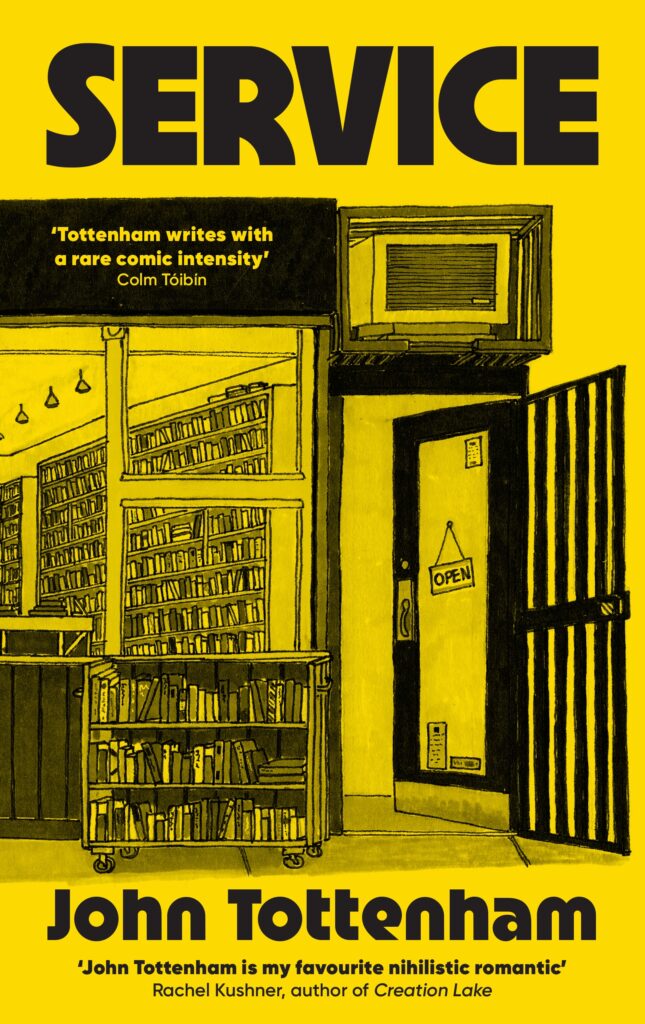
This extract is reproduced with permission from John Tottenham’s debut novel Service, published in the UK & Ireland by Tuskar Rock, and in North America by Semiotext(e).

ABOUT THE AUTHOR
John Tottenham is the author of four volumes of poetry: The Inertia Variations (2004 & 2010), Antiepithalamia & Other Poems of Regret and Resentment (2012), The Hate Poems (2018), and Fresh Failure (2023). A unique purveyor of “magnanimous misanthropy” and “magical cynicism,” Tottenham has been described as “Los Angeles’s foremost poète maudit.” His long-standing column in Artillery is widely read, and his paintings and drawings have been exhibited in solo shows at galleries in Los Angeles and New York. Service is his first novel.

