
Orpington to London Victoria #7 – George Berger Column
And then, finally, I have a vision that changes everything. A vision of my father as a frightened little boy, one who had a far tougher upbringing than I did, for all my whinging. A scared little boy who doesn’t understand his harsh surroundings. A tear running down his five year old cheek. A barefoot boy who left school at 14 to get a job and look after his disabled mum, his father having passed away due to an accident on the docks. A boy forced to be a man way before his time.
By George Berger.

Minute 9: Portrait of a Lady on Fire
If the patriarchy defines the rules of the society in which the narrative is set, however, then it sits on the periphery. The focus, instead, is on how desire builds and is felt, as Marianne and Héloïse become lovers. The relationships in the film that are defined by power, ownership and oppression, are the antithesis of the one formed between Marianne and Héloïse. As the latter begins to paint the former we see an affair born between equals. And, tellingly for a film that is about the relationship between artist and sitter, it is through the act of looking that this equality is engendered. Throughout, director and writer Céline Sciamma creates a visual language that is a purposeful act of transgression.
By Emma Jones.

Q&A: Dominic Jaeckle, Tenement Press
From the editorship of Hotel on through to the advent of Tenement’s activities back in 2021, I was drawn to the spike of SJ Fowler’s anarchic wit, and I’ve been fortunate enough to count on Fowler as a friend and frequent collaborator. With either the page or stage in mind, our collaborations have always leaned on conversation, and the candour of our exchanges always proved coloured by a free circulation of ideas. Be it a consideration of creativity, fresh enthusiasms, works-in-progress, or projects-in-percolation—all was ever fair game—and (in the best sense of the word) it seemed inevitable that, once the Press had found its feet, we’d begin thinking on the prospect of our working on a publication together.
Dominic Jaeckle of Tenement Press interviewed by 3:AM‘s new Fiction Editor, Daniel Davis Wood.
Outside the First Museum
Fruitless orchard lines the graceless square barricade of the blockade. It stops the crowd amassing and overwhelming the gate. Planted from memory, from some gardeners’ notes, a recollection of blueprints, is the line of tall, absolutely un-tropical, trees. They are oddly tall, like certain people, swaying above even the spiked tip of the obstruction doors. They have foliage only upon their upper reaches, where it’s too high for men to climb. In that regard there has been fidelity to how it used to be. Outside the first Museum. Old we might say, rather than first. Who can say what Museum was first? That is for a Museum of Museums. Something likely to be on its way.
Read an extract from SJ Fowler‘s MUEUM.
Poem Brut #150 – Blank

Jules Sprake has experimented with forms of printmaking and poetry, often starting with photographs of buildings or discarded objects to produce work that focuses on dis/connections between the parts. She is interested in the use of traditional printmaking techniques such as etching, cyanotype, salt print or lithography to process these photographs and poems.
In the 150th of the Poem Brut series, new poetry by Jules Sprake.
Lori & Joe
Lori’s initial apparent lack of interiority is also belied by her feeling for the landscape. As well as being about time and memory, Lori & Jo is also a book about place, though you will find no rhapsodic swells of new nature writing here, no purple passages about the storied beauty of the Lakes. The land is seen entirely from within that consciousness, close up. This is about being a body — and a streaming consciousness — in the landscape, the untouchable nature of the mind against rocks and rain and puddles and fog. And the importance of a good pair of boots.
C. D. Rose reviews Amy Arnold‘s Lori & Joe.

Knockout Artist
Lawrence reminds Xavier of the “white boys” he went to High School with who imitated black rappers so unflatteringly they put on a “modern-day minstrelshow” and told Xavier that he listened to “white music” and talked “all proper” because his black mother taught college English. In defending his pride, Xavier goes too far and the dark inner voice takes over during sparring:
‘An image flashed across his mind’s eye Lawrence’s face leaking blood from openings both natural and not. And Xavier wanted to make the image real.’
Wes Brown reviews John Vercher‘s After the Lights Go Out.

An Introduction to the English Translation of Dig Where You Stand
Dig Where You Stand prompts workers to become researchers, to follow the money and the power it represents, confers and reproduces. It invites them to take on the role as experts on their job and industry and “dig” out its hidden histories to produce a new picture and understanding of that industry and their position within it as a vital step towards social and economic transformation.
An extract from the introduction to Sven Lindquist‘s Dig Where You Stand.
The Fear (Extract): Still Lives
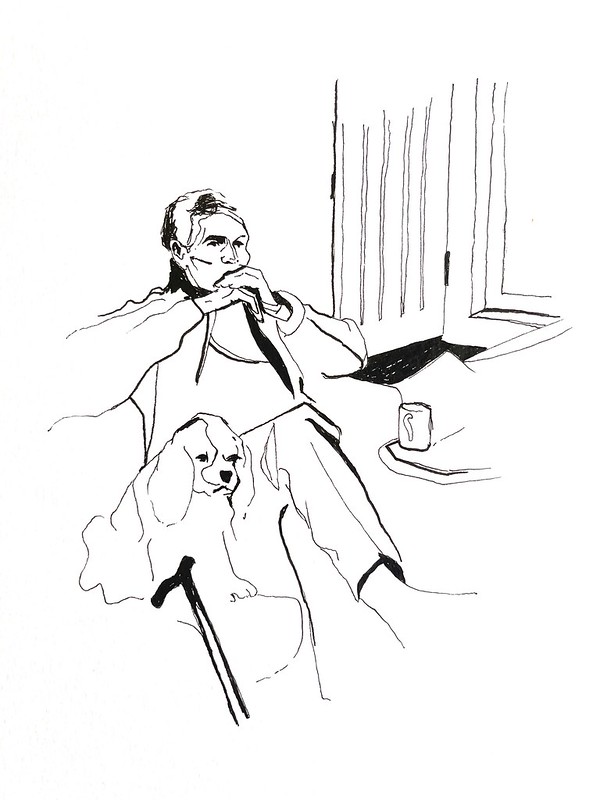
He had, to me, died very slowly and gradually, and detached from the outside world. The grief was therefore dispersed over the years, but no one had seemed very involved until this point, in which he had physically gone, which seemed in some ways quite arbitrary. I wasn’t sure how I felt about it entirely, but at times it felt good that I was finally allowed to be proud of him, to tell people what he was like, to be allowed the ritual of death. The illness had become a strange spectre, before — haunting us all with the imminence of death, the Fear — but now that tension faded, and in a strange way it brought him back to me, more fully, in essence. A spirit distilled, managed, sort of. As if grief can be bottled, memories saved, legacies controlled.
Read an extract from Christiana Spens‘s poignant, luminous new memoir, The Fear.
3:AM in New York: 1239
On Friday 7 April, at 7 PM, in a brownstone garden, 1239 will host a clutch of 3:AM Magazine writers, who will present what they please.
Jackson Arn
Zach Issenberg
Harris Lahti
Tom Laplaige
Christopher Urban
Basic spirits provided; communal contributions welcome. Things may go late.
For the street address in Brooklyn, write to mark.desilva@protonmail.com or message @MarkdeSilva1 on twitter. Asking around may also work.
.
Poem Brut #149 – Solinho

leading with translation of Fernando Pessoa’s two lines da alma, solinho is a written ruin in worship of the capacity to feel love, despite our failure to speak type scribble scream apt expression of it. solinho will live again as broadside forthcoming from FATHOM.
grammar for extinction pulls form of spawn fossils off toppled cliffs with graphite & rice paper, there is spray paint there too.
street cat blood lifted off our front door following a fight between two of our very good friends is what centers one last inverted flower between two-tone ink & handcut 6×9.
In the 149th of the Poem Brut series, new poetry by Jesse Kominers.

Minute 9: Synecdoche, New York
It’s interesting because there are moments in this film I find physically painful to watch. There’s a moment when Hoffman’s character is putting together this massive production in a warehouse the size of the city and it becomes so introspective that I can hardly bear to look at it. I think I chose Synecdoche for a piece of criticism like this because I knew it wouldn’t mean I’d have to watch the entire film again, and I don’t know what that says about me or about the work, to be simultaneously drawn towards something and its creator but not to be so drawn towards it that I want to simply watch it over and over again and can even comfortably do so.
Grant Maierhofer on the 9th minute in Synechdoche, New York.