
Peekaboo Bosh
The book is dedicated to those who “risk their lives, their liberty, and their sanity in the defence of non-human animals” and it is perhaps the last of these sacrifices that most exercises King in this short but important work. In a system that imposes the “eternal Treblinka” conjured up by Isaac Bashevis Singer and to which King nods, staying sane is a difficult and lonely task which even the sociability of collective resistance cannot always assuage. Mental collapse is a recurrent theme, and King extends this exploration to the perpetrators of the horrors as well as those who protest them.
Ben Richards reviews Peekaboo Bosh by John King.

The Hunter’s Daughter
I thought, if Eleanor could just kill me, my dad would see my stepmother for what she really was: vapid, self-obsessed, manipulative. An ex-courtesan who ran the town’s first power plant, she was the last person I would have expected him to marry. I first met her when he invited her to our annual pig roast and the two of us spent an hour by the fire. After talking at length about the moral benefits of reading, she French braided my hair and wiped the dirt off my pants. I was nine at the time and admired this woman deeply—her beauty, her reserve, her manner of speaking. Everything about her contrasted with how I had grown up: days tracking deer and skinning squirrels, hauling water from the creek, sleeping on a straw mattress, dirt stuck under my fingernails, clothes stiff with dried sweat. I even went into town and bought ribbons so I could style my hair the same way, and I wore them every day while I worked.
A short story by Brianna Di Monda.

The Shape of Memory
Dr. Abubacarr Njie (placeholder name, as he was ferried by the Americans in 1945 from one continent to another, from one vessel of transportation to another, narrowly escaping Soviet spies in Germany by rail, spending several weeks in the western lowlands of Albania diagnosed with malaria, living incognito as Mr. Eduardo Alvarez, chief editor for Der Spiegel, residing in Argentina from 1949 to 1966, finally arriving in America under the guise of Dr. Abubacarr Njie, research scientist for the California Institute of Technology) died last month. Later in the month, I published an obituary of Dr. Njie in the local Pasadena Chronicler, describing him as a reserved man dedicated to his work and a humble father to two lovely daughters and a reclusive son. Then, yesterday, a muddy manila envelope containing two notebooks of differing sizes, shapes, and colors arrived in the mail, delivered from Dr. Njie’s home address.
A short story by Kevin Ye.

Necromodernist Architectures in Contemporary Writing
These books are, in a sense, anti-cultural products: they demand time, patience, and acceptance of incompletion. In doing so, they enact a politics — not of slogans or themes, but of form itself. In persisting as unreadable, they insist on the possibility of thought beyond optimisation. A Tomb in H-Section is exemplary here: it does not seek to be “about” anything in the reductive sense; it is, instead, an experience of navigating the wreckage of narrative in the 21st century. And in that experience, it points to what literature, however marginalised, can still do: not to revive the modernist project, but to haunt the present with its afterlife.
By David Vichnar.

my holleedays by Charlotte Lewis
sunday 23th Juligh
my name is Charlie but my real name is Charlotte Lewis. I am 6. today is the Holleedays. I have a dad but he is at work and a mam but She is sick and a litel brother called Oscar but he is a pain in the nek. in the holleedays my nana is staying at are house cos Mam is in hostipal and dad is at work. today my nana gived me a noat book cos she said I do good riting and I can rite abowt the holleedays or rite a story or what ever. I said I want to rite non Ficshun cos we lurned abowt non ficshun in year 1. Nana said what is non ficshun and I said didunt you lurn abowt non ficshun at school and nana said I didunt lurn nothing at School. then I telled nana abowt ficshun and non ficshun cos Nana is not very clever. Non ficshun is a real story abowt real Stuff that really hapuns and ficshun is maid up with Monsters and prinsessis and advenchurs and stuff that is not real. Like a funkshuning helth servis said dad. nana said may be if you rite a ficshun story you can bring my Nee operayshun forwud so it doant hurt no more. I said no I am going to rite a non ficshun story abowt my holleedays.
A short story by C S Mee.

Someone Else
“I tried to talk to him, but he wouldn’t even hear me out. He said he didn’t want me to save him, because he’s fed up with those who want to lift his spirits, and if he did feel the need for someone like that, well, that’s what psychiatrists are for. That’s when he told me he’s seeing Dr. Berényi, to whom he’s been referred by the Kincses family. Dr. Berényi suggested that he should make a lifestyle change, because he has a so-called achievement complex. In other words, by the age of forty he has accomplished everything he could, a nice apartment, a car, a summer home, a wife, children, appreciation in the field of science, and the problem is that he has no more goals left, and therefore he has nothing to fight for. So, he must make some changes, swap apartments with someone, or God-knows-what, because once he finds himself in a new environment, he’ll then have a lot of things to keep him busy, such as moving, organizing, and so on, he’ll have lots of small goals, since he has no more big goals left and, as they say, many a little makes a mickle.”
A short story by Miklós Vámos, translated by Ági Bori.

Glantz: An Appreciation
This is an expressionism-adjacent headzone that a lot of Anglophone writers can’t bear to stay in, or else can’t manage to put words on without reducing to an ahistorical kitsch. Ryan is a far more adept, uneasily-at-ease cartographer than such writers. He’s “one of the clear-eyed among us,” as the barman in Glantz puts it — “those who can see in the dark.” First, on the level of the book’s larger architecture, his sense of “a world without God” is less a vague intuition than it is a concrete plot device, as he narrates one man’s loss of faith and the gradual decoherence which begins to seep into the entire world around him, becoming more cause than symptom.
Tim MacGabhann on Glantz by Tobias Ryan.
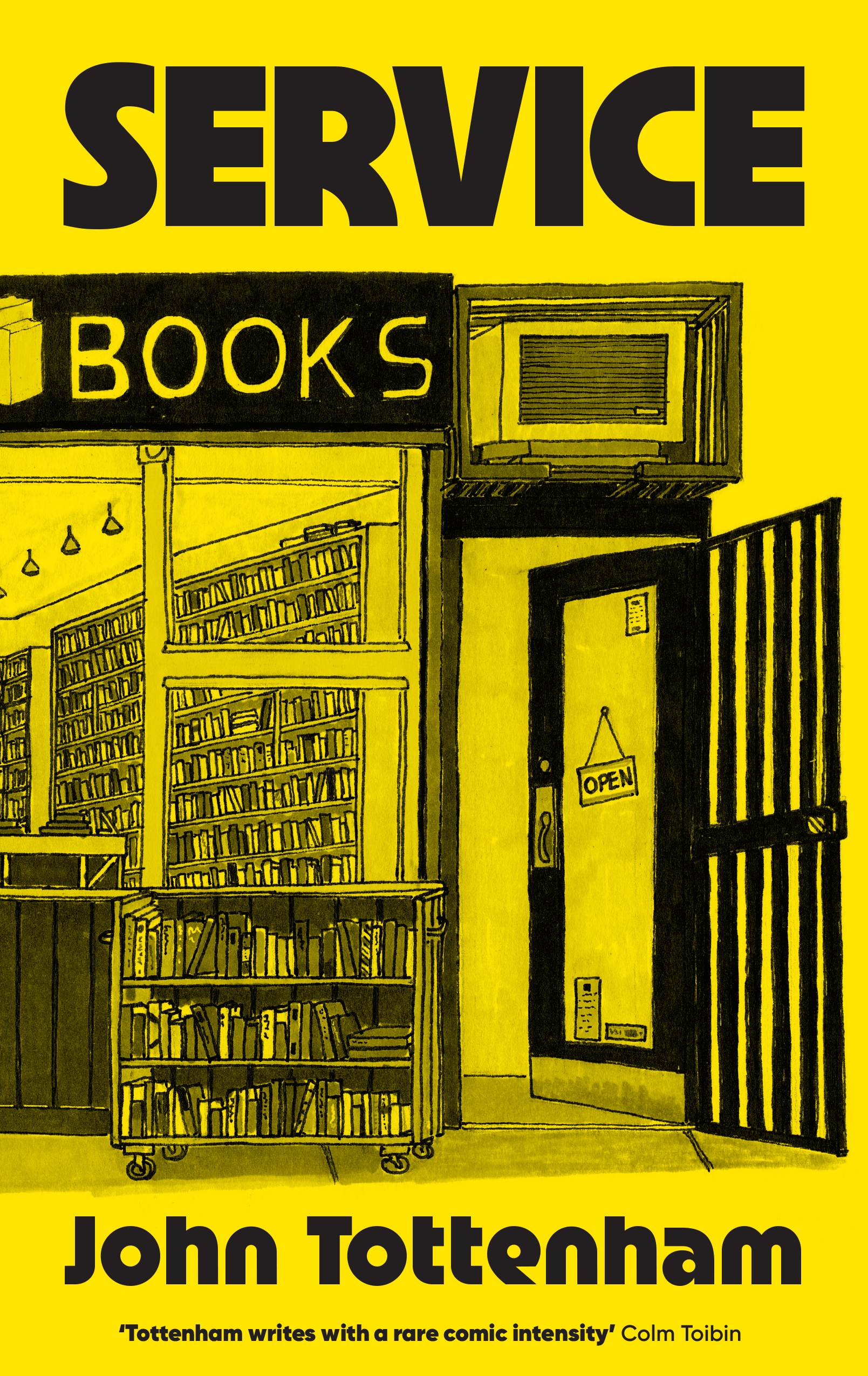
Service
Wrapping children’s books for Silver Lake MILFs; a target for the malodorous and the tedious: this isn’t really the end of the literary business I had in mind. If I wasn’t already a misanthrope, this job would have turned me into one.
How did it come to this?
It is what happens when somebody nearing the end of their prime, who is unfit for daily toil, and has a morbid horror of anything involving effort, is forced, through a harsh diminishing of circumstances, to earn an honest living.
It’s a long story, too sad to be told, and I am not inclined to tell it. Life is plotless. Plots are for graveyards.
Read the opening of Service, John Tottenham‘s stunning debut novel.
The Anti-Wizard
I once wrote about an entity called the anti-wizard. My thoughts turned out to be not all that original. I learned the anti-wizard had already appeared in a popular videogame long before my words ever fell to paper, although I inferred that the game’s creator had likely never researched the classics, never studied Gilgamesh, Aeschylus, the Septuagint, Galen, the Ynglinga, the Nag Hammadi, the Picatrix, Ficino, the KJV, Hegel, Blavatsky, Haraway, Mbembe, Negarestani, et cetera. To my embarrassment, however, my wife was familiar with the videogame. She used to play against the anti-wizard with an ex-boyfriend long before me.
A short story by Garrett Crowe.

Mainlining the Anti-Logos
The exhibition is, finally, an exercise in forging the anti-logos weapon. It is messy, deeply unsettling, often pretentious, and often beautiful in its uncompromising ugliness. It rejects the false comfort of the tidy image and insists, through blood and bone and resonant acoustic waves, on a shattering entry into a history that has always been based on its suppression. The work, taken as a whole, confirms the quiet, terrifying truth that the most visceral reality of the self is precisely what cannot be shown, but must be forced into being. We are left, having endured this encounter, less clean than when we arrived, and perhaps, marginally more conscious of the pressure beneath our own skin.
Steve Finbow reviews London’s Second Daughter III exhibition.

My Little Fish
Something is happening to me, I don’t know what, only that when I went to the bathroom one day during Mrs. X–’s class, a dead fish came out of my body and tumbled into the toilet bowl. It was flat and thin, crowned with petallike gills that shimmered under the dirty stall lights, a shock of red-orange against white. I did not know what to do. The toilet hadn’t flushed since the beginning of the year. If I left the fish in the bathroom, my classmates would be sure to trace its odor back to me; it reeked of rust and decay and salt water. So I took the little fish and I chewed it up. Salt flooded my mouth in a warm torrent. I did not tell anyone what I had done.
A short story by Maggie Wu.

The Nothing-Something of Loren Ipsum
Gallix’s novel explores a nothing-something analogous to the one Ophelia’s utterings become, asking in its first chapter, “what is lost when nothing is lost? When it becomes something?” The question here, posed by the novelist Sostène Zanzibar, refers to a note that reads “NOTHING IS LOST” and is found on the corpse of the murdered, we learn later, “Solange de la Turlute, the controversial boss of one of France’s largest family-owned publishing houses,” the first in series of murders, mostly of authors. But the question resonates beyond this context and seems to serve as the grounding question of the entire novel, “the book you are currently reading, which . . . is not the book I wanted to write,” the author, Adam Wandle — whom Ipsum is in Paris researching for a book and whose works provide slogans for the group behind the murders — asserts, but in such a way as to make ”the porous borders” between character — here Wandle — and author —Gallix — “almost indistinguishable,” to appropriate phrases of a passage from Loren Ipsum that blurs, in a different manner, the distinction between fictional and nonfictional worlds.
Albert Rolls reviews Loren Ipsum by Andrew Gallix.