
Sovietica: An Interview with Caroline Clark
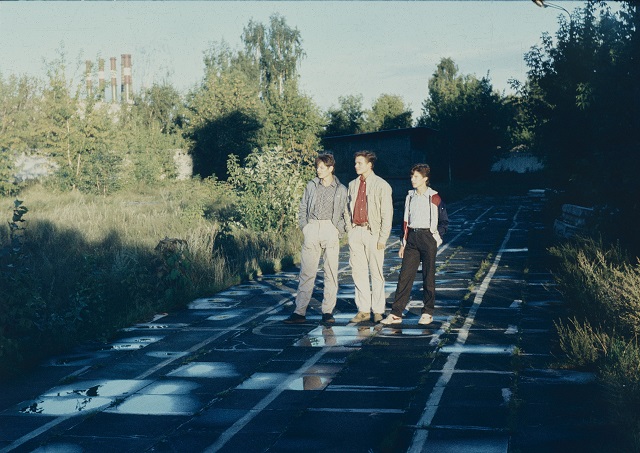
Sovetica grew slowly over many years. It started back when I was living in Moscow in the early 2000s, Andrei showed me some stereo slides he had made in the late ‘80s. I talk about them at the end of the book. They fascinated me. How you peer into the viewer and look into these pictures of the past. You have to hold them up to the light and then they come alive. Then there was his way of telling stories about growing up: I was again fascinated — this time by the ease and fluency with which he spoke.
Rowena Macdonald interviews Caroline Clark, author of Sovietica.

Safely Gathered In: An Interview with Sarah Schofield
I have a theory that short stories blossom from a place, feeling, or situation that otherwise eschews easy explanation. A short story gives the complexities space to breathe, stretch out a little and take shape. You know that amazing moment when you are reading a short story and something in it, some emotional truth or reality that had been flying a little out-of-reach under your own radar suddenly takes shape? That, for me, is what a short story can do that other forms cannot do. A novel or play or drama may have too wide a lens, a poem perhaps too narrow. The short story is perfectly placed to capture the evasive emotional truths we all feel nudging below the surface.
Sarah Schofield interviewed by Katy Wimhurst.

Welcome to Upper Zygonia: An Interview with Amanda Earl
The common thread has been whimsy, exploration, and connection with kindred misfits. My journey into writing began with imagination and loneliness, feeling like an outsider. Stories and books made me feel less alone. My grapheme synaesthesia meant that colours have always had emotional and fanciful importance to me. Letters of the alphabet are living and colourful objects, my best friends. In 2005 or so when I first found out about visual poetry, I recognized that I’d also always been doing that because as a child, I drew individual letters and numbers, trying to get the exact shade of green for 5, for example.
Amanda Earl interviewed by Katy Wimhurst.

Autobiographical Fiction, Avant-Garde Sexuality & Eccentric Family Life
Sexuality can bring you extremely close to someone, or make you very distant, cold. People can have sex, and ignore each other in the street the next day. You’ve been naked together, been inside each other’s bodies, and then you don’t want to have anything to do with one another. It’s as if the bodies don’t fit, can’t communicate; the touches are like insults. But with others, it’s a fluid language. I also find it interesting to notice what one talks about after such an act. Or to feel the silence. Sexuality can be a shortcut to intimacy and to conversations about essential things. It’s a lot about that in my novel.
Rob Doyle interviews Norwegian novelist Edy Poppy.

Snapshots of the Apocalypse: An Interview with Katy Wimhurst
Much of the fiction I write is pretty dark—addressing themes of apocalypse, dystopia, unemployment, madness, ecological breakdown—and I think the strange or magical elements in the tales allow for a healthy dose of wonder or playfulness too, an antidote to all the grim. After all, life is magical as well as dark. Magical realism tends to come from writers and perspectives on the margins (women, people of colour, non-westerners, migrants), while surrealism has always been an attempt to undermine western culture from within; that both genres arguably have a subversive impulse appeals to me.
Katy Wimhurst interviewed by Petra McQueen.
Lines of Thought: Correspondence between Christopher Clifton and Andrew Milward Part II
In leaving unthought the absent itself, we give up that which remains beyond our present concerns, what cannot in any way be apprehended in thought. In the clearing that Dasein is, things are either in the light or remain in darkness; but this darkness does not concern the absent thing. It is a darkness that concerns only the subject for whom the thing is not present. In a later text of Heidegger’s, the point reaches its most complete form: “What is gone away has disappeared, is absent; what is gone away is, in a certain manner, no more, it is destroyed.”
Christopher Clifton and Andrew Milward in conversation.

Lines of Thought: Correspondence between Christopher Clifton and Andrew Milward Part I
All of which is not to say that true knowledge is not possible, only that all knowledge is conditional. To use another misplaced image: one could say that a tree knows the sun, and it knows it absolutely, but nonetheless, this knowledge is conditional to the layer of the ozone, and the rest of the conditions of the planet that enable it to be this living knowledge of the sun. As soon as these conditions have been altered or destroyed it is invalid, and it dies. Human death is of course a more conscious affair, and one that can be preceded or brought forward by reflection, asking questions, and the process of accepting other terms, which I call finance. At the heart of every knowledge is a death.
Christopher Clifton and Andrew Milward in conversation.

Journey into the Wild
The language and poetics of writers I’ve translated have infected my own work, and the practice of translation has probably taught me more about writing than anything else. One big example for me is how paying attention to what a text sounds like and trying to recreate or compensate for that in translation has totally shaped the sonic quality of my work. Translating also makes it clear how language produces these excess effects which augment or ripple out past a singular, intentional meaning—each word carries a surplus of potential connotations, and they can add up to something unexpected. This is something I think about when I translate, and it has become a bigger part of my own writing as well.
Jeff Alessandrelli and Joshua Pollock in conversation.

Overcapacity and Post-Scarcity: An Interview with Aaron Benanav Part II
“I think that when people are free from material insecurity, in a deep and abiding way, they don’t only spend more time resting and relaxing. They dream big. They emerge from their communities and, by some inner magnetism, are drawn towards other individuals who share their same interests. In other words, people associate freely with one another. That’s the fascinating, sometimes dangerous dimension of human beings. It’s in the power of free association that true genius lies, the genius of the collective. Much of human creativity and inventiveness emerges from our relationships and networks. In a world free of material insecurity, we could build associations freely, for any purpose we can think of, to flourish individually and together.”
Tom Lordan interviews Aaron Benanav.

Overcapacity and Post-Scarcity: An Interview with Aaron Benanav Part I
“That’s what explains the apparent financialization of the economy. It is a symptom, rather than a cause, of declining opportunities for economic growth in the present-day economy. Instead of lending money to purchase buildings and equipment to expand production, more and more money is being held in the form of stocks, bonds, and real estate – or is lent out for households to purchase homes, educations, or cars. The latter induces some investment of course – if it is easier for people to buy cars on credit, then people will buy more cars than they would have otherwise – but the effect of financial incentives on actual purchases has become less and less pronounced over time.”
Tom Lordan interviews Aaron Benanav.

Rough: Rachel Thompson Interviewed
“Do you mind if we don’t have sex?”
How often this question, if asked by a woman on a first date, is met by the other side with understanding? One-night stands could be quite fun, but there could be personal reasons why you might not want to engage in sex on the first night with someone you don’t know or trust, even if you’re attracted to them. Some men feel offended by the rejection, going as far as asking to be reimbursed for the money they’d spent on the woman, reducing sex to a transactional act and objectifying women.
Rachel Thompson interviewed about her new book, Rough, by Nataliya Deleva.

A Bestiary of Short Fiction
In the present moment, it is not difficult to look at animals and feel a certain amount of guilt. We are the generation who have grown up under the gathering cloud of climate change and the looming threat of mass extinction. The fantasy of ‘nature’s revenge’ is now a cathartic outlet for that level of guilt. Indeed, it no longer feels like ‘revenge’, it is something more like redemption, or reclamation. This happens at the end of ‘Pigskin’ and is ever-present throughout the tales of ‘Fauna’. I’m trying to highlight the entirely false hierarchy we’ve imposed on the animal kingdom. We’ve got ourselves at the top like overlords, and our favoured courtiers just underneath – the dogs, dolphins, tigers, cats, eagles – and then everyone else in descending order down to the flies, worms, and slugs. The inversions of Fauna are an attempt to topple this imaginary structure of animal importance.
Katy Wimhurst interviews David Hartley.

