
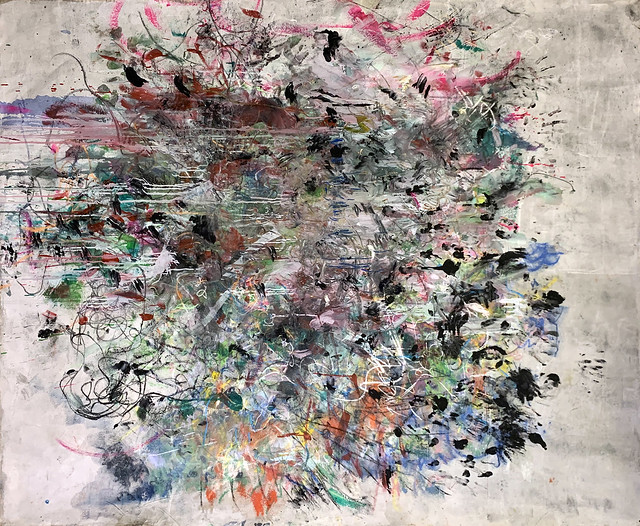
Embodied Patterns: An Interview with Claire Zakiewicz
My practice is very experimental and I have developed a number of chance methods in painting. Some are more interesting and successful than others, but even the failures are an important part of development. In acting, dance and painting, I sometimes control or restrict movement, which can open up other ways of working. Drawing downward strokes with my attention to breath, setting a tempo for the movement and following the shape of the page are examples.
Steve Finbow interviews Claire Zakiewicz.
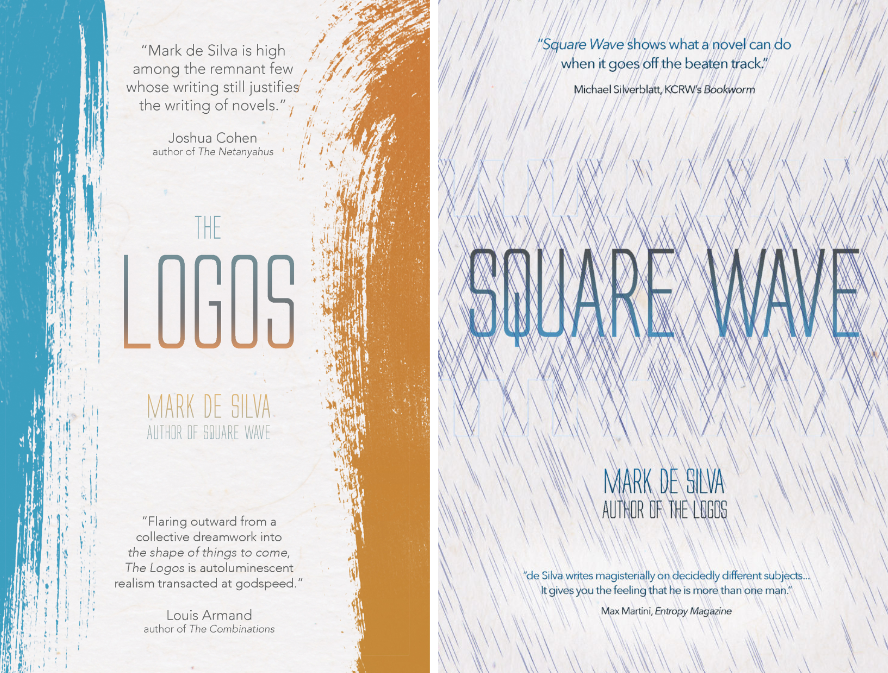
The Novels: An Interview with Mark de Silva
Everything hangs on the meaning of “philosophy.” If philosophy’s a practice that consists in the adjudication, tacit or otherwise, of quite general propositions about reality’s nature, then Square Wave isn’t really a philosophical novel. But if philosophy needn’t involve authorial assertion, and can instead consist simply in the prolonged dwelling within the realm of such propositions—that is, within the conceptual (and not just sensory) imagination—then yes, the book is, among other things, a philosophical novel.
Daniel Davis Wood interviews Mark de Silva about his novels, The Logos and Square Wave.

A Sacramental Activity: An Interview with Paul Stanbridge
‘Sebald is a massive figure for me, but the biggest influence on my writing is David Jones,’ says Stanbridge, who wrote his PhD on Jones’ Anathemata. ‘It took him 15 years to write, and he had no idea what he was doing, or where he was heading. Examining his method completely changed my attitude to writing. From then on, I wrote in disconnected fragments, generating discourse out of scraps of research data which I felt compelled to gather. Jones said art should be produced out of “what is actually loved and known,” he believed that the making of artworks is a sacramental activity: the manipulation of physical entities in order to make representation of a non-physical truth. In other words, art is praise.’
C. D. Rose interviews Paul Stanbridge about his new book, My Mind to Me a Kingdom Is.

Everything That We Are Was Invented by A Poet: An Interview with Manuel Astur
I think that’s what art and poetry do: renew reality. We cover the pure reality that is nothing more than matter with words and art, and that renews our existence. It renews the experience of existence. So obviously, a good writer has to be very far from the commonplaces of common expressions and of the political ideas that are evil in art. You have to arrive innocent to reality. You have to be like Adam naming things; that’s what a poet does, and that’s what they bring to the world.
Manuel Astur interviewed by Laura Garcia Moreno.

The Arena of the Unwell: An Interview with Liam Konemann
The thing about indie sleaze is that it’s a retrospective term made up by someone who needed a handle for their Instagram account. That scene wasn’t really called anything at the time, although on the music side you had these kinds of genre labels like new rave, post-punk revival, garage rock revival, and so on. Which people also didn’t like. I think it’s a good enough term, and also fun to say. Like all labels applied after the fact though, it kind of reframes an entire time period, linking things that weren’t necessarily connected and making everything look grubbier, more fun and more subversive than they were. But that’s just nostalgia for you, and kind of a function of how culture works. Us music journalists are guilty of it all the time.
Liam Konemann interviewed by Patrick Trotti.

‘Rebellion Gives Me Hope’: An Interview with Sim Kern
I needed a break from all the awfulness. I started to realize that things may never get better in my lifetime, just worse and worse, but the fascists can’t keep me from creating a better world in my head. Writing anarchist utopian fiction is an act of rebellion. And I do think it’s one that can have a powerful real-world impact. They say it’s easier to imagine the end of the world than the end of capitalism, and for most people, that’s true. I didn’t realize how true it was for me until I read Ursula K Le Guin’s The Dispossessed. Solarpunk fiction sets out to disprove that idiom, to give folks a vision of a far better world, so we have a compass bearing to head towards.
Sim Kern interviewed by Katy Wimhurst.

More Parody Than Satire: An Interview with James Greer
I knew as it developed tentacles and tangents that Bad Eminence would likely be swimming against what no one ever calls (but should?) the literary tide. That’s always been the case with me, a person who is not particularly good at swimming. Having said that, I do read more or less everything w/r/t contemporary literature, and enjoy quite a bit of what I read. I didn’t set out to write something in opposition to anything else. My brain doesn’t work that way. I wish I could just write something that people enjoy on a large and commercially successful scale, but — this could be my 90s indierock roots showing — I have an unfortunate tendency to sabotage anything that comes across as overly earnest.
James Greer interviewed by Andrew Gallix.

Reflections on An Island: An Interview with Karen Jennings
This is something that I have been thinking about ever since I was a little girl. We had elderly neighbours and I used to visit them and listen to the stories and old wives tales they told. One of these – my absolute favourite – was about how farmers, in order to see if the soil was ready for planting, used to dig a shallow hole, pull down their pants and put their bums in the earth to feel the temperature of the soil and get a sense of how it felt. I thought this was hilarious (I was a child after all), but I also thought it was wonderful. To have such an intimate connection with the land, to be able to know it in such a way that it is almost an extension of one’s body.
Karen Jennings interviewd by Katy Wimhurst.

The German Ideology: An Interview with Tom Whyman
Really though beyond all that, the reason why The German Ideology in particular is worth reading today is that in it, Marx takes the Idealist tradition he was raised in and shows us how to turn it into something politically vital. He takes Thought out of the academy, and shows us how it is grounded in life as lived. In this he sets thought to work, as something that ought to be aimed at the radical overthrow of all the ‘existing conditions’ which oppress us, which fail to allow us to exist as the liberated subjects the Idealists took us to be.
Thom Wyman interviewed by Matt Colquhoun.

Philosophy for the Guilty: Andy West Interviewed by Rob Doyle
Drafting and redrafting a memoir is a bit like cleaning a mirror and gaining an ever clearer reflection of who you are. One of the things I discovered was how growing up I spent a lot of my time trying to stoically accept the existence of the jeering gallows crowd, rather than turning to them and giving them the finger. On uncovering that half way through writing the book, I felt sad about having put so much energy into resignation. The defiance that you see emerging as The Life Inside develops was both me going against the retributionists and me writing against myself.
Andy West interviewed by Rob Doyle.

On Symbiosis and the Welcome Limitation of Collaboration: An Interview with Dennis Cooper Part II
I never studied fiction. I play on experimental stuff, and I do all these other things, but I don’t know how to do a lot of stuff and I don’t wanna know how to do them. I never learned how to do those things. I can’t do it. I don’t like plot. I don’t like psychological development. I don’t like all that stuff, but I also don’t have a fucking clue how to do it. I’ve read very, very little science fiction literature, like very little, very little. I like genre. I used to like detective novels and stuff. I used to really like, you know, all those guys, but I can’t imagine doing it. I mean, I can, maybe, but it would be very, very difficult. I think I had to stick to my weird shit.
Chris Kelso interviews Dennis Cooper.

On Symbiosis and the Welcome Limitation of Collaboration: An Interview with Dennis Cooper Part I
Zac [Farley] and I, we shoot it together. We edit it together and everything is completely equal, but for sure he has a real strong visual sense. I went to film classes when I was in college because I wanted to make films and realized very quickly when I started taking classes and trying to make films that it was just terrible. I could not do it. It was terrible. And I saw the other people in the class making these things and I was like, ‘oh, I can’t’. So, I just gave up, but I always wanted to make films. It’s kind of perfect because you know, I take total ownership of what we were doing even though I’m not technically, you know, the ‘director’.
Chris Kelso interviews Dennis Cooper.

